




Innovative Quantum Technology for Expressing Combinatorial Optimization Constraints Efficiently
Introduction
The development of quantum technology that can efficiently handle the constraints inherent to real-world combinatorial optimization problems is groundbreaking. This research mainly conducted by Tatsuhiko Shirai and Nozomu Togawa from Waseda University introduces a new algorithm designed to enhance the accuracy of solving these complex problems using quantum computers.
Research Background
Combinatorial optimization problems are present in various aspects of real life, often escalating in complexity to the point where traditional computers struggle to find optimal solutions. While significant progress has been made towards addressing these challenges, especially with the advent of gate-type quantum computers that harness quantum mechanical principles, there remain substantial hurdles. Notably, maintaining accuracy while dealing with constraints has been a significant obstacle, as current quantum computers often produce unsatisfactory solutions.
Key Developments
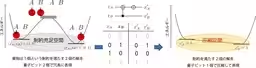
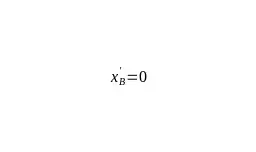
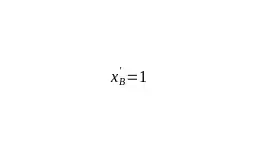
The research team proposed a unique approach to represent the constraints of combinatorial optimization problems succinctly and efficiently using quantum computing techniques. By compressing the space of possible solutions, the algorithm enhances the search efficiency for optimal solutions. For instance, the research outlines a scenario where a single fruit must be allocated to either Alice or Bob, using quantum bits to determine the allocation. The traditional method would require multiple quantum bits to represent this constraint, but by innovatively compressing the representation, the research team demonstrated that only one quantum bit was necessary.
Compression Technique
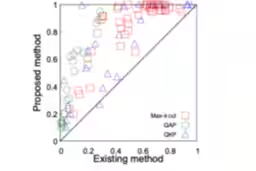
The proposed system reduces the number of quantum bits required by adopting a method that compresses the solution space, thereby enhancing the precision of the search for optimal solutions. The process involves a transformation operable on a gate-type quantum computer that delivers substantial improvements in the accuracy of results across various combinatorial optimization problems.
Exploring Applications
The implications of this advancement are vast. Not only does this method simplify the operational complexity on quantum hardware, but it also paves the way for advanced quantum software development. This could lead to significant breakthroughs in optimizing traffic flow, ultimately aiding in the reduction of congestion and lowering carbon emissions, addressing important societal concerns.
Future Perspectives
Although the current method showcases promising results, the research continues with a strong focus on real-world applications across various domains beyond optimization problems, such as chemical calculations and machine learning. These explorations aim to validate the effectiveness of the proposed techniques in practical situations.
Conclusion
Overall, this study represents a critical leap towards exploiting the full potential of quantum computing for solving complex problems that bear substantial societal impact. As quantum technology continues to evolve, further refinement of these techniques is anticipated, ultimately leading to a new era in computing.
References
- - IEEE Transactions on Quantum Engineering is set to publish the paper titled, "Compressed Space Quantum Approximate Optimization Algorithm for Constrained Combinatorial Optimization" by Tatsuhiko Shirai and Nozomu Togawa on August 25, 2025. For more information, visit: IEEE Xplore.
Acknowledgments
This research enjoyed the support of NEDO (New Energy and Industrial Technology Development Organization) alongside funding from the Japan Society for the Promotion of Science, enabling promising advancements in the field of quantum technology.





Topics Consumer Technology)
【About Using Articles】
You can freely use the title and article content by linking to the page where the article is posted.
※ Images cannot be used.
【About Links】
Links are free to use.