



Unlocking Effective AI Utilization in Store Operations: A Guide for Managers
Introduce AI in Store Operations: A Practical Guide for Managers
As AI technology continues to evolve, its implementation in the business world is becoming more widespread. However, simply stating "Use AI" doesn’t guarantee effective adoption, especially in multi-store environments. Understanding when, how, and in what manner AI should be utilized is crucial. This article discusses the recent initiative by Comix, a Tokyo-based company, which aims to support managers in effectively employing generative AI for store operations.
Background Challenges
Recent surveys, such as one conducted by Teikoku Databank, indicate that approximately 34.5% of companies are employing generative AI in their operations, with 86.7% acknowledging its effectiveness. Yet challenges persist, particularly about identifying the suitable tasks for AI applications, the disparity in employee capabilities, and the verification processes of AI outputs.
The reality is that relying solely on tools doesn’t guarantee success. In a retail setting, multiple tasks simultaneously occur—shift scheduling, ordering, handling complaints, training new employees, daily report reviews, and sales analysis all run concurrently. If a manager merely instructs employees to "handle it with AI," without clear guidelines on what materials to use, expected outcomes, and areas that require human judgment, they risk reverting to traditional methods.
Moreover, individual innovation in AI use may not translate to collective improvement without structured systems for sharing findings across stores and among colleagues. The new resource developed by Comix doesn't merely showcase AI functionalities; it serves as a practical guide for managers to define operational tasks, refine directives, and incorporate successful practices into the organization’s standard procedures.
Free Resource Offering
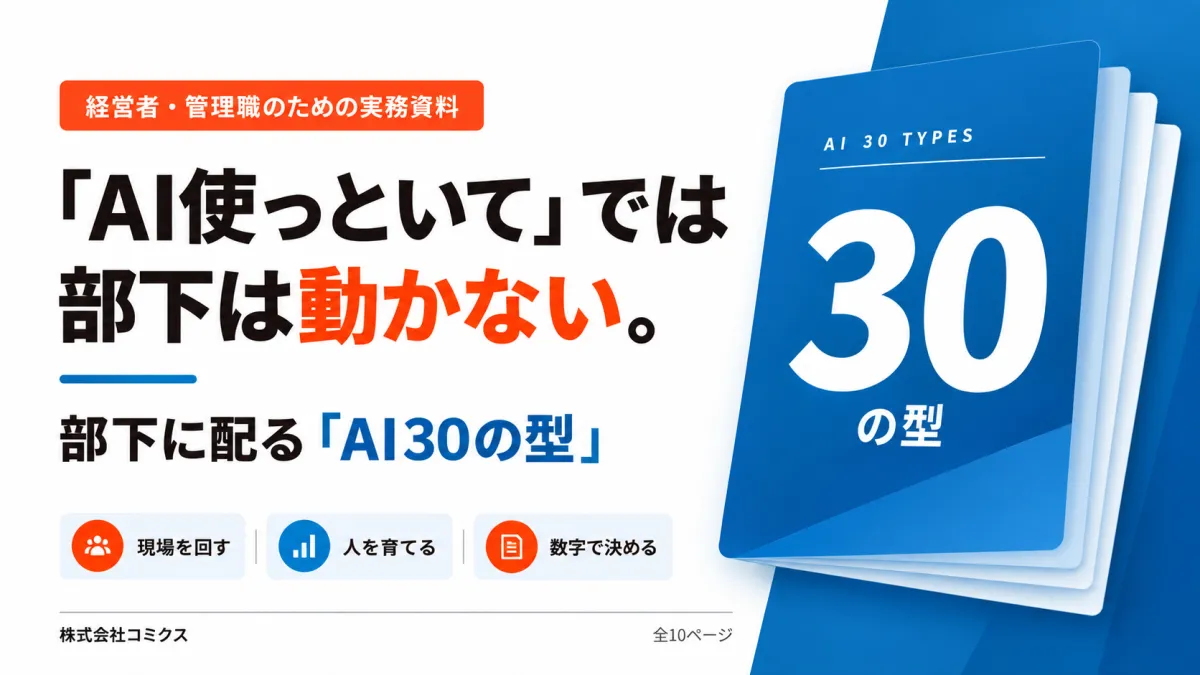
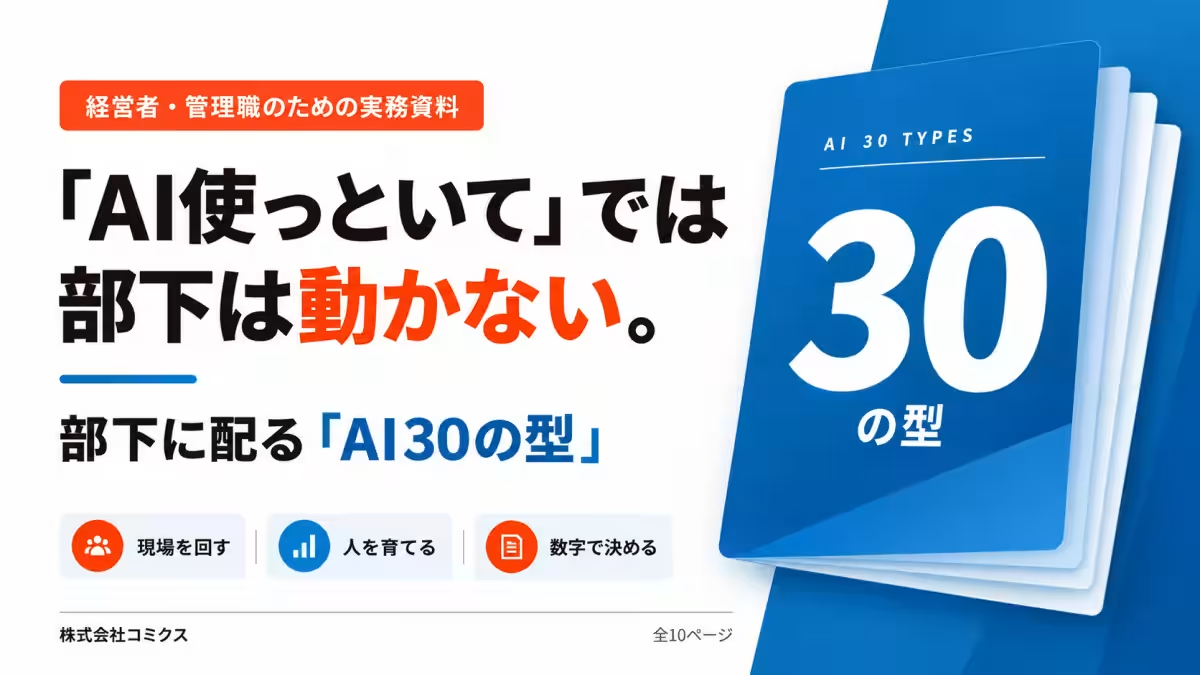
Comix has recently unveiled a free 10-page operational document titled "'Just Use AI' Won't Move Your Team: Distributing '30 Types of AI' to Your Subordinates." This document categorizes 30 different tasks suitable for generative AI across three domains, designed specifically for various retail, dining, and service settings. Below are the key elements included in this resource:
1. Ten Types for Daily Operations: This section provides templates for shift planning, analysis of ordering quantities, initial responses to complaints, and new employee manuals.
2. Ten Types for Employee Development: This offers scripts for the first day of training, guidance for on-the-job mentoring, interview questions, and evaluation comments.
3. Ten Types for Data-Driven Decision Making: It encapsulates summaries of daily reports, hypotheses for sales fluctuations, strategies for enhancing customer spending, and monthly reviews.
4. Selection Criteria for Initial Tasks: Guidelines suggest tasks that occur three or more times weekly, can be easily explained, and wouldn’t halt store operations if errors occur.
5. Four-Point Instruction Template: A structured format for assigning tasks, clarifying roles, materials, required outcomes, and limitations.
6. Methods for Sharing Successful Practices: Encourages weekly 15-minute sessions to discuss time savings and usage tips for collective learning.
Personalized Consultation Services
In addition to providing this complimentary resource, Comix is offering tailored consultations to help businesses assess their operations and select initial tasks for AI application. The areas covered in these individual consultations include:
- - Task Streamlining: Focusing on the frequency, ease of procedural setup, and potential impacts of errors to narrow down suitable tasks.
- - Designing Instructions: Clarifying materials needed, submission formats, prohibitions, and review processes.
- - Establishing Maintenance Practices: Planning weekly sharing sessions and updating instructions to reflect shared templates.
Key Characteristics of the Resource
- - Task-oriented Selection: This resource allows companies to choose from 30 specific examples based on the frequency of tasks.
- - Four-Line Instructions for Clarity: This minimizes any discrepancies between requested tasks and expected results, making supervision easier.
- - Human Oversight Emphasis: It clearly delineates between AI-assisted tasks and those requiring human judgment, such as customer interactions and evaluations.
- - Gradual Rollout Strategy: Comix promotes testing three tasks initially rather than implementing AI across all functions at once. Only the most effective models will be standardized for broader application.
Target Audience and Usage Scenarios
The intended users of this material include:
- - Entrepreneurs in multi-store operations looking to leverage generative AI for productivity improvements.
- - Store managers and area supervisors aiming to standardize directives and evaluation of outputs from employees.
- - HR, training, and operational excellence professionals interested in gathering and implementing best practices from various stores.
Example Implementation Scenarios:
- - Operations Management: Crafting drafts for shifts, orders, handovers, and addressing inquiries or complaints.
- - Talent Development: Preparing materials for new employee training, on-site mentoring, and evaluations.
- - Data Management: Streamlining daily report summaries, determining factors affecting sales, devising improvements, and monthly assessments.
Future Outlook
Comix is committed to ensuring that the use of generative AI does not stop with a few individual employees. Instead, they aim to support managers in selecting, instructing, verifying, and sharing practices across organizations. Starting with frequently executed tasks with limited impact from errors, they will monitor time savings and output quality weekly, nurturing replicable models. Comix will continue to expand its resources, aligning them with the operational needs of multi-location and retail businesses, reinforcing the integration of generative AI into their routine operations.
For anyone interested in obtaining the resource, please submit a request through the contact form specifying "Material Request" under "Inquiry Details."
Topics Consumer Technology)






【About Using Articles】
You can freely use the title and article content by linking to the page where the article is posted.
※ Images cannot be used.
【About Links】
Links are free to use.