



Tsubame Lab Launches a Revolutionary Cloud-Based Research Automation Platform
Introduction to Tsubame Lab
Tsubame Lab, a startup based in Meguro, Tokyo, led by CEO Kojiro Narasaki, has recently launched its innovative cloud-based research automation platform, the Tsubame Cloud Lab. This platform allows researchers to design, execute, and manage experiments online, regardless of their physical location, marking the commencement of Japan's first decentralized cloud laboratory network. Integrating all lab automation systems into a single cloud-based platform, Tsubame Lab aims to revolutionize how research is conducted in Japan.
The Reality of a Researcher's Workday
The daily life of researchers in university labs and corporate R&D departments is often misunderstood. Contrary to popular belief, the bulk of a researcher's time is consumed by tedious, manual tasks instead of focusing on the core essence of scientific inquiry: formulating hypotheses, designing experiments, analyzing data, and extracting new insights. Many researchers reportedly spend less than 10% of their day engaged in creative activities.
The majority of their time is spent on repetitive tasks such as weighing and preparing reagents, creating media, pipetting liquids, operating centrifuges and incubators, cleaning and sterilizing equipment, logging data manually, and entering it into records. While these tasks may appear straightforward, they demand high accuracy, leave little room for errors, and consume an enormous amount of time.
However, this issue transcends mere busyness; reliance on manual processes threatens the very reliability of science itself. Reproducibility—the ability to obtain the same results using identical procedures—lies at the heart of scientific principles. Yet, many researchers struggle to replicate others' experiments or even their own past work, often due to subtle variations in experimental conditions, incomplete records, and protocols reliant on tacit knowledge. These are structural problems stemming from the reliance on manual labor and memory in the research process.
What is Lab Automation?
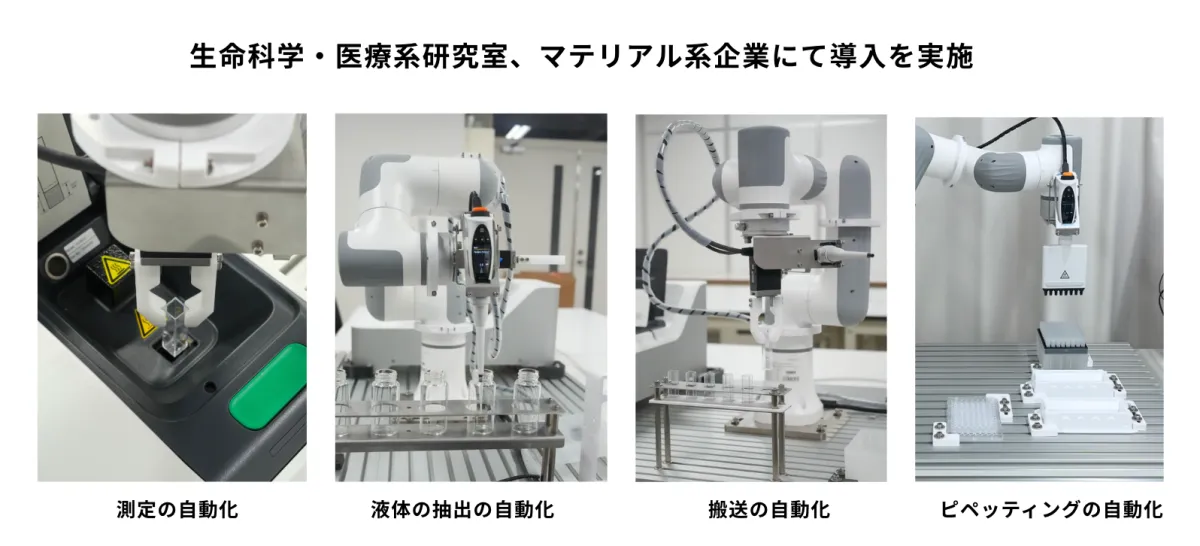
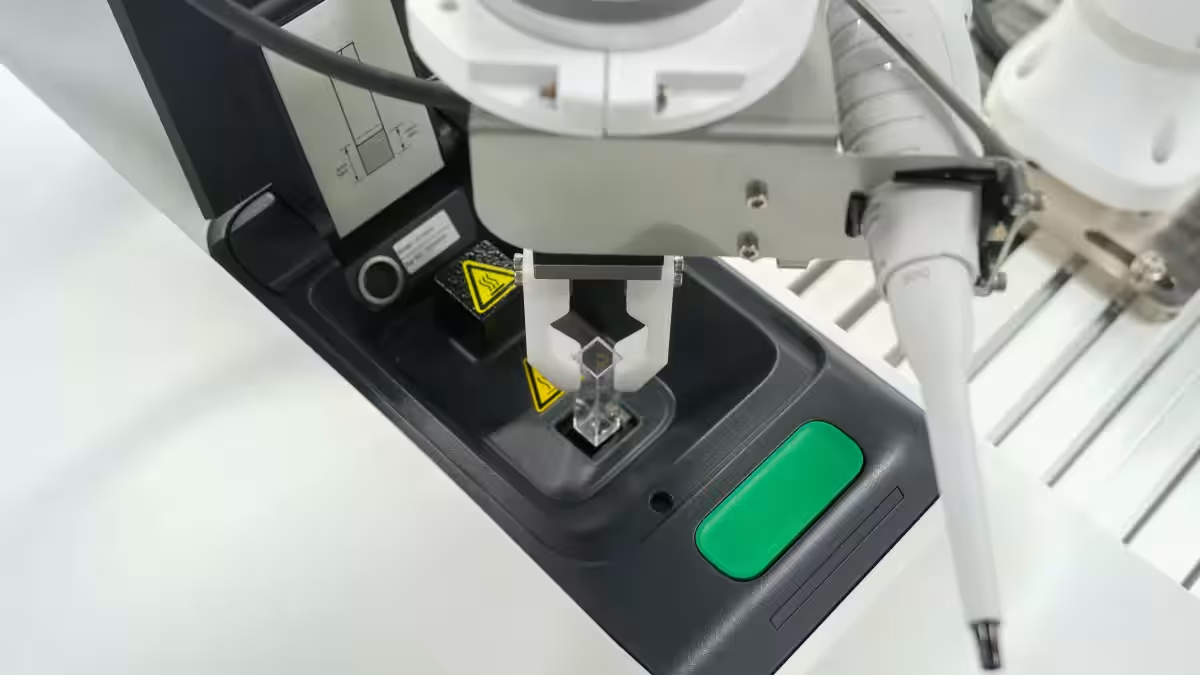
Lab automation emerged as a solution to address these challenges. It encompasses technologies such as robotic arms, automated dispensing systems, sensors, and control software that automate the preparation, execution, measurement, and recording of experiments. By enabling robots to take over manual tasks, automation facilitates around-the-clock operation, guaranteeing complete reproducibility of experimental conditions. Digital control and record-keeping of variables such as reagent quantities, temperatures, times, and operation sequences ensure that experiments yield consistent results regardless of who conducts them.
In Europe and North America, lab automation has already become essential infrastructure for pharmaceutical companies and material manufacturers focused on drug discovery and material exploration. Recent advancements in AI have led to the development of 'self-driving labs,' where AI not only analyzes experimental results but also suggests and executes subsequent experiments in real-time.
In contrast, Japan is still in the early stages of adopting lab automation. The primary hindrance lies in high costs and the barriers to implementation. Traditional lab automation systems tend to be semi-custom products tailored to lab-specific protocols, with prices ranging from tens of millions to hundreds of millions of yen and typical implementation timelines of 1 to 2 years. Furthermore, maintaining these systems and updating software requires specialized personnel, rendering them practically inaccessible for most university labs and small- to mid-sized enterprises outside of large corporate research facilities. Consequently, many experiments in Japanese research settings remain manual, leading to a widening productivity gap compared to Europe and the United States.
Understanding Cloud Labs
The next evolution in lab automation is the cloud lab concept. A cloud lab offers fully automated experimental equipment as a cloud-based service, enabling researchers to design, order, execute experiments, and acquire data over the Internet. This allows researchers to conduct experiments from anywhere in the world without needing to invest in expensive equipment in their own labs.
This transformation mirrors the disruption caused by cloud computing in the IT industry, where businesses no longer need to purchase and manage their servers but can leverage cloud services to access computing resources as needed. The cloud lab concept brings similar changes to the experimental domain, enabling immediate execution of experiments without personal lab facilities or inaccessibility of certain methods.
In addition to cost savings, cloud labs guarantee complete reproducibility and traceability by automatically documenting all experimental workflows as digital protocols. They further facilitate data sharing and collaborative research among global scientists conducting experiments on the same platform.
While several cloud lab services are already commercialized in the U.S., there are currently no such offerings in Japan.
Tsubame Lab's Unique Approach
Tsubame Lab is pioneering the integrated deployment of lab automation and cloud lab technology in Japan, distinguishing itself as more than just a service provider for automation installations or cloud lab operations. Traditionally, these two aspects of lab automation have been treated as separate business models. Tsubame Lab aims to overthrow this divisive paradigm.
Every automation system Tsubame Lab implements connects to the cloud from day one, forming a unified platform. In other words, Tsubame Lab is not merely an SIer (system integrator) but rather is constructing a decentralized cloud lab network that expands with each implementation.
Networked Cloud Lab and Core Cloud Lab
The Tsubame Cloud Lab network expands in two primary forms:
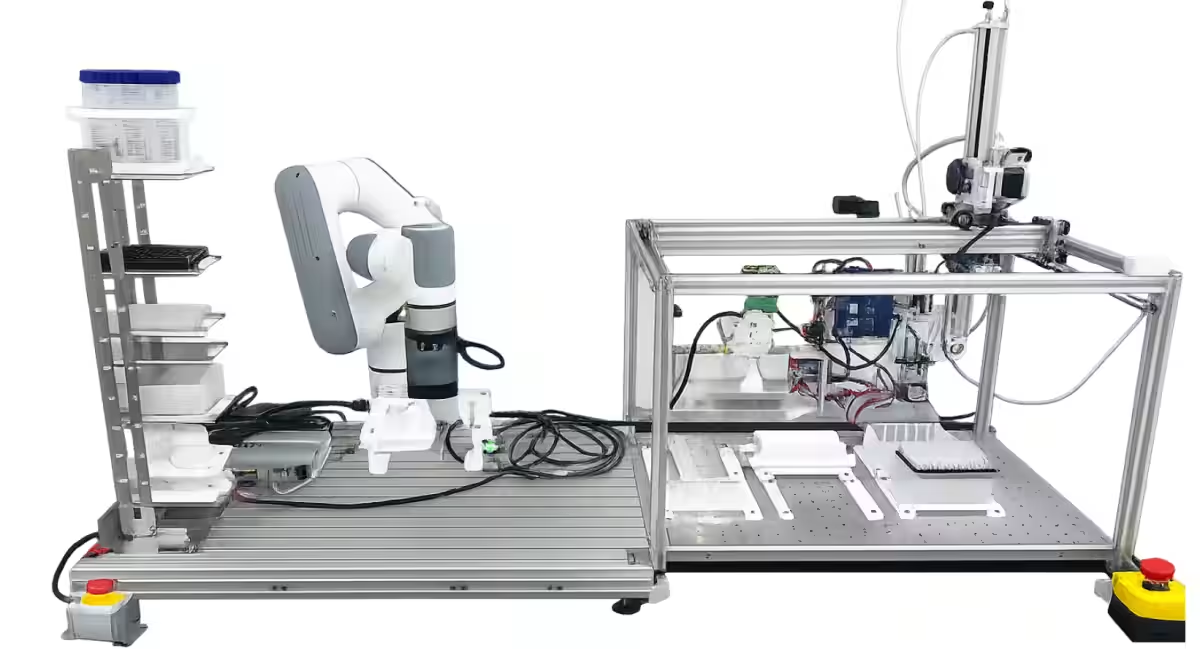
1. Networked Cloud Lab: Automation systems are installed within corporate or research facilities. While this may look like traditional lab automation, a crucial difference lies in the connectivity to Tsubame's cloud platform, allowing unprecedented capabilities:
- Remote access enables researchers to design, execute, and monitor experiments from anywhere.
- The cloud-based data management system automatically organizes design conditions, operation logs, and measurement data.
- Multiple research teams within the same organization can share utilization of the automation system, enhancing device usage rates while simplifying on-device scheduling and reservations.
- Fully on-premises configurations are also available for security-conscious enterprises, ensuring compliance with stringent security requirements.
2. Core Cloud Lab: Tsubame Lab operates its fully automated experimental facilities. In contrast to the scattered installation of Networked Cloud Labs, Core Cloud Labs serve as core hubs under direct management. Users can access Core Cloud Lab equipment via the cloud, submit protocols for execution, and receive real-time results without owning their automation devices. This offers an easy entry point into cloud lab experiences for researchers and is integrated with Tsubame Lab's existing facilities across Tokyo, including T-Campus and two additional R&D locations.
Unified Platform and Its Significance
The Tsubame Cloud Lab is uniquely designed to ensure that the Networked Cloud Lab and Core Cloud Lab operate on the same platform. This means:
- - Using the same technology stack from hardware control to data processing, asset sharing becomes seamless among users.
- - All experimental data is accumulated and managed in a unified format.
- - The same user interface allows access to both lab types via T-Lab Studio, the AI-infused experimental design software.
- - AI functionalities apply consistently across the labs based on the accumulated data to optimize protocols and detect anomalies.
This design establishes a consolidated platform rather than two separate entities, creating a feedback loop where data and insights from Networked Cloud Labs enhance AI capability across the entire system, benefiting Core Cloud Lab users and vice versa. The value of the platform continues to grow with the expansion of its network.
Tsubame Lab's Future Plans
Looking forward, Tsubame Lab aims to roll out its Cloud Lab as a robust SaaS offering, gradually scaling its network. Initial focus will be on accumulating successful implementations of Networked Cloud Labs domestically while increasing the number of Core Cloud Lab sites and extending experimental capabilities. Concurrently, T-Lab Studio's AI functions will be augmented to enable automated optimization of protocols and suggest subsequent experiments based on prior results.
In the long term, Tsubame Lab has plans for international expansion, targeting markets like the U.S. where cloud labs are rapidly gaining traction. Tsubame Lab envisions a research infrastructure where researchers around the world can conduct experiments online at any time and from anywhere—an ambitious mission they strive to achieve.
Topics Consumer Technology)
【About Using Articles】
You can freely use the title and article content by linking to the page where the article is posted.
※ Images cannot be used.
【About Links】
Links are free to use.