



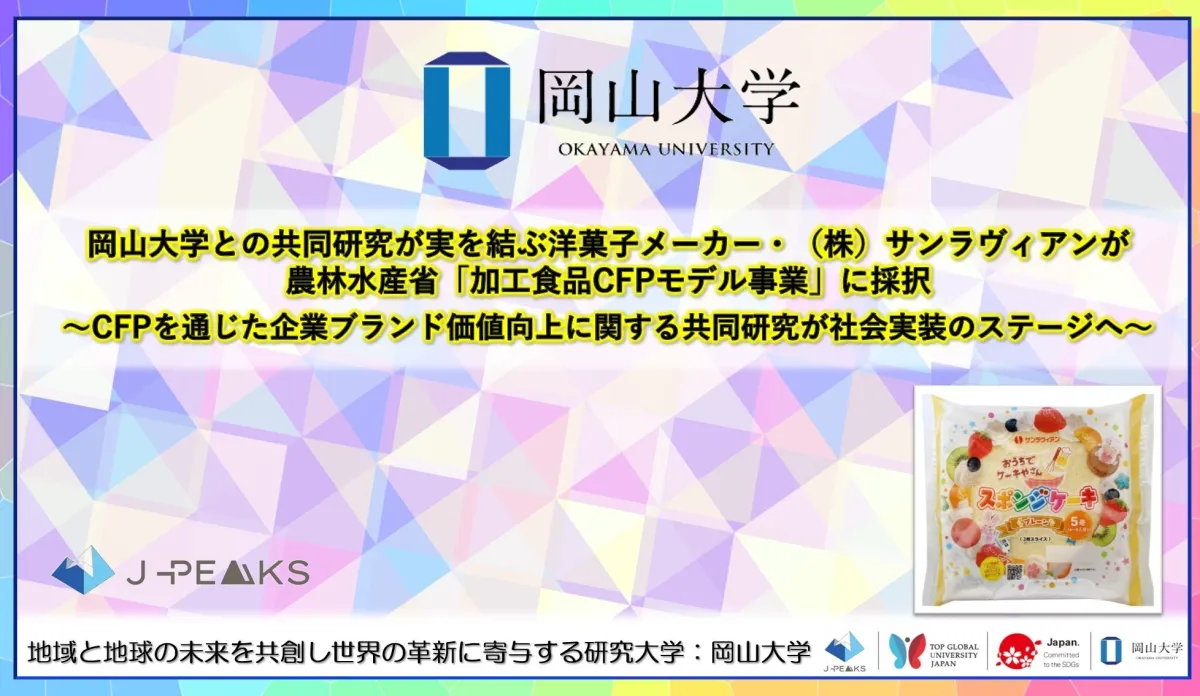
Sun Lavien and Okayama University Collaborate on Food Sustainability Research
In an exciting collaboration, Sun Lavien, a confectionery producer based in the Okayama Prefecture, has successfully been selected for the "Carbon Footprint Model Project" by the Ministry of Agriculture, Forestry and Fisheries. This recognition follows a joint research effort established with Okayama University in December 2025, aiming to develop practical carbon footprint calculation models within the processed food sector. The collaboration emphasizes the significance of sustainability within manufacturing processes, showcasing how regional enterprises can lead in environmental initiatives.
Sun Lavien specializes in creating handcrafted delicacies such as sponge cakes, fruit cakes, and Belgian waffles. The company's commitment to quality follows their guiding philosophy to deliver products that are crafted well and delivered properly. Alongside this quality assurance, the firm remains proactive in addressing environmental and social issues, aiming for a tangible impact through their operations.
The carbon footprint (CFP) concept measures greenhouse gas emissions produced throughout the life cycle of a product—from raw material sourcing, production, distribution, to disposal and recycling. As society faces the challenge of achieving carbon neutrality across supply chains, the Ministry of Agriculture sees this model project as a key to developing effective role models within the processed food industry.
Notably, smaller companies often find it difficult to engage with carbon footprint calculations. However, Sun Lavien has taken the initiative to participate in this challenge, demonstrating a commendable effort to integrate academic knowledge and practical application in their business model.
Professor Tatsunori Tenohjiyama of Okayama University's Graduate School of Social Culture Sciences expressed his delight in the project's acceptance. He noted, "Carbon footprint assessment is a powerful method to tackle climate change, yet many small businesses struggle to engage due to a lack of understanding about its benefits and challenges. It’s rewarding to see our collaborative research with Sun Lavien recognized through this model project. We aim to establish a practical, versatile carbon footprint calculation and application model that can serve as a reference for small businesses nationwide."
The joint research focuses on approximately 100 products manufactured and sold by Sun Lavien, exploring effective ways to display the carbon footprints of lower-emission products while analyzing the impact on brand value through consumer interviews. Now that the ministry’s model project has been approved, the team aims to further refine their research into actionable business practices that can ultimately be adopted across the processed food sector.
Okayama University aspires to provide solutions to regional environmental challenges by translating academic research into practical applications. Continuing its collaboration with Sun Lavien and engaging with the ministry’s model project, the university aims to implement carbon footprint calculations starting with products such as sponge cakes and Belgian waffles. The knowledge gained will be communicated widely, supporting sustainable growth within local businesses and contributing to a decarbonized society.
Exciting efforts are underfoot at Okayama University as they strive to become an open, research-oriented hub, championing sustainability and innovation within their local communities. Future endeavors will surely reveal more about their roles in shaping an environmentally conscious food production landscape.





Sun Lavien specializes in creating handcrafted delicacies such as sponge cakes, fruit cakes, and Belgian waffles. The company's commitment to quality follows their guiding philosophy to deliver products that are crafted well and delivered properly. Alongside this quality assurance, the firm remains proactive in addressing environmental and social issues, aiming for a tangible impact through their operations.
The carbon footprint (CFP) concept measures greenhouse gas emissions produced throughout the life cycle of a product—from raw material sourcing, production, distribution, to disposal and recycling. As society faces the challenge of achieving carbon neutrality across supply chains, the Ministry of Agriculture sees this model project as a key to developing effective role models within the processed food industry.
Notably, smaller companies often find it difficult to engage with carbon footprint calculations. However, Sun Lavien has taken the initiative to participate in this challenge, demonstrating a commendable effort to integrate academic knowledge and practical application in their business model.
Professor Tatsunori Tenohjiyama of Okayama University's Graduate School of Social Culture Sciences expressed his delight in the project's acceptance. He noted, "Carbon footprint assessment is a powerful method to tackle climate change, yet many small businesses struggle to engage due to a lack of understanding about its benefits and challenges. It’s rewarding to see our collaborative research with Sun Lavien recognized through this model project. We aim to establish a practical, versatile carbon footprint calculation and application model that can serve as a reference for small businesses nationwide."
The joint research focuses on approximately 100 products manufactured and sold by Sun Lavien, exploring effective ways to display the carbon footprints of lower-emission products while analyzing the impact on brand value through consumer interviews. Now that the ministry’s model project has been approved, the team aims to further refine their research into actionable business practices that can ultimately be adopted across the processed food sector.
Okayama University aspires to provide solutions to regional environmental challenges by translating academic research into practical applications. Continuing its collaboration with Sun Lavien and engaging with the ministry’s model project, the university aims to implement carbon footprint calculations starting with products such as sponge cakes and Belgian waffles. The knowledge gained will be communicated widely, supporting sustainable growth within local businesses and contributing to a decarbonized society.
Exciting efforts are underfoot at Okayama University as they strive to become an open, research-oriented hub, championing sustainability and innovation within their local communities. Future endeavors will surely reveal more about their roles in shaping an environmentally conscious food production landscape.
Topics Consumer Products & Retail)

【About Using Articles】
You can freely use the title and article content by linking to the page where the article is posted.
※ Images cannot be used.
【About Links】
Links are free to use.