



GlobalData Reveals Key Insights on Voice Services Evolution at MWC 2026
Revolutionizing Voice Services in the AI Era at MWC 2026
During MWC 2026 held in Barcelona, Andy Hicks, a prominent analyst from GlobalData, introduced an insightful whitepaper titled "Reinventing Voice: A Converged, AI-Enabled, and Multimodal Voice Core for Next-Gen Telecommunications." The document highlights how telecommunications companies can harness a fully converged voice network to craft AI-driven services, thereby reshaping the value proposition of voice services.
The Importance of a Fully Converged Voice Network
As the rollout of 5G-A accelerates, the quest for cohesive global network standards continues. While 2G and 3G networks are nearing their end, many telecom firms still rely on them to support essential services like machine-to-machine (M2M) communication and international roaming. In this light, a fully converged voice network that supports a range of services from 2G to 5G has become increasingly vital for telecom operators. This kind of network not only addresses operational challenges but also lays the groundwork for seamless future evolutions.
The global movement towards containerization amplifies this trend, providing a pathway for telecom companies to transition effortlessly from virtual machines to a container-based architecture. This shift is expected to reduce total cost of ownership (TCO) and enable persistent innovation and flexible updates within voice services.
Harnessing AI for Voice Transformation
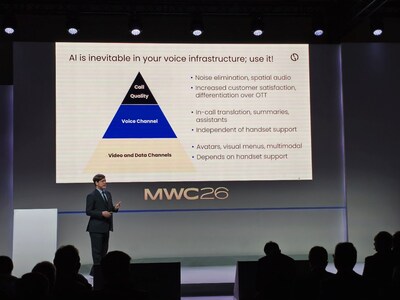
Hicks elucidates that the rapid advancements in AI pave the way for innovative speech services. He outlines a three-phase process in which AI can be deeply integrated with voice technologies.
1. Enhancing Call Experiences: The initial phase focuses on leveraging AI to improve the fundamental experience of voice calls. This enhancement ultimately creates a competitive edge over over-the-top (OTT) applications. Innovations such as intelligent noise cancellation and improved spatial audio elevate conversational standards.
2. Introducing Innovative Functions in Audio Channels: In the second phase, AI is embedded within audio channels to roll out groundbreaking features such as real-time translation and intelligent call summaries. Notably, these services do not place additional demands on end devices, allowing telecom companies to implement them rapidly and gain a lead in AI-driven voice service innovations.
3. Transitioning to Multimodal Communication: Finally, the third phase witnesses AI integration across video and data channels, evolving voice communication into a multimodal ecosystem. This transition opens up opportunities for interactive customer support and health assistance, leading to the realization of the concept of Call-as-a-Service.
Hicks emphasizes that telecom operators must capitalize on the opportunities presented by AI. By leveraging a fully converged voice network, they can fuel service innovation and rejuvenate the core value of voice services, thanks to the symbiotic advancements stemming from AI and 5G-A.
In conclusion, the vision set forth in Hicks's whitepaper at MWC 2026 highlights the rapid evolution of voice services in the age of AI. As operators seek to navigate the changing landscape, those who prioritize a fully integrated approach will likely thrive in this dynamic environment.
For more insights, read the full whitepaper here.
Topics Telecommunications)
【About Using Articles】
You can freely use the title and article content by linking to the page where the article is posted.
※ Images cannot be used.
【About Links】
Links are free to use.