



Creating a Future Where Literacy Challenges Are Not Seen as Disabilities
Embracing the Future of Learning
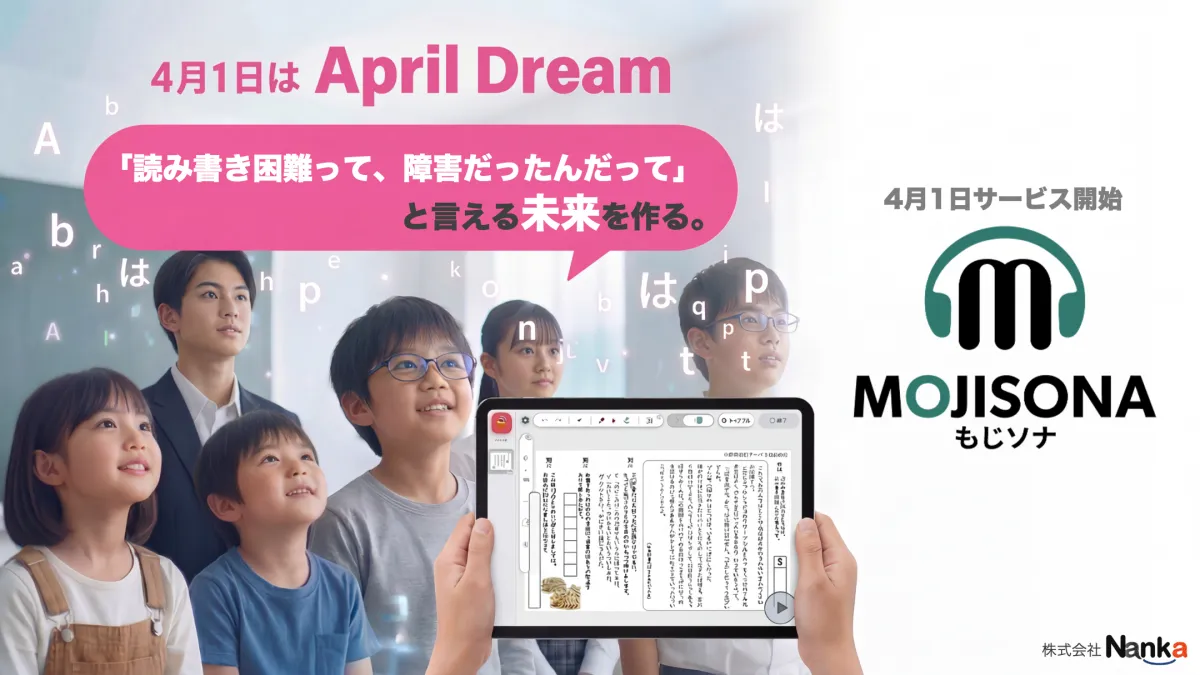
At Nanka Corporation, we believe in the transformative power of dreams. In line with the April Dream initiative, we strive to create a world where literacy struggles are no longer categorized as disabilities.
In society today, no one refers to myopia as a disability anymore. Thanks to widespread access to glasses, individuals can address their vision impairments seamlessly. But what about literacy challenges? In Japan, approximately 8% of elementary and junior high school students struggle with reading and writing. Often, these children are seen as simply needing to try harder, a misconception that can lead to feelings of inadequacy.
Our innovative learning support tool, Mojisona, aims to be the equivalent of glasses for those with literacy difficulties. We envision a future where children across the nation can access this tool without hesitation or stigma, enabling them to confront and navigate their learning journeys. We truly believe that one day we will look back and say, "Literacy challenges were once perceived as disabilities."
The history of myopia provides an insightful context. Just like myopia, which was once considered a disability before glasses were invented in the late 13th century, literacy challenges are often attributed to the individual rather than the social context. Without the tools to support those with reading difficulties, such struggles are amplified.
In the past, individuals with myopia faced significant challenges that could threaten their survival. Complications arose from not being able to see distant threats while hunting or being unable to navigate their surroundings effectively. Thus, myopia was genuinely a disability, but as soon as corrective lenses became available and widely accessible, it ceased to carry that label. This change arose not because people's eyesight improved, but because the environment and available tools changed. So, too, can the narrative surrounding literacy challenges shift as we develop supportive technologies.
Currently, we are in a similar phase of development with literacy. The absence of adequate tools, akin to "learning glasses," leads to the mislabeling of these challenges as disabilities. At Nanka, our mission is to change this dynamic, making sure that support tools like Mojisona are readily available to all children in need.
A Personal Journey
The inspiration behind Mojisona stems from our founding president, Keita Morikawa, who discovered his own dyslexia at the age of 37. For years, he struggled with self-doubt, often thinking, "Maybe I'm just not cut out for this." Many children are currently battling similar feelings, which drives our determination to support them. We want to provide the tools and understanding they deserve from an early age.
It’s crucial to clarify that children with literacy challenges possess intelligence and the capacity to think critically. They can communicate and type; however, traditional learning methods that emphasize reading and writing may become overwhelming, leading to errors or fatigue. Just as we wouldn’t ask a person with myopia to strain their eyes, children with reading difficulties need tailored approaches to learning rather than demands to simply 'try harder.'
Mojisona serves as a bridge, delivering a different way to learn. With a click of a button, it can read aloud from textbooks or materials captured by a tablet camera, and students can input their thoughts through voice or keyboard. Recognizing that children already have the intellect to engage with ideas, we focus on simplifying the processes of reading and writing to help them unlock their potential. Our technology has overcome numerous obstacles, shaped by feedback from students, parents, and educators to ensure it meets real needs.
Our Vision for the Future
Nanka Corporation dreams of a future where the term "disability" becomes obsolete. Just as individual learning styles vary, so too should our methods of instruction; some students benefit from reading while others excel at listening. These differences are merely variations, not disabilities. With the right tools at hand, no one should feel hindered in their learning journey.
We are committed to making Mojisona widely available as part of inclusive education. This involves two critical components:
1. Personalized Adjustments - Providing tailored learning experiences to every child, just as people with myopia can wear glasses to have clear vision. Teachers and schools must ensure that children access Mojisona, regardless of their environments.
2. Infrastructure Development - Establishing a reliable support system in schools nationwide, enabling access to Mojisona for every student. This is similar to having ramps for individuals with mobility challenges; with the right infrastructure, tools like Mojisona should be accessible regardless of a child's background.
When both of these elements are in place, society will evolve to a point where literacy challenges are no longer labeled as 'disabilities.' We are resolved to create this future where children across all backgrounds have equitable access to learning methods that cater to their unique needs.
Through our ongoing efforts, we will construct a world where every child can confidently say, "I can learn in my own way."
For more information about Mojisona, please visit our official website: Mojisona Official Site.
Topics Other)
【About Using Articles】
You can freely use the title and article content by linking to the page where the article is posted.
※ Images cannot be used.
【About Links】
Links are free to use.