



Innovative Vibration Energy Harvesting Using Plant-Derived Molecules
Innovative Vibration Energy Harvesting Using Plant-Derived Molecules
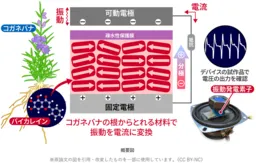
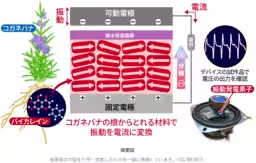
In recent years, the quest for sustainable energy solutions has led researchers to explore groundbreaking technologies, one of which is vibration energy harvesting. This innovative method converts minute vibrations, often found in environmental settings, into usable electrical energy. A remarkable study conducted by the National Institute of Advanced Industrial Science and Technology (AIST) focuses on using a plant-derived polar molecule, Baicalein, to develop a self-assembled electret that can effectively harvest energy from vibrations.
The Potential of Baicalein in Energy Harvesting
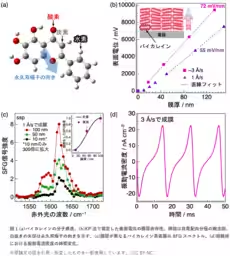
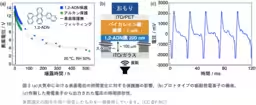
Baicalein, extracted from the roots of the plant Euphorbia hirta, possesses unique properties that allow it to generate an electret thin film through vacuum deposition. Unlike conventional electrets, this self-assembled electret does not require extensive charge treatment, significantly simplifying the manufacturing process. The researchers have successfully demonstrated that by optimizing the film deposition conditions, they could achieve a charge density of 2 mC/m², comparable to existing synthetic electrets. Moreover, through the development of a protective layer, the durability of the film has been enhanced, making it suitable for long-term applications in varying atmospheric conditions.
Mechanisms and Applications of the Electret
Electrets, often referred to as "permanent magnets for electricity," retain electric charge for extended periods. This study found that the electret formed from Baicalein exhibited significant alignment of dipoles, leading to spontaneous polarization that can generate electricity. The ability to harvest energy from vibrations opens up exciting possibilities for wearables, IoT devices, and environmental sensors that require a sustainable and maintenance-free power source. Such applications hold promise in fields where battery replacement is impractical or undesirable.
Overcoming Challenges for Environmental Stability
One of the critical challenges identified in the study is the electret's vulnerability to environmental factors, particularly humidity. The researchers discovered that the polarization state of the Baicalein electret could diminish rapidly due to moisture exposure. To combat this issue, they successfully applied a hydrophobic protective layer, significantly extending its operational lifespan from just a few hours to over 130 hours. The remaining challenge is to further enhance the moisture barrier properties to ensure long-lasting performance in real-world conditions.
Implications for Future Research and Development
As the IoT industry continues to grow, the demand for efficient, self-sustaining energy sources will escalate. The advancements showcased in this study lay the groundwork for future innovations in vibration energy harvesting technologies. Further exploration into other plant-derived materials that exhibit similar properties will be pursued to diversify the sources of sustainable energy. Ultimately, optimizing production methods for these self-assembled bioelectrets can lead to the successful commercialization of effective power solutions for a range of smart technologies.
Conclusion
This pioneering research highlights the potential of utilizing plant-derived molecules for energy harvesting applications. As technologies continue to evolve, the insights from this study could play a crucial role in the development of more sustainable and eco-friendly energy solutions. For more detailed findings, the study was published on July 20, 2026, in the journal Advanced Functional Materials.
Explore further in the field of energy harvesting and the innovative use of biocompatible materials, as researchers push the boundaries of traditional energy solutions for an increasingly sustainable future.
Topics Energy)
【About Using Articles】
You can freely use the title and article content by linking to the page where the article is posted.
※ Images cannot be used.
【About Links】
Links are free to use.