



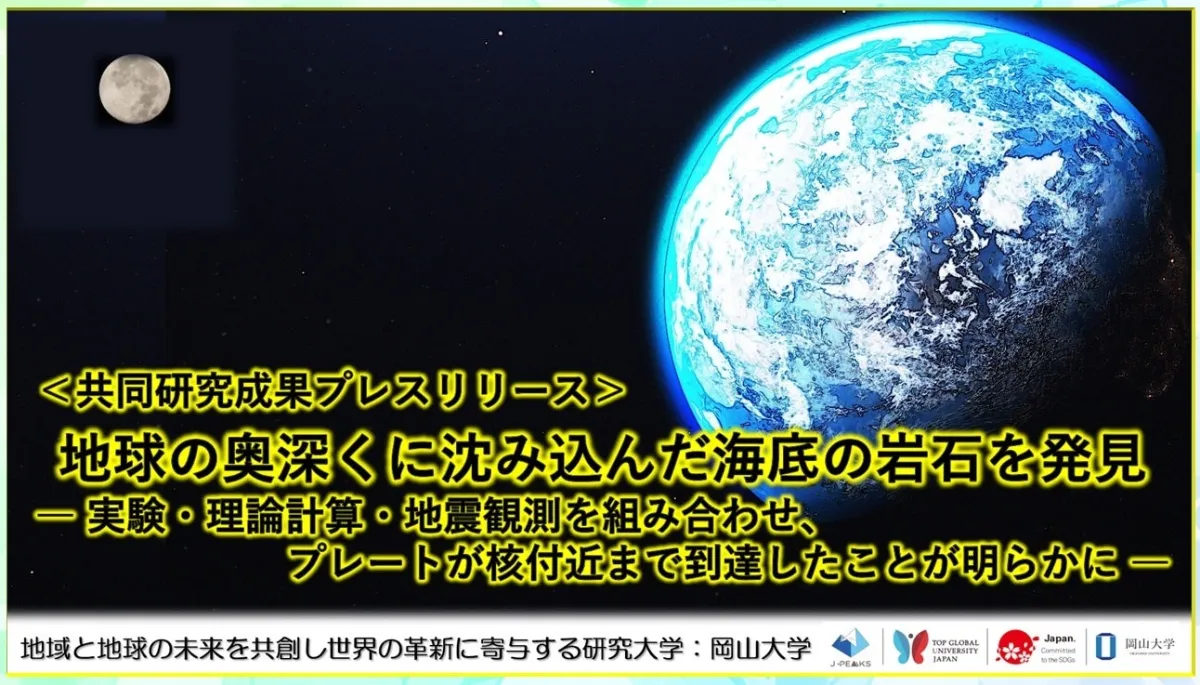
Deep-Sea Discoveries: Rocks Reaching Earth's Core-Mantle Boundary Unveiled
Unveiling the Depths: Rock Discoveries Beneath the Ocean
In a recent collaborative study among researchers from Meiji University, the SPring-8 Synchrotron Radiation Research Institute, the University of Tokyo, and Okayama University, exciting evidence has emerged that oceanic rocks may descend to the Earth's core-mantle boundary (CMB), situated roughly 2900 kilometers below the surface. This research, which combines experimental techniques, theoretical computations, and seismic observations, offers a new understanding of how tectonic plates interact with the Earth's interior.
Research Background
Traditionally, it has been believed that the oceanic plates that subduct at ocean trenches gradually transport materials deep into the Earth's mantle over millions of years. However, directly demonstrating that these materials reach near the core—a challenge faced by geologists for some time—was difficult until now. The present study shifts our perspective by establishing that an abundance of silicon dioxide (SiO2) in these subducting oceanic crusts significantly influences their behavior under extreme conditions.
Key Discoveries
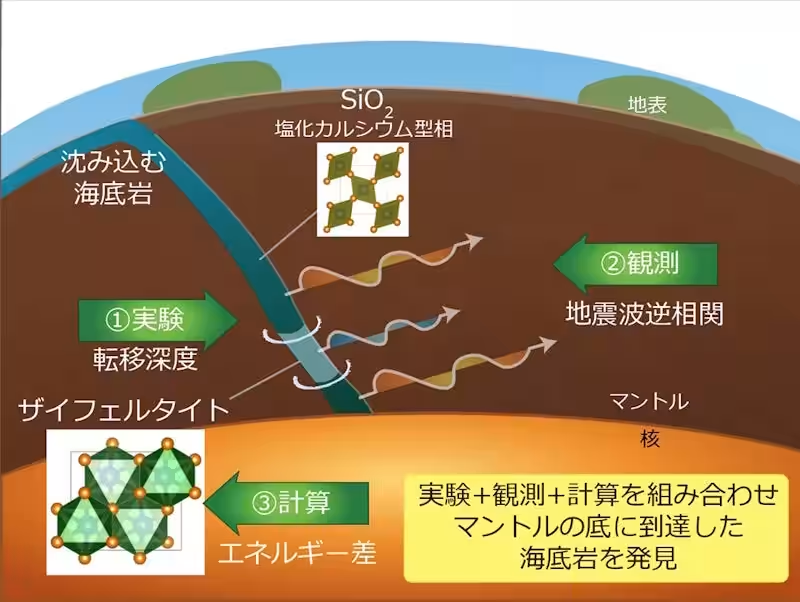
The research, led by Associate Professor Ryosuke Shinmyo from Meiji University and conducted alongside several graduate students and researchers including Saori Kawaguchi and Takayuki Ishii, focused particularly on SiO2's transformation into a high-density structure known as "seifertite" under the extreme pressure and temperature conditions that exist at the CMB. This transformation is critical as it uniquely alters seismic wave behavior, thus acting as a marker for locating subducted materials.
The team meticulously executed high-pressure, high-temperature experiments and utilized the advanced SPring-8 synchrotron facility to determine the exact conditions under which SiO2 transitions into seifertite. Following this, they employed quantum theoretical calculations to confirm their experimental findings and to address concerns regarding metastable phases that could affect the results.
Additionally, a comprehensive analysis of seismic wave data was undertaken. The researchers cross-referenced the velocity structures observed in seismic waveforms from Central America and below Hawaii, successfully correlating the mineral changes identified in the lab with the anomalies detected in the Earth's deep interior.
Implications
This study not only sheds light on the deep geological processes but also raises essential questions about the dynamics of the Earth's layers, including the role of oceanic plates in the evolution of the mantle and core systems. The findings have been documented in the journal "Scientific Reports" and were made publicly available on June 10, 2026.
Conclusion
The collaborative effort between multiple esteemed institutions has yielded significant advancements in our understanding of the Earth's internal structure, confirming that oceanic rocks can indeed reach depths previously thought unreachable. As our knowledge of geological processes deepens, further explorations stand to enhance our comprehension of how these mechanisms might influence surface phenomena, including tectonic activity and volcanic eruptions.
For more in-depth information, refer to the original study published in "Scientific Reports" (DOI: 10.1038/s41598-026-54731-6).



Topics Other)
【About Using Articles】
You can freely use the title and article content by linking to the page where the article is posted.
※ Images cannot be used.
【About Links】
Links are free to use.