




Nationwide Study Reveals Radio Wave Strength Across Major Cities in Japan
Nationwide Study Reveals Radio Wave Strength
The National Institute of Information and Communications Technology (NICT) in Japan is embarking on a groundbreaking journey to unveil the radio wave strength in major urban areas across the nation. This ambitious initiative, part of a contractual research project commissioned by the Ministry of Internal Affairs and Communications, aims to collect, accumulate, and make accessible data on radio wave exposure levels, highlighting the importance of transparency and public safety.
Data Collection and Measurement Process
Since 2019, NICT has been diligently measuring radio wave exposure levels to facilitate a better understanding of the electromagnetic environments that we live in. As of October 30, 2025, the organization will make public the data obtained through over 40,000 kilometers of travel conducted by specially equipped measurement vehicles. This data covers key cities such as Tokyo, Osaka, Sapporo, and Fukuoka, among others.
One significant aspect of this study is its approach to data collection. As radio waves are invisible and inaudible, their strength is not something individuals can perceive directly. This invisibility often leads to concerns and uncertainties regarding exposure levels. By adopting advanced measurement technologies, NICT aims to mitigate public apprehensions by providing solid, reliable, and easy-to-access data.
The Importance of GIS Mapping
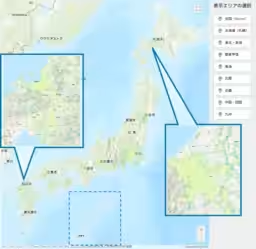
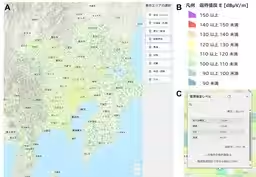
The data will be made available in a Geographic Information System (GIS) format, allowing users to view radio wave strength data through detailed maps. This innovative feature does not only represent radio wave strength but combines it with information on infrastructure, building data, and various statistics, making it a versatile tool for different stakeholders including local governments, researchers, and the general public.
The GIS maps will quantify the average strength of radio waves measured in areas of one square kilometer, ensuring that the information is both granular and actionable. NICT's commitment to transparency positions them as a leading public research entity, setting a precedent for future studies across Japan.
Background and Historical Context
The use of radio waves through devices like mobile phones and wireless LANs has become predominant in our daily lives. NICT initiated this massive long-term measurement project to ensure that radio waves, which are inherently harmless based on international exposure guidelines, remain so. The agency carefully designs its measurement approaches to incorporate diverse geographical contexts, encompassing various urban settings without bias.
Given the nature of the data collection, the results can provide essential insights into how radio waves fluctuate within urban environments. Through rigorous methodologies combining fixed, spot, and mobile measurements, including those from vehicle-mounted devices, NICT has been able to achieve a broad and detailed understanding of radio wave exposure levels, with specific attention to maintaining neutrality and reliability in their research approach.
Expanded Measurement Reach
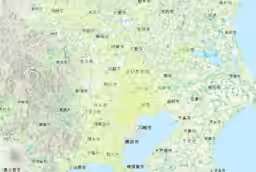
Previously, the measurement data released by NICT was limited to the Kanto area. However, significant strides have been made to expand this further, obtaining results across multiple major cities and surrounding areas, thus covering nearly 9 government-designated cities within a substantial radius. Since the commencement of vehicle-mounted measurements in 2021, they have successfully created maps revealing the strength of radio waves from base stations and broadcasting towers, complete with detailed geographic tagging in GIS format.
As a leading institution, NICT not only aims to enhance domestic understanding of radio wave environments but also to contribute to international dialogue on radio frequency exposure, sharing findings that can benefit broader populations. By continuing to conduct long-term monitoring and advancing their methodologies, NICT aspires to stay at the forefront of electromagnetic research and public education.
Conclusion and Future Perspectives
Looking ahead, NICT plans to continuously expand its measurement areas and conduct repetitive measurements in the same regions to document year-on-year developments. Armed with comparisons from international measurement practices, there’s a clear potential for this data to serve as a model for other nations. NICT's dedication to creating a robust framework for collecting and sharing radio wave exposure data reflects a commitment to public health and safety that underscores its role as a leading scientific and research entity in Japan.
For more detailed insights into this study, you can find further resources including maps and previous announcements on the official NICT site.


Topics Other)
【About Using Articles】
You can freely use the title and article content by linking to the page where the article is posted.
※ Images cannot be used.
【About Links】
Links are free to use.