




EG Testing Services Launches Comprehensive Low-Code Development Support Services
Introduction
In a significant move towards facilitating digital transformation (DX) for businesses, EG Testing Services Co., Ltd., a subsidiary of E-Guardian, has officially launched a comprehensive solution named "Low-Code Development Tool Construction and Support." This service aims to expedite the utilization of low-code development tools from application creation to testing and operational management, providing a one-stop service for companies.
About E-Guardian Group
E-Guardian has a long-standing commitment to fostering a secure internet environment through an extensive range of services including net patrol, customer support, debugging, and vulnerability assessment. Led by President Yasuhisa Takaya, the company is capitalizing on advances in AI technology to develop IT solutions that meet evolving market needs. Within this framework, EG Testing Services specializes in offering testing services for software and hardware, including games, websites, and mobile apps.
The Rise of Low-Code Platforms
The investment landscape for DX initiatives has been transitioning from mere system construction to sustainable business transformation. With this shift, the market for low-code and no-code development platforms has seen rapid growth. However, challenges such as an oversaturation of applications driven by citizen developers, dependency on individual developers, and a shortage of personnel for operational support have emerged as crucial governance issues.
Recognizing these challenges, EG Testing Services aims to provide more than just tools; it emphasizes the importance of stable execution and tangible results from business operations as the true value for customers. This philosophy forms the foundation for the initiation of this new service.
Comprehensive Total Solution
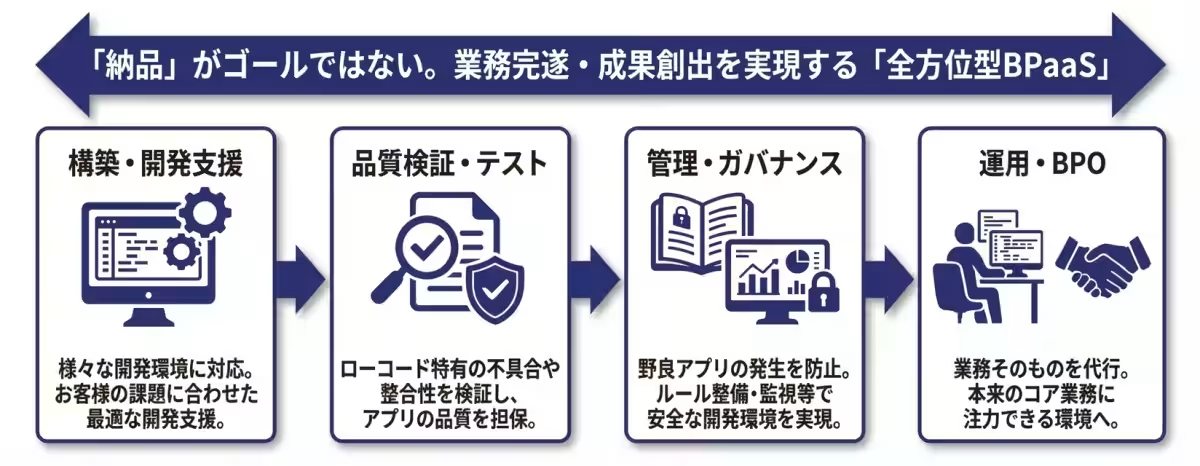
Unlike traditional service models that focused solely on the completion of system delivery, the new service model extends responsibility to ensuring the completion of business processes. By leveraging years of expertise in testing and validation, EG Testing Services offers comprehensive support from establishing high-quality low-code development environments to subsequent operations and business process outsourcing (BPO).
These efforts are directed at helping companies transition away from a "build and forget" mentality towards a deeper commitment to genuine business transformation (DX).
Service Overview
The newly launched service encompasses the following key areas:
1. Construction and Development Support: Support for application development on major low-code platforms such as kintone, Microsoft Power Platform, Salesforce, SmartDB, Claris FileMaker, and UnitBase, tailored to customer challenges.
2. Quality Assurance and Testing: Utilizing their core business expertise in third-party verification, EG Testing Services ensures that the quality and alignment of applications created through citizen development are rigorously assessed to prevent issues unique to low-code development.
3. Management and Governance: Support for the creation of manuals, documentation, and guidelines to prevent the emergence of rogue applications, alongside monitoring usage to maintain safe citizen development practices.
4. Operations and BPO: Expanding beyond mere system operation, the service covers complete business outsourcing that includes constructing application request forms as well as checking submitted data and providing helpdesk support. This allows clients to concentrate their resources on core business operations.
Future Directions
Moving forward, the E-Guardian Group remains committed to delivering specialized, high-quality services that align with its mission of "We Guard All." The Group will continue to strive towards creating services and products that make everyday life more convenient and enriched for all users.
Conclusion
With the launch of the "Low-Code Development Tool Construction and Support" service, EG Testing Services is poised to play a critical role in enabling firms to navigate the complexities of digital transformation effectively. This initiative not only enhances operational efficiency but also sets a precedent for evolving governance practices within the growing landscape of low-code development.

Topics Business Technology)
【About Using Articles】
You can freely use the title and article content by linking to the page where the article is posted.
※ Images cannot be used.
【About Links】
Links are free to use.