



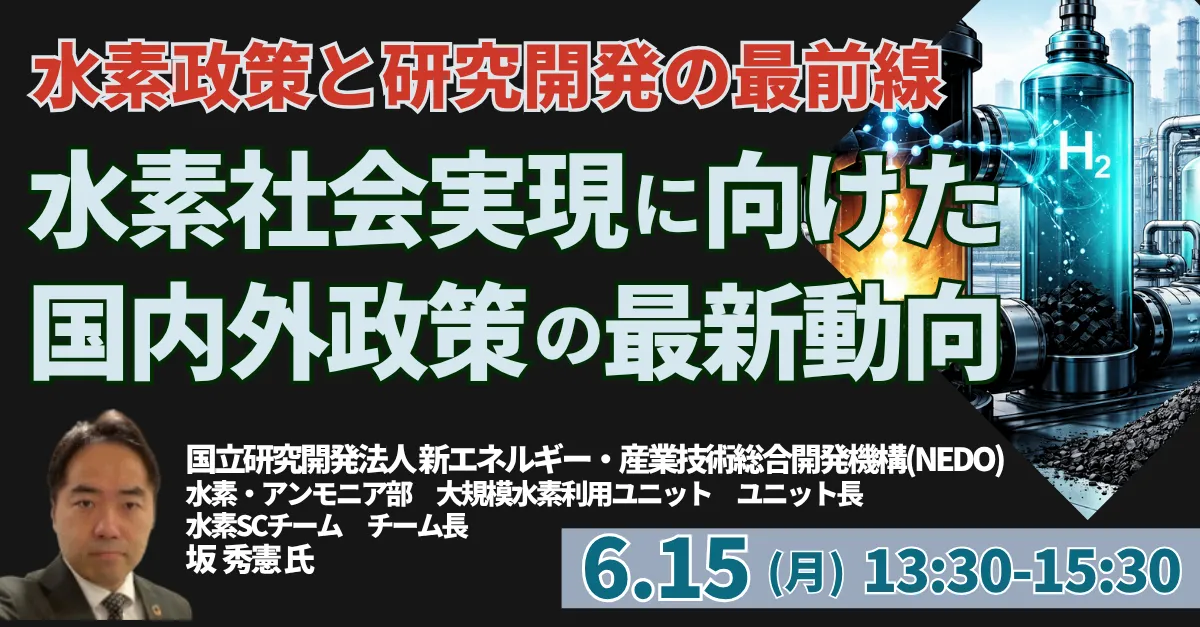
Exploring the Latest Trends in Hydrogen Policy and NEDO's R&D Directions for a Hydrogen Society
Hydrogen Society: Trends and Research in Policy and Development
In the pursuit of a sustainable energy future, hydrogen has emerged as a critical player. The upcoming seminar hosted by the Japan Planning Institute (JPI) aims to shed light on the latest trends in hydrogen policies both domestically and internationally, while also exploring the research directions spearheaded by the New Energy and Industrial Technology Development Organization (NEDO).
Seminar Details
Scheduled for June 15, 2026, from 1:30 PM to 3:30 PM, this seminar features Hidenori Saka, the head of the Large-Scale Hydrogen Utilization Unit at NEDO. With a proven track record in policy and technology development in the hydrogen sector, Saka will provide attendees with valuable insights and practical knowledge that can influence business decisions. Not only will participants gain from his expertise, but they will also have the opportunity for Q&A sessions and networking with fellow professionals.
Key Insights from the Seminar
Participants can expect to learn about:
- - Key points of the Hydrogen Basic Strategy and related legislation, including their impacts on business decisions.
- - The competitive landscape regarding hydrogen policies and demand dynamics in the U.S., Europe, China, and South Korea.
- - Current technological developments in hydrogen electrolysis, liquefaction transportation, and regional implementation.
Target Audience
This seminar is ideal for:
- - Executives and developers in energy business companies focused on strategic planning and new business development.
- - Professionals engaged in technology development or research related to hydrogen and ammonia.
- - Manufacturing and infrastructure companies committed to decarbonization strategies.
- - Government officials involved in energy policies and regional development.
Importance of Hydrogen
Hydrogen represents a clean energy source that does not emit CO₂ when burned and can be produced from various resources, significantly enhancing energy security. Its long-term storage and suitability for long-distance transport make hydrogen a cornerstone in the global movement toward carbon neutrality. The seminar coincides with accelerated discussions in Japan about related legislation and safety standards for hydrogen usage, revealing a timely need for clarity and insight into the future of hydrogen as part of Japan’s energy strategy.
Overview of the Seminar Content
1. Significance of Hydrogen and Japan's Policy Framework
- Understanding the importance of hydrogen in the energy landscape of Japan.
- The role of hydrogen in current policies and strategies, including the Hydrogen Basic Strategy and advancing legislation.
2. International Trends and Collaborations
- A look into global initiatives surrounding hydrogen technology, including demand trends worldwide.
- Updates on hydrogen stations and fuel cell vehicle integrations across different nations like the U.S., Europe, China, and South Korea.
3. NEDO's Initiatives in Hydrogen Technology
- An exploration of NEDO’s hydrogen and ammonia research and development efforts.
- Innovations in large-scale hydrogen electrolysis technology and the world’s first liquefied hydrogen transport ship.
- Scenarios for regional hydrogen utilization models and expansions in Fukushima Prefecture.
4. Q&A and Networking Opportunities
- A chance for attendees to engage directly with Saka and other participants, fostering inter-industry collaboration.
Registration and Fees
The seminar is available for attendance in various formats:
- - On-site participation (no archive included).
- - Live stream (no archive included).
- - Archive viewing available for those who cannot attend live.
The fee for attending is 37,270 yen (tax included) for a single participant, with discounts available for multiple registrations from the same organization. Public entity representatives can benefit from reduced rates.
For further details and registration, please visit this link.
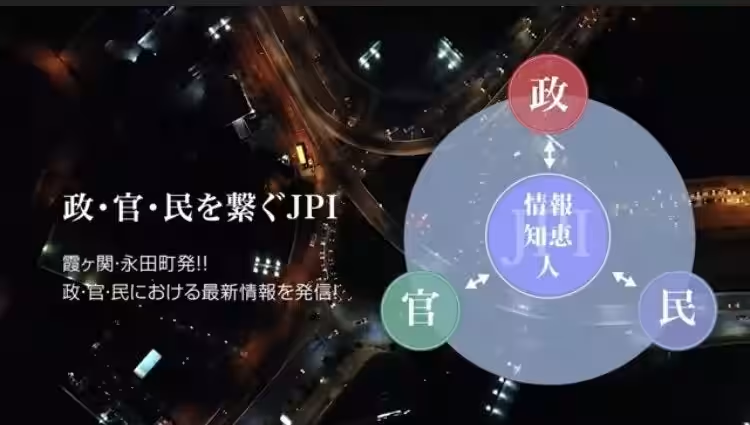
JPI, dedicated to bridging knowledge among government, industry, and academia, has provided impactful seminars for 50 years, focusing on critical national projects and policies. Join us to explore the forefront of hydrogen research and policy direction moving into a carbon-neutral future.

Topics Environment)
【About Using Articles】
You can freely use the title and article content by linking to the page where the article is posted.
※ Images cannot be used.
【About Links】
Links are free to use.