



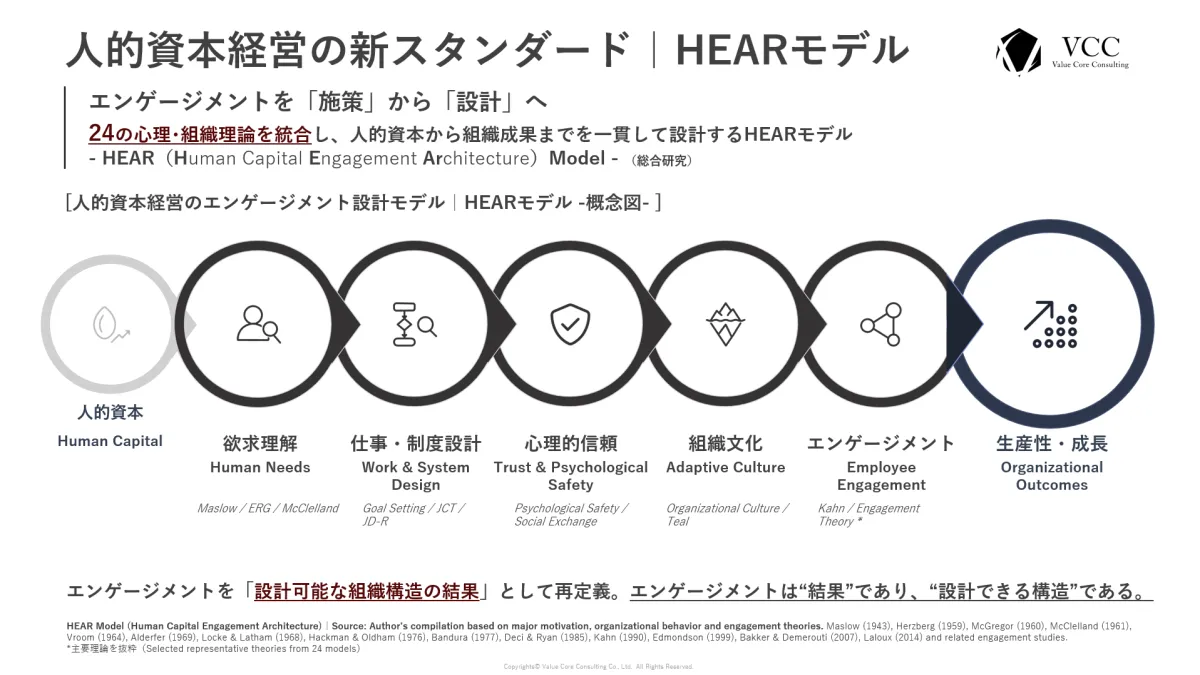
Introducing the HEAR Model: A New Standard in Human Capital Management
Revolutionizing Human Capital Management: The HEAR Model
In a time where Japanese corporations face challenges such as a declining workforce and the pressing need for increased productivity, a new model has emerged that aims to maximize human capital value. Value Core Consulting (VCC) has developed and unveiled the HEAR Model (Human Capital Engagement Architecture)—a fresh, structured approach to enhance engagement within organizations by applying a blend of 24 theories from organizational behavior, psychology, and management research.
Understanding the Need for Change
As per a recent survey by Teikoku Databank, 90.2% of enterprises highlighted 'human resource enhancement'—including recruitment, retention, and development—as their foremost concern, amidst 31 issues reported. This shows a critical focus on how organizations can be structured to derive value from their human capital.
Despite this emphasis, employee engagement in Japan is alarmingly low. According to Gallup, Japan's engagement rate was just 8% in 2025. This figure stands in stark contrast to a global average of 20% and an East Asia average of 18%. The findings emphasize a serious gap: the structure connecting human capital to outcomes is inadequate, leading to reduced productivity.
The fallout from early employee turnover is staggering; a 2022 En-Japan survey noted that companies incur approximately 6.4 million yen in losses when an employee earning 6 million yen departs within six months. With hiring and training costs factored in, preventing high turnover is crucial for sustainable management.
The HEAR Model Explained
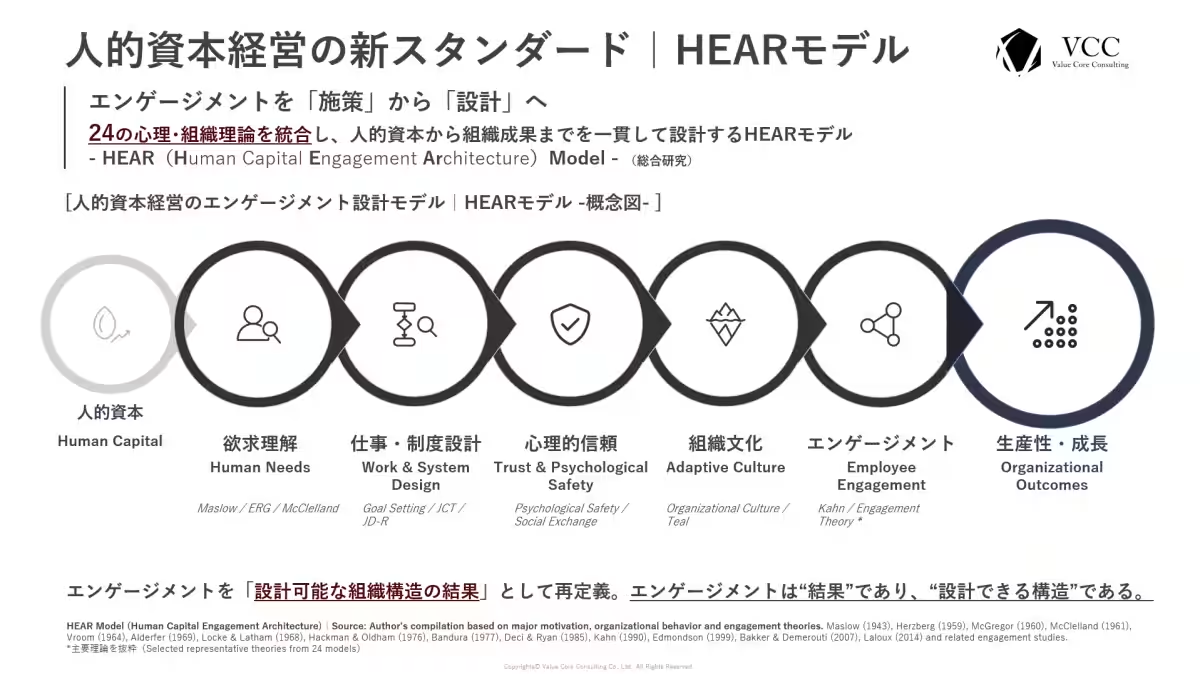
The HEAR Model redefines engagement, transitioning it from being just a set of policies to a well-structured organizational architecture. Its development is rooted in the understanding that a unified framework can significantly improve both engagement and organizational productivity.
Key Elements of the HEAR Model
1. Visibility of Individual Motivations: It illustrates how personal growth desires connect to job design and organizational culture, ultimately leading to enhanced outcomes.
2. Integration of Theories: It resolves the fragmentation between various theories and practices. This model enables comprehensive design while communicating organizational strategies consistent with effective management.
3. Repeatable Management Practices: Moving away from leadership dependence, it allows for a scientifically-informed approach to managing challenges across different circumstances.
Guiding Principles of HEAR: A 5x24 Framework
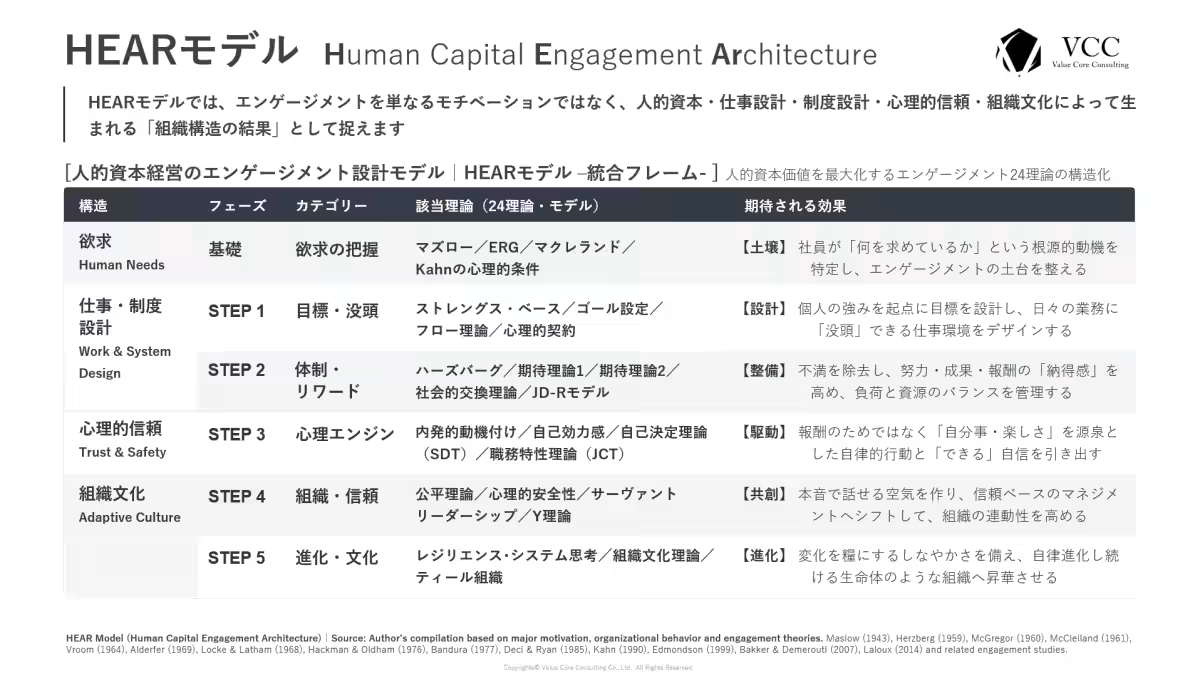
The HEAR Model synthesizes the knowledge amassed over approximately 80 years in organizational science through a robust framework involving 24 academic theories. It is categorized into five essential areas:
- - Human Needs: Incorporates theories, such as Maslow’s hierarchy of needs and the ERG theory, to identify core motivations.
- - Work & System Design: Connects effort to results using strength-based approaches, goal-setting theory, flow theory, etc.
- - Intrinsic Motivation: Ensures the sustainability of actions through psychological constructs, including self-efficacy and self-determination.
- - Organizational Structure: Fosters trust through principles of psychological safety and servant leadership.
- - Evolution & Culture: Establishes a sustainable organizational structure supported by cultural theories.
A Look at Results and Implementation
The HEAR Model has reportedly driven tangible success across various industries, including a 240% increase in annual sales for a call center and substantial growth figures in finance and manufacturing sectors. These results stem from designing and implementing a cohesive structure rather than relying solely on isolated initiatives.
This model extends beyond just enhancing individual performances; it also fosters organization-wide behavioral changes, enabling VCC to support transformational change effectively throughout diverse industries.
Future Endeavors and Outreach
To further disseminate its impact, VCC plans to introduce a 'checklist' to help organizations identify structural challenges by April 2026. This free resource will enable firms to gain insights into their current organizational frameworks.
Starting in May, VCC will also offer seminars and engagement initiatives tailored to bridge theory and practice in human capital management.
Through the HEAR model, VCC aims to transition human capital management from sporadic initiatives to solid frameworks, contributing to the sustainable growth of companies in Japan and beyond.
Conclusion
The HEAR Model is poised to redefine how businesses perceive human capital. By establishing a clear structural foundation, organizations can not only improve engagement but also significantly enhance their overall productivity and success.
For further information on the HEAR model and its applications, VCC can be reached via their contact details at Value Core Consulting Company.
Topics Business Technology)
【About Using Articles】
You can freely use the title and article content by linking to the page where the article is posted.
※ Images cannot be used.
【About Links】
Links are free to use.