



The Impact of TOMOEGAWA's Green Chip CMF on Environmental Sustainability
The Impact of TOMOEGAWA's Green Chip CMF on Environmental Sustainability
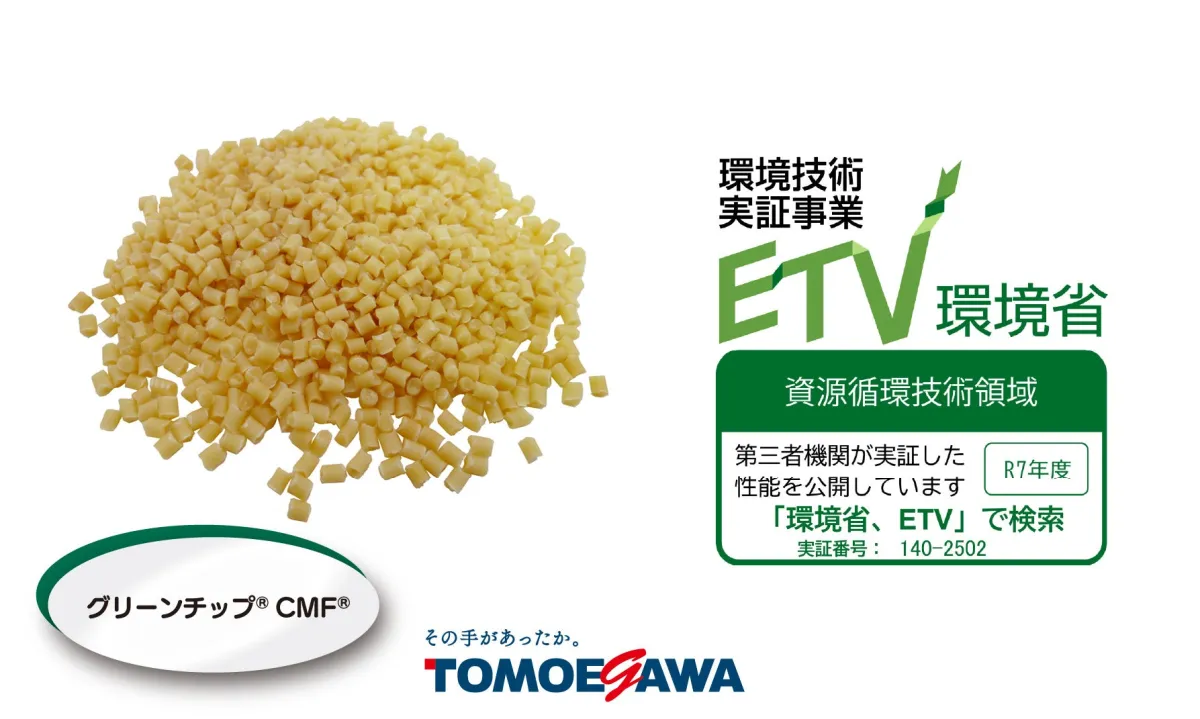
TOMOEGAWA Corporation, headquartered in Chuo-ku, Tokyo, has made significant strides in promoting environmental sustainability through their cellulose fiber-rich resin, Green Chip CMF. Recently, the Ministry of the Environment in Japan has verified the material's various properties and its effectiveness in resource recycling as part of their Environmental Technology Verification (ETV) program. This news not only highlights TOMOEGAWA's commitment to sustainability but also the potential of Green Chip CMF in various applications.
About the Environmental Technology Verification (ETV) Program
The ETV program is an initiative by the Ministry of the Environment aimed at objectively verifying the environmental conservation effects of advanced environmental technologies that have already been commercialized. This verification process allows technology users to make informed decisions based on publicly available data, thereby promoting the utilization and dissemination of these technologies. By adhering to the ISO 14034 framework, the ETV program ensures a credible assessment of technology effectiveness.
Background of the Verification
In recent years, the reduction of petroleum-derived resources in plastic products and the overall reduction of greenhouse gas emissions across product life cycles have become pressing issues. Green Chip CMF, a composite resin that incorporates 55% cellulose fibers derived from wood into polypropylene (PP) resin, is expected to address both the reduction of petroleum-based resin usage and the promotion of resource recycling. As part of this effort, Green Chip CMF was selected for verification under the ETV program focusing on resource recycling technologies, and a third-party organization was tasked with conducting the comprehensive evaluation.
Overview of the Technology
Technology Name: Green Chip CMF
Features:
- - Composite resin containing 55% cellulose fiber in PP resin
- - Reduction of petroleum-derived resource usage through the utilization of wood-derived biomass
- - Superior mechanical properties and heat resistance compared to standard PP resins
Main Intended Uses:
- - Automotive parts, home appliance components, tableware, cutlery, everyday goods, furniture, and more
Summary of the Verification Results
The verification process assessed various properties and material recycling capabilities of Green Chip CMF as a plastic resin. The results revealed that Green Chip CMF demonstrated impressive performance in key physical properties, such as tensile strength, flexural strength, and heat resistance, surpassing many standard PP resins. Furthermore, during the material recycling process involving grinding, re-pelletizing, and molding, it showed minimal changes in physical properties, confirming its effectiveness as a resource-circulating material.
Future Developments
Building upon the findings from this verification, TOMOEGAWA aims to expand the applications and usage of Green Chip CMF as a resource-circulating material. The company is dedicated to contributing to the development of sustainable societies via the effective utilization of renewable resources and the promotion of circular economy practices.
For further details, visit the TOMOEGAWA Corporation website and explore contributions to a sustainable future with Green Chip CMF, a noteworthy advancement in environmentally friendly technology.

Topics Other)
【About Using Articles】
You can freely use the title and article content by linking to the page where the article is posted.
※ Images cannot be used.
【About Links】
Links are free to use.