



Ur AI Launches Nebula: A Revolutionary AI Document Solution for Japanese Businesses
Ur AI Launches Nebula: A Revolutionary AI Document Solution for Japanese Businesses
Ur AI, headquartered in Tokyo and led by Ella Sandeep, has officially launched Nebula, an innovative document AI product aimed at converting Japanese business documents into formats compatible with artificial intelligence systems. On July 13, 2026, the company introduced Nebula in two forms: Nebula Frontier, an API-accessible platform, and Nebula Sovereign, a fully self-hosted solution that operates within clients' environments.
Nebula Frontier addresses challenges such as ineffectiveness in reading documents like PDFs and costs associated with tokens that increase every time a document is shared. In contrast, Nebula Sovereign is tailored to tackle the rising costs and security constraints accompanying AI usage expansion.
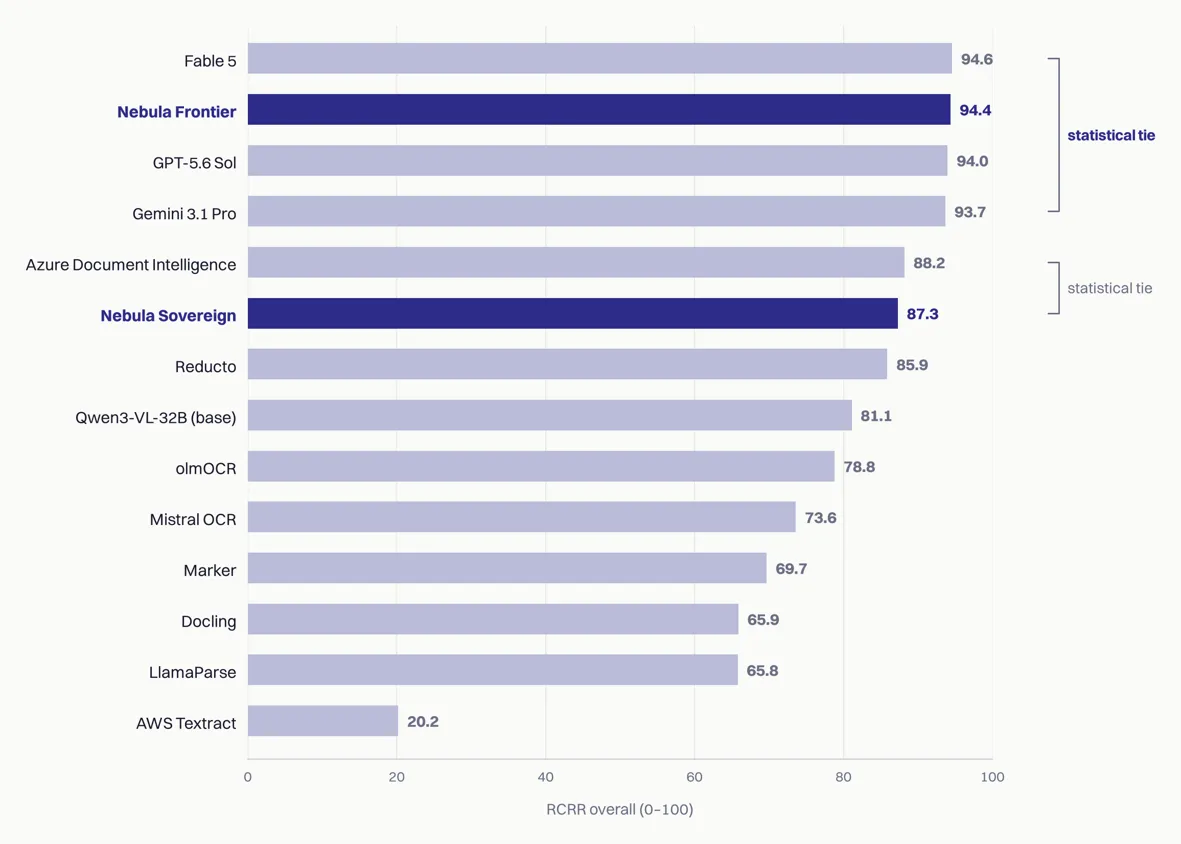
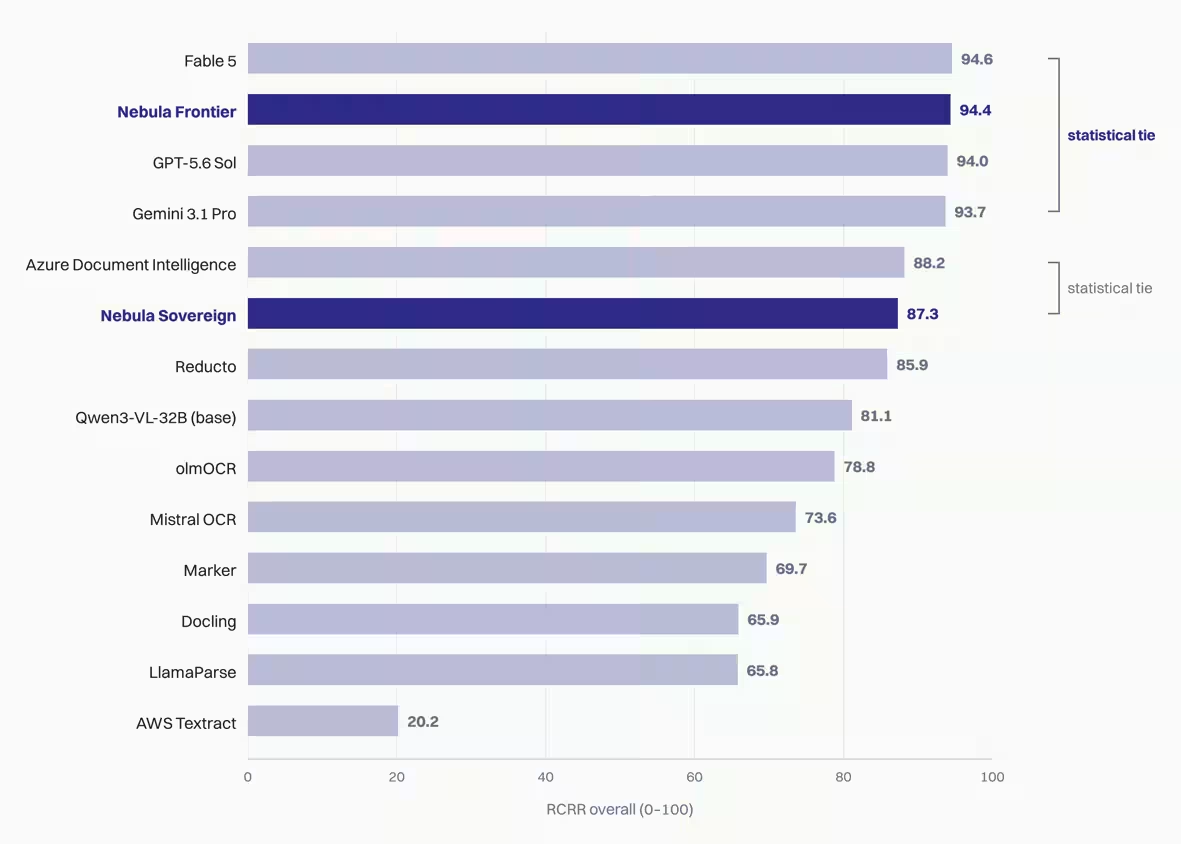
Moreover, Ur AI has unveiled a new benchmark, the RCRR Benchmark (reading-comprehension recovery rate), which measures how well meaning is preserved after document conversion. Nebula Frontier achieved an impressive RCRR overall score of 94.4, the highest among evaluated document AI products. Its performance aligns statistically with leading frontier VLM APIs such as Fable 5, GPT-5.6 Sol, and Gemini 3.1 Pro, recording a score of 94.3 for text and table-based queries.
Background of the Announcement
A significant portion of business knowledge resides within PDFs, scanned documents, and presentations, which necessitate conversion into machine-readable formats for AI systems to interpret. However, during this conversion process, key components like numerical relationships, table structures, and chart significances may be lost. Even if the text itself is accurately read, a broken document structure can result in misleading AI responses.
Ur AI identifies this concern as the challenge of 'preserving meaning during document conversion' and has developed the RCRR Benchmark to quantify it.
Overview of RCRR Benchmark
The RCRR metric evaluates how well an AI can answer questions after reading a converted document, assessing not just literal text accuracy but understanding akin to human responses. Constructed from 99 pages of actual Japanese IR materials published on TDnet, the RCRR Benchmark involved 1,410 independently verified questions posed to all systems under consistent conditions. Given that real operations often involve handling over 100 pages of PDFs and multiple files, the VLM API was evaluated based on image input of pages.
After rigorous testing, Nebula Frontier emerged with a RCRR overall score of 94.4, outperforming other document AI products in its category. In comparison, the Azure Document Intelligence scored 88.2, while Nebula Sovereign recorded 87.3. Commercial and open-source OCR systems varied from 20.2 to 85.9. A comprehensive analysis is available in the technical report.
Deep Dive into Performance Evaluation
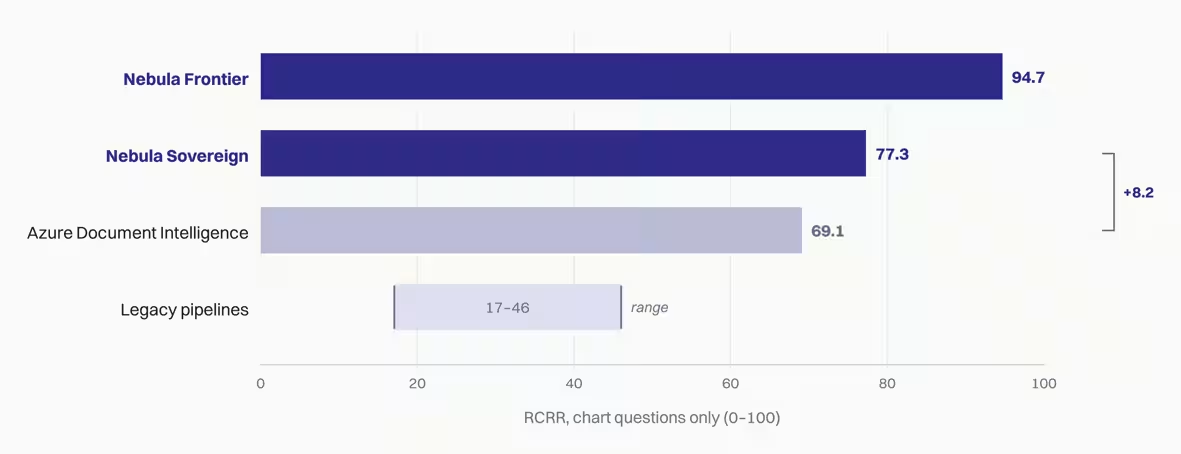
The evaluation results highlighted Nebula Frontier’s ability to seamlessly integrate with Ur AI's conversion pipeline, significantly surpassing competitors like Azure Document Intelligence by 6.2 points statistically. While the latest frontier VLM APIs showed similar performances, Nebula Frontier consistently excelled in text and table scores, achieving the highest score of 94.3 among all evaluated systems.
On the other hand, Nebula Sovereign, running on fine-tuned Qwen3-VL-32B in a self-hosted environment, performed competitively, demonstrating substantial benefits for handling sensitive documents. Azure Document Intelligence and Mistral OCR were statistically comparable to Nebula Sovereign.
Unique Features of Nebula Sovereign
Nebula Sovereign operates entirely within client-controlled GPU environments, addressing critical concerns regarding data sovereignty, security, and cost predictability—especially vital for industries handling sensitive information, such as finance and healthcare.
The baseline model achieved an initial score of 81.1 before undergoing Ur AI's domain-specific fine-tuning, which boosted the overall score by +6.2 points and text-table scores by +8.1 points. Optimization for specific document types through additional fine-tuning is also supported, demonstrating Ur AI's commitment to tailored improvements.
Technical Reporting and Data Availability
Detailed evaluation results and methodologies are documented in the technical report, where specificity on statistical confidence intervals and constraints is available. The creation of gold standard data involved utilizing VLM, ensuring integrity and transparency in the scoring process. The report also includes scores from various systems not shown in the primary analysis.
Conclusion and Future Steps
Nebula Frontier is now available on both platforms and APIs, providing customers the ability to trial with 100 pages or less at no cost. Meanwhile, Nebula Sovereign is available through enterprise-specific implementations, tailored to clients' needs. Ur AI is poised to redefine how businesses utilize AI in document management. For more information, visit their official website at https://ur-ai.net.
Topics Business Technology)
【About Using Articles】
You can freely use the title and article content by linking to the page where the article is posted.
※ Images cannot be used.
【About Links】
Links are free to use.