



New Insight into Temperature Dependence of Silicon Quantum Bits for Enhanced Gate Fidelity
Unraveling the Temperature Dependence of Silicon Quantum Bits
Recent research by a collaboration between Tokyo University of Science and AIST has provided insights into the temperature dependence affecting silicon quantum bits, specifically in terms of their gate fidelity. This exploration highlights noise mechanisms detrimental to quantum bit performance, using statistical simulations and theoretical models for analysis.
Research Summary
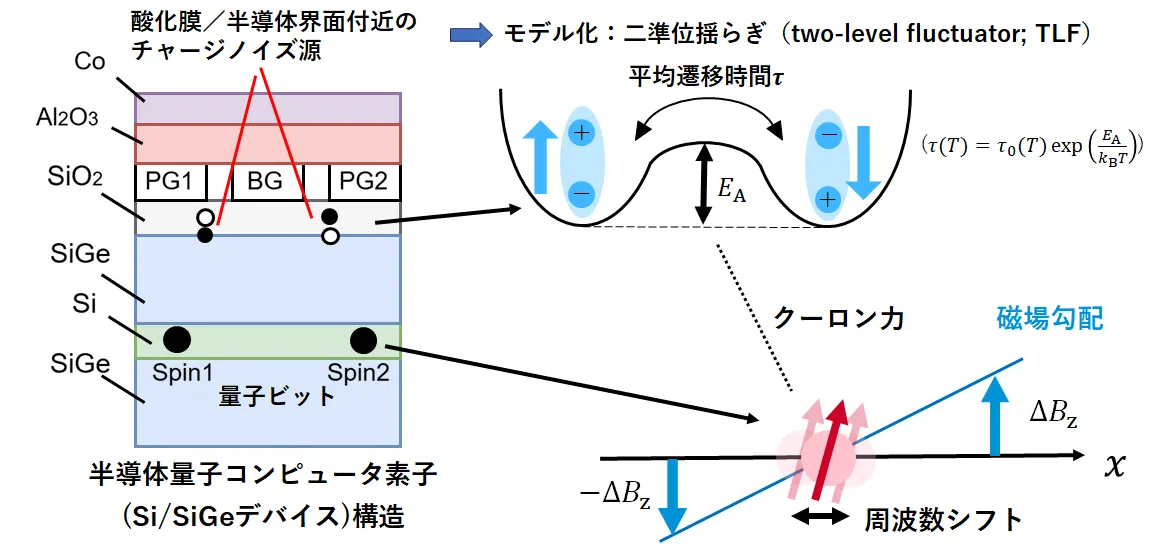
The study focused on silicon spin quantum bits, uncovering how charge noise from two-level fluctuators (TLFs) impacts the temperature-dependent shift of the quantum bit frequency. Surprisingly, conditions that improved the gate fidelity were found at higher than usual operational temperatures (around 200 mK). This represents a significant deviation from established assumptions that lower temperatures are universally better.
Through systematic parameter evaluation, this research identified that a crucial aspect of TLF dynamics—namely, activation energy and transition times—could explain the observed phenomena. The results suggested that electronic transitions, rather than atomic movements, could likely be responsible for the noise adversely affecting gate fidelity.
This research holds promise for future silicon quantum computer design, offering guidance toward controlling interface charge traps to stabilize quantum gate frequencies.

Background of the Research
Quantum computers represent a groundbreaking technological advancement, capable of processing complex problems much faster than traditional computation. Silicon quantum bits, compatible with existing semiconductor manufacturing technologies, are considered an innovative approach for scaling and increasing density in quantum computers. Given the delicate nature of quantum bits, operating them at ultra-low temperatures is vital to minimizing thermal fluctuations and performance degradation caused by environmental noise.
A significant issue is the observable non-monotonic temperature dependence of the Larmor frequency of the quantum bits, which, during operation, alters the resonance conditions necessary for precise microwave control. Recent experiments have shown a counterintuitive improvement in performance at higher temperatures (around 200 mK) compared to lower standard operating temperatures (approximately 20 mK). This phenomenon, however, lacked clarity until now regarding its noise mechanisms in operation.
Detailed Research Results
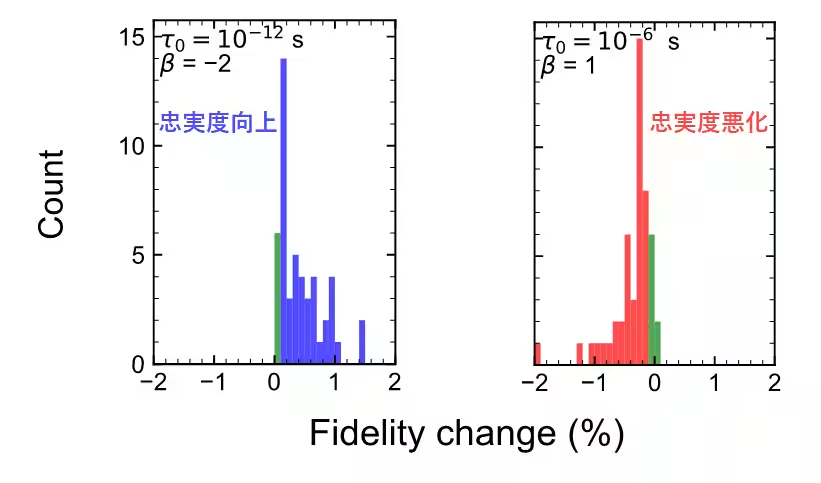
The research team modeled numerous TLFs near the Si/SiGe quantum dot and diligently examined their temperature-dependent dynamics through numerical simulation. They constructed a model encompassing quantum dots influenced by external magnetic field gradients and systematically altered various parameters, including spatial arrangements and activation energy distribution of the TLFs. With this, they reproduced the previously reported eccentric temperature-dependent behavior of the Larmor frequency and gate fidelity enhancements at higher temperatures.
The findings indicated that for TLFs with a distribution of activation energy following exponential trends and minimal transition times, the experimental observations of non-monotonic frequency shifts and improved fidelity in higher temperatures were best aligned.
This leads to the conclusion that controlling semiconductor/oxide interface states will be pivotal in the push toward realizing large-scale and high-density quantum computing, achieving stabilized quantum gate frequencies alongside high fidelity operations.

Going forward, the team plans to conduct experimental validations involving bias-scaling to control interface trap states, applying their findings to device design dynamics while expanding evaluations based on real-world spatial and energy distributions.
Terminology
1. Silicon Spin Quantum Bits: Quantum bits utilizing the spin of confined electrons in silicon, compatible with standard semiconductor manufacturing tech.
2. Gate Fidelity: A metric indicating the accuracy of quantum gate operations—higher fidelity means lower operational errors.
3. Two-Level Fluctuators (TLFs): Minute defects or charge states transitioning between two conditions, theorized as the noise source influencing quantum bit frequency shifts.
4. Larmor Frequency: The characteristic frequency at which electron spins precess in an external magnetic field, directly linking to control precision of quantum bits.
5. Si/SiGe Quantum Dots: Tiny regions formed within silicon and silicon-germanium layers that enable controlled electron localization for quantum bit functionality.
Publication Information
The findings were published online in the international journal "IEEE ACCESS" on May 4, 2026, reflecting the broader implications of advancements in the field of quantum computing.
Topics Consumer Technology)

【About Using Articles】
You can freely use the title and article content by linking to the page where the article is posted.
※ Images cannot be used.
【About Links】
Links are free to use.