



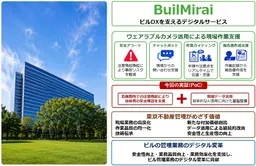
Hitachi Initiates PoC for Improved Safety in Building Management Using BuilMirai
Innovating Building Management with Technology: Hitachi's New PoC
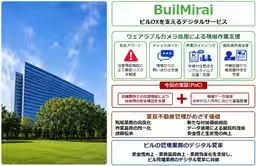
In a significant move towards digital transformation in building management, Hitachi, in collaboration with Tokyo Real Estate Management, has embarked on a proof of concept (PoC). This initiative aims to bolster safety and standardize work quality through real-time support for field operations using cutting-edge technology. The pilot project takes place at the Nakano Central Park South, providing a real-world testing ground for the innovative solutions developed by Hitachi's BuilMirai, which is at the heart of their next-generation offerings branded as 'HMAX for Buildings.'
The Need for Transformation
The building management sector faces numerous challenges due to the increasing aging of technical personnel and a shortage of skilled workers. The transfer of knowledge from experienced engineers has become critical to maintaining operational efficiency. As building inspections and maintenance demand rigorous adherence to safety protocols, ensuring consistent quality has become paramount.
Recognizing these challenges, Tokyo Real Estate Management has been exploring digital technologies to eliminate dependency on individual expertise. This initiative with Hitachi and Hitachi Building Systems represents a strategic effort to validate a new operational model that enhances on-site productivity and establishes a sustainable management framework.
PoC Objectives and Details
1. Safety Alert Functions
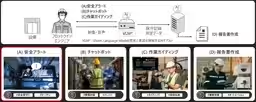
In the field, a QR code system will be implemented alongside wearable cameras. When scanned, these QR codes will deliver audio alerts and instructions directly to operators’ smartphones, ensuring timely safety reminders and follow-up actions. This proactive measure is aimed at preventing oversights regarding hazardous locations and ensuring procedural compliance, thereby maintaining consistent quality regardless of individual experience levels.
2. Accumulation and Utilization of Field Data
The PoC will also focus on collecting data from inspection histories and operational environments, which will be instrumental in visualizing processes and conducting analyses. This data-centric approach will support initiatives for procedural reviews, standardization, and continuous improvement of quality. In the future, the accumulated data is expected to enhance services through AI capabilities for risk management and report generation.
Aligning with BuilMirai's Vision
The overall goal of this PoC is to solidify the safety alert function and explore the prospects of enhanced data utilization through AI, forming an integral part of Hitachi's broader vision for building management under the HMAX model. This initiative not only demonstrates the feasibility of operational efficacy in a real-world scenario but also marks a key step toward future service innovations.
Hitachi's approach integrates technological insights gained from internal applications into real-world customer environments, broadening the scope of AI applications for various operational contexts.
Insights from Key Stakeholders
Ryoosuke Kojima, Tokyo Real Estate Management Business Promotion Director
“This PoC is pivotal for enhancing safety and raising our service quality standards. As a part of the Tokyo Building Group, we are committed to leveraging digital technology to address on-site challenges. We aim to forge a new standard in building management through our collaboration with Hitachi.”
Takamasa Shiose, Hitachi Building Systems BMS Division Strategy Director
“Through this collaboration with Tokyo Real Estate Management, we advance our goals to elevate safety and standardize quality at the ground level. The learnings from this PoC will facilitate the development of advanced AI services, broadening the application of our solutions across diverse infrastructure and operational tasks.”
Conclusion
As urban environments evolve and the demands on building management increase, the integration of technology like Hitachi's BuilMirai is critical. This PoC represents more than just a test—it is a step towards transforming traditional practices for a safer, more efficient future. With plans to expand outreach and optimize various operations through AI, this collaboration symbolizes a shift toward a smarter, more sustainable building management sector.
Topics Business Technology)
【About Using Articles】
You can freely use the title and article content by linking to the page where the article is posted.
※ Images cannot be used.
【About Links】
Links are free to use.