



Identification of Bacterial Gene Key to Symbiotic Evolution in Insects
Insights into Symbiotic Evolution of Stink Bugs
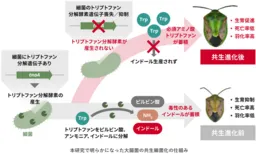
Recent research conducted by the National Institute of Advanced Industrial Science and Technology (AIST) has unveiled significant findings on symbiotic evolution within insects, specifically examining how the bacterium Escherichia coli can shift to a symbiotic role in stink bugs. The study reveals that the loss of a single enzyme gene responsible for tryptophan degradation can transform E. coli into a supportive bacterium that aids stink bug growth and survival.
Key Findings and Research Process
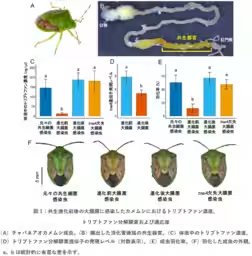
The team, consisting of lead researchers Yayun Wang, Minoru Moriyama, Ryuichi Koga, and Takema Fukatsu, utilized a unique experimental system combining the brown marmorated stink bug and E. coli. They demonstrated that when the tryptophan degradation enzyme is disrupted, E. coli takes on the characteristics of symbiotic bacteria which thrive in the intestines of the stink bug.
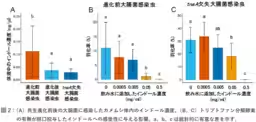
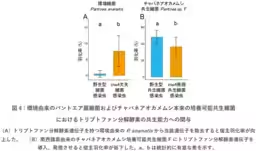
The loss of this enzyme leads to increased levels of tryptophan, an essential amino acid, in the host stink bug. Simultaneously, the toxic by-product indole produced by the enzyme is reduced. This dual effect enhances the growth conditions for the stink bug, showcasing the potential significant impacts of minimal genetic alterations on mutualistic relationships.
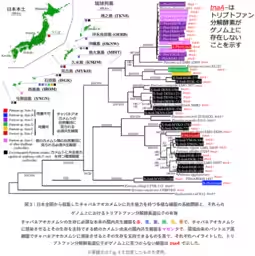
Field studies further confirmed that naturally occurring symbiotic bacteria in various stink bug species also lack the tryptophan degradation gene. This suggests that similar evolutionary changes have intrinsically occurred in these bacteria, highlighting the multifaceted role of this enzyme in symbiotic evolution.
Implications for Symbiotic Relationships
The research confirms that symbiotic evolution can occur due to a single genetic mutation, showcasing the significance of specific enzymes in the evolutionary adaptation of species. It provides a clearer understanding of the molecular mechanisms behind these symbiotic relationships, emphasizing how bacteria can switch roles based on their genetic makeup.
The implications extend beyond just this one insect-bacterium relationship; they offer insights into the broader ecosystem dynamics where multiple species interact and adapt to each other, often through symbiotic pathways. The researchers believe this knowledge could lead to advanced biotechnological applications, allowing for the design and manipulation of symbiotic relationships to enhance biodiversity and ecosystem stability.
Overview of Stink Bug Ecology
Stink bugs are known to possess various symbiotic bacteria within their digestive systems, which play crucial roles in their survival and development. With over 40,000 species worldwide, and more than 1,500 found in Japan alone, stink bug populations are increasingly recognized for their agricultural impact and ecological significance. Understanding their symbiotic relationships with gut bacteria opens new avenues for managing species that affect crop health.
The recent research indicates that the evolution of symbiotic bacteria is rapid and can be driven by simple genetic changes, a surprising contrast to previous beliefs that such evolutionary processes were complex and slow. Potential future studies may explore additional mechanisms of symbiotic evolution, analyzing genetic variations in both hosts and bacteria to create a comprehensive overview of these interactions.
Future Directions
Looking ahead, the researchers plan to delve deeper into the factors influencing the intricate relationships between guts and symbiotic bacteria across various insect species. By further examining the molecular mechanisms that contribute to these evolutionary processes, they aim to enhance our understanding of microbial ecology and its implications for environmental management and agricultural strategies.
This pioneering study will be published in the journal Nature Microbiology on February 27, 2026, providing a critical examination of the genetic underpinnings of symbiotic relationships in nature.
Topics Other)
【About Using Articles】
You can freely use the title and article content by linking to the page where the article is posted.
※ Images cannot be used.
【About Links】
Links are free to use.