




Understanding the Dendritic Growth Phenomenon in Thin Film Formation Through the Integration of Topology, Physics, and AI
Understanding Dendritic Growth Phenomenon in Thin Films
In a significant advancement for the semiconductor and telecommunications industries, a collaborative research effort involving multiple prestigious institutions in Japan has successfully illuminated the intricate dendritic growth patterns observed during the thin film formation process. Led by Professor Misato Tone from Tokyo University of Science, alongside Professors Ippei Obayashi and Yasuaki Hiraoka from Okayama University and Kyoto University, respectively, the team has developed a novel method that integrates mathematics, physics, and artificial intelligence (AI) to quantitatively analyze this branching phenomenon.
The study explores how dendritic structures—characterized by branching patterns—affect the electrical properties of thin films, which are crucial for the performance of electronic devices. As we advance towards the era of Beyond 5G, there is a growing demand for devices that operate in the terahertz (THz) frequency range. These devices require high charge carrier mobility, which can be significantly influenced by the quality of the materials used in their construction.
Research Overview
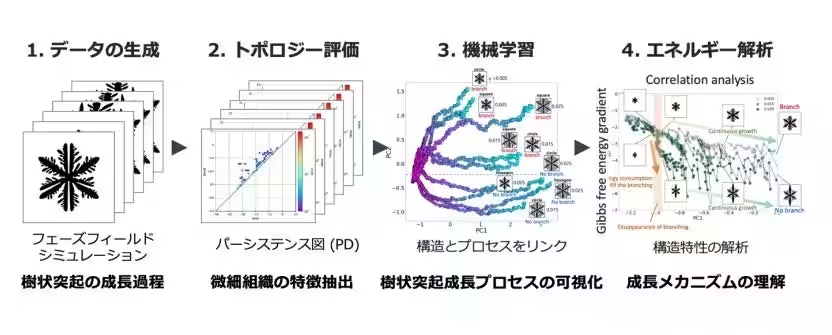
The research team employed cutting-edge machine learning techniques combined with topological and free energy analyses to dissect the mechanisms underlying the dendritic growth patterns. By focusing on the growth processes, they established a link between the structures formed and the dynamics of film deposition. This connection is vital as dendritic formations can lead to inconsistencies in thickness and surface quality, posing significant barriers to producing high-quality thin films.
A particular focus was placed on multilayer films composed of graphene and hexagonal boron nitride (h-BN) deposited on copper substrates. These structures are known for their superior charge mobility, making them ideal candidates for a wide range of applications, from semiconductors to sensor technologies. The quality of the thin film generation on the copper substrate is essential not only for the films themselves but also as a catalytic support structure, increasing the importance of controlling the deposition process.
Historically, analyses of the growth mechanisms have predominantly relied on qualitative microscopy. This study pioneers a move towards a quantitative understanding, showcasing the innovative application of mathematical concepts to materials science. The inclusion of persistent homology, a method from topology, allows researchers to maintain a clear visualization of the thin film structures during their development.
The team’s findings not only promise advancements in the fabrication of high-quality thin films but also propose a new research methodology that combines distinct fields—mathematics, physics, and AI. This holistic approach is critical in paving the way for improved processes in the semiconductor field and supporting the demands of next-generation electronics.
The results of this impactful study were published on April 8, 2025, in the journal Science and Technology of Advanced Materials: Methods. The full paper, entitled “Linking Structure and Process in Dendritic Growth Using Persistent Homology with Energy Analysis,” details the methodologies and findings, marking a step forward in the realm of material sciences.
Conclusion
As the technological landscape continues to evolve with an increasing focus on semiconductor performance in the realm of Beyond 5G, the implications of this research stretch far beyond just materials development. It embodies a synergistic advancement in scientific understanding that drives innovation forward. As the researchers continue to explore the intricacies of film formation processes, their work sets a new standard for future developments in the field, promising enhanced quality and performance in next-generation electronic devices.
For those interested in delving deeper into this cutting-edge research, further details can be found in the linked study.



Topics Consumer Technology)
【About Using Articles】
You can freely use the title and article content by linking to the page where the article is posted.
※ Images cannot be used.
【About Links】
Links are free to use.