



Innovative Cashless Payment 'Omairi Pay' Launches for Temples and Shrines
Introduction to 'Omairi Pay'
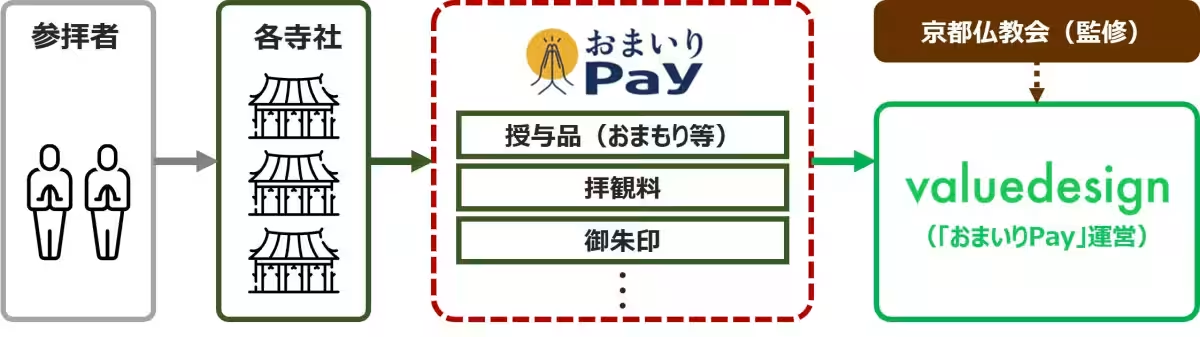
In a groundbreaking collaboration between Value Design, a subsidiary of Peak Cloud Holdings, and the Kyoto Buddhist Association, a new cashless payment service called 'Omairi Pay' has been launched. This innovative service is tailored specifically for religious institutions, allowing for cashless transactions related to gifts and entrance fees.
Launch Details
'Omairi Pay' made its debut in April at Kinkaku-ji (Golden Pavilion), Eikan-do Zenrin-ji, and Shokoku-ji Museum of Art, with plans for gradual expansion to additional locations. The Kyoto Buddhist Association, known for promoting careful practices following the 2019 announcement, provides guidance to ensure that religious freedom is respected through this system.
Key Features of 'Omairi Pay'
- - Religious Freedom Compliance: This payment solution limits itself to religious contexts, setting it apart from standard commercial transactions. It operates under the principle of separating secular business from religious activities.
- - Name Confidentiality: Individual temple and shrine names remain undisclosed to payment service providers, safeguarding the identity of the religious institutions.
- - User Protection: By limiting participating temples and transaction amounts, the service aims to prevent misuse and protect worshippers from potential fraud.
- - Streamlined Operations: 'Omairi Pay' comes equipped with simple register functionalities and various management screens designed to enhance the administrative operations of temples and shrines.
Overview of 'Omairi Pay'
- - Service Name: Omairi Pay
- - Service Type: A cashless payment service for specific religious items and entrance fees.
- - Users: Visitors paying respects at temples and shrines.
- - Participating Temples: Various temples across Japan focused on supporting religious freedom.
- - Management: Operated by Value Design and guided by the Kyoto Buddhist Association.
Supported Payment Methods
- - Credit Cards: JCB, American Express, Diners Club, Visa, Mastercard.
- - Contactless Electronic Money: Transportation IC cards, QUICPay, iD, Rakuten Edy, WAON, Nanaco.
Implementation Timeline
- - Gift Transactions: Expected to commence in April 2026.
- - Entrance Fee Transactions: Anticipated to begin in July 2026.
Looking ahead, further features such as online ticketing for visits, offerings, and funds for religious ceremonies are currently being discussed with relevant stakeholders, indicating a significant shift in religious transaction practices.
Future Locations for 'Omairi Pay'
By April 2026, the following temples are scheduled to participate:
- - Eikan-do Zenrin-ji
- - Shokoku-ji Museum of Art
- - Kinkaku-ji (Golden Pavilion)
- - Hōkoku-ji (Great Buddha of Kamakura)
- - Shokoku-ji
- - Kōan-ji (Tō-ji)
The aim is to expand 'Omairi Pay' to temples and shrines across Japan that share a commitment to religious freedom, further supporting visitors’ spiritual experiences.
About Kyoto Buddhist Association
Founded from a pre-war protector group of Buddhism, the Kyoto Buddhist Association serves as a collaborative entity bridging various sects and focuses on promoting religious events and community connections. Over the years, it has transformed and evolved into the modern-day association it is today, providing guidance and support for initiatives like 'Omairi Pay'.
Company Profile: Value Design
- - Company Name: Value Design, a 100% subsidiary of Peak Cloud Holdings
- - Headquarters: 3-1-1 Kyobashi, Chuo-ku, Tokyo, Japan
- - Website: Value Design
- - Established: July 2006
- - CEO: Shuji Hayashi
- - Business Overview: Value Design offers innovative cashless payment solutions, including its flagship services like 'Value Card', 'Value Wallet', and 'Value Gift'.
Conclusion
'Omairi Pay' represents a meaningful stride toward modernizing religious practices while ensuring adherence to foundational beliefs. As the service rolls out and expands, it promises to enhance the spiritual experience for attendees while preserving their religious rights.

Topics Consumer Technology)
【About Using Articles】
You can freely use the title and article content by linking to the page where the article is posted.
※ Images cannot be used.
【About Links】
Links are free to use.