



Innovative Techniques to Prevent Ash Adherence in Combustion Plants
Innovative Techniques to Prevent Ash Adherence in Combustion Plants
In the realm of waste management and energy recovery, ash residue from combustion plants poses a significant challenge. A collaborative effort between the National Institute of Advanced Industrial Science and Technology (AIST) and Tokyo University of Agriculture and Technology has led to the development of an advanced technology aimed at mitigating the high-temperature adherence of ash particles. This breakthrough is crucial for the efficient and stable operation of combustion facilities, particularly those dealing with sewage sludge and biomass waste.
Understanding the Problem
Ash generation is an inevitable outcome of burning waste materials, including sewage sludge and biomass. Although these facilities play a critical role in energy recovery, the ash produced can adhere to the inner walls of combustion chambers, leading to reduced energy efficiency and potential damage due to corrosion. The main culprits behind the adherence are the chemical composition of the ash, particularly the presence of phosphorus and alkali metals which have low melting points under high temperatures, making them more prone to melting and sticking.
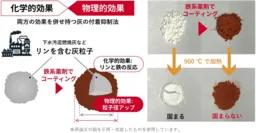
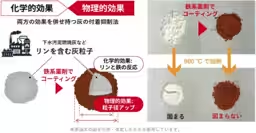
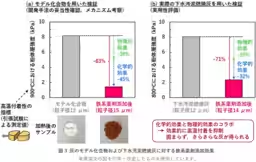
Recognizing the impact of ash composition variability over time, the research team set out to devise a dual approach—addressing both the chemical and physical properties of ash. By employing a new methodology that involves coating ash particles with specially formulated agents, the team has successfully reduced the strength of adhering particles, a key indicator of adherence, by an impressive 83%.
The Research Approach
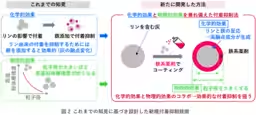
Historically, methods to prevent ash from sticking have focused on the chemical characteristics of the ash. However, as these characteristics change over time due to different operational conditions, the effectiveness of dedicated agents could also fluctuate. To overcome these limitations, researchers developed a system that not only enhances the chemical interactions between the ash and the coating agents but also increases the effective particle size by coating the ash particles. Larger particle size can significantly reduce the tendency for adherence.
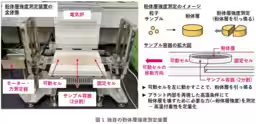
The findings stem from rigorous tests utilizing a proprietary apparatus designed to measure particle adherence under high-temperature conditions ranging from 500 to 900 degrees Celsius. The innovation involves using iron-based additives to chemically interact with phosphorus-laden ash, resulting in the formation of higher melting point compounds that are less likely to adhere.
Success Metrics
In experiments, the team observed that the application of iron sulfate solution effectively decreased the strength of the powder layer by up to 83% at 900 degrees Celsius, dramatically showcasing the potential of the new technique. They confirmed that not only did the membrane coating process enhance particle diameter, but it systematically lowered the ash's adherence tendencies through synergistic chemical and physical mechanisms.
Subsequent tests using actual samples of sewage sludge combustion ash demonstrated the practical applicability of this method, affirming its effectiveness in tackling issues stemming from not only phosphorus but also other compounding elements like potassium.
Future Developments
The positive implications of this research extend far beyond simply improving combustion technologies. The knowledge gained from this investigation will inform further trials utilizing the additive agents in real-world sewage treatment facilities. The aim is to optimize the application methods for these agents during combustion processes and enhance the overall resource recovery from burning ash, contributing to more sustainable waste management practices.
As this technology progresses, it will improve the operational stability of combustion plants, securing their role as essential infrastructure in modern waste management, while also assisting in reducing the overall environmental impact associated with energy production.
For more information and to explore the detailed results of the research, the full study is available in the Chemical Engineering Journal under the title "Controlling particle adhesion at high temperatures via chemical and physical effects using an Fe-based additive".
References
1) Genki Horiguchi et al. (2021). ACS Sustainable Chem. Eng.2021, 9, 45, 15315–15321. DOI: 10.1021/acssuschemeng.1c05676
2) Genki Horiguchi et al. (2022). Fuel Volume 321. DOI: 10.1016/j.fuel.2022.124110
Topics Environment)
【About Using Articles】
You can freely use the title and article content by linking to the page where the article is posted.
※ Images cannot be used.
【About Links】
Links are free to use.