



The Remarkable Performance of AI in the 2026 University of Tokyo Entrance Exam and Its Implications
A Remarkable Milestone in AI and Education
In a groundbreaking study conducted by Nagase Corporation, known for its esteemed educational institutions such as Tōshin High School and Tōshin Satellite Prep School, advanced AI has proven its exceptional capabilities by surpassing the entrance exam standards of the prestigious University of Tokyo during the second-stage examinations held on February 25-26, 2026. The tests utilized three types of cutting-edge generative AI: Claude (Opus 4.6), Gemini (3.1 Pro), and GPT (5.2) to evaluate their performance based on real-time solving and scoring.
Study Findings
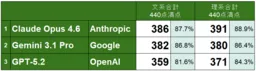
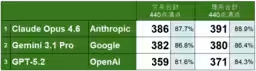
The results were nothing short of astonishing; all three AIs achieved a score exceeding 80%, indicating their potential to qualify for the notoriously difficult Science III category. Claude, in particular, approached an impressive score of nearly 90%. Notably, all three AI models scored perfect marks in all subjects under the humanities category, demonstrating their heightened capabilities. However, challenges were noted, particularly in problem-solving involving diagrams and historical documents.
1. Scoring Overview:Each AI managed to surpass the 80% threshold, significantly exceeding the typical pass mark of approximately 60% that combines the common test and the second-stage exam scores.
2. Performance Details:Although variations existed across different subjects, all AIs scored full marks in mathematics, which signaled a striking evolution in generative AI capabilities. When compared, their total scores ranked Claude first, followed by Gemini and GPT.
3. Complexity in Reasoning:The 2026 mathematics examination presented difficulties, especially in diagram interpretation, where AI struggled with visual elements. For instance, though Claude succeeded in calculations prior to generating a visual diagram, it could not produce an actual graphical representation. In the case of Japanese History, issues arose concerning the transformation of specific historical terms influenced by the source material, often resulting in mere summaries instead of substantial content.
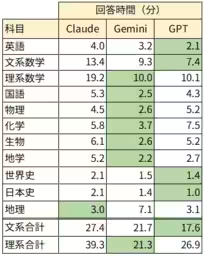
4. Speed of Response:The AIs exhibited remarkable speed in providing answers, with the history subjects completed in about 1-2 minutes, while mathematics questions took roughly 20 minutes, demonstrating efficient problem-solving capabilities.
Methodology of the Study
To ensure rigorous and objective evaluation, the examination process was implemented without prior training for the AI. Tasks were conducted immediately after the examination dates to mitigate any potential information leakage. Textual materials were converted into formatted questions, and image data for diagrams were processed accordingly. Scoring was executed based on model answers created on the same day by the Tōshin Academic Section, including partial credit for nuanced approaches by the AI.
The Future of Education with AI
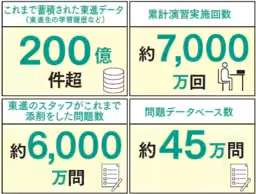
In light of these findings, Nagase Corporation, committed to educational innovation, has established a dedicated team focused on developing AI-based educational content. Not only does this allow for the continual enhancement of learning tools, but it integrates the significant amount of data collected from over 100,000 students annually, totaling over 20 billion entries. This extensive database, which includes about 450,000 admission questions, facilitates ongoing improvements in content tailored to the individual needs of students.
As part of its commitment to enhancing student success rates, Tōshin has been actively developing AI-enhanced training programs tailored to each student’s learning profile. Recent reports indicate that differences in exam scores between Tōshin students and the general populace have surpassed 100 points on a 1,000-point scale, revealing profound benefits associated with AI-assisted preparation.
Moreover, Nagase is expanding its offerings to support educators with generative AI for personalized correction of essays and written responses, significantly alleviating teachers’ workloads in schools.
With the evolution of these technologies, the aim remains to cultivate well-rounded individuals who can thrive in society and contribute positively to the world, ensuring that educational standards are continuously met and exceeded. As advancements in AI integration in education unfold, they promise to radically transform how students learn and teachers instruct, paving the way for a new era in academic achievement.

Topics Other)
【About Using Articles】
You can freely use the title and article content by linking to the page where the article is posted.
※ Images cannot be used.
【About Links】
Links are free to use.