



International Seminar on Climate Change Adaptation Strategies Through Island Development in Atoll Countries
International Seminar on Climate Change Adaptation in Atoll Countries
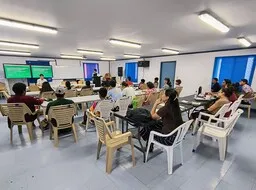
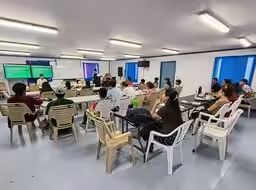
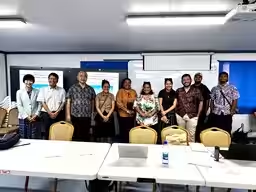
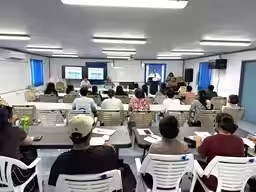
Recently, the College of the Marshall Islands (CMI) hosted an international seminar titled "Artificial Island Development as a Climate Change Adaptation Strategy in Atoll Countries". This event was conducted in collaboration with Hosei University and the Japan Global Infrastructure Foundation (Japan GIF). It was aimed at engaging local stakeholders including CMI faculty, students, NGO representatives, and members from the Japanese Embassy and JICA staff. The seminar took place on August 29, 2025, at CMI's College Center, starting at 2 PM local time.
Purpose of the Seminar
The purpose of this seminar was to investigate how atoll nations, threatened by rising sea levels, can protect their national sovereignty, cultural identity, and the right to remain on their lands. The discussions were rooted in an analysis of migration motivations within the Marshall Islands, while drawing lessons from the Maldives’ experience with artificial island development. The financial aspects of such developments were also explored.
Key Highlights
Opening Remarks by David Newnham, President of CMI
David Newnham addressed the pressing issue of rising sea levels that pose a significant threat to the Marshall Islands. He emphasized that the land where the local culture has flourished is gradually disappearing. He highlighted the seminar as a vital opportunity to discuss actions needed and how to unite to address these challenges.
Introduction by Mikiyasu Nakayama, Chairman of Japan GIF
Nakayama elaborated on the threats posed by climate change to atoll countries, citing the Maldives as a case study in artificial island development. Following his introduction, three presentations were made, and a panel discussion was held to address the issues and opportunities at hand.
Presentation Summaries
1. “Perception of Artificial Island Development among Citizens of Majuro: Research Findings and Implications for Climate Change Adaptation” by Yoshihiro Fujikura (Hosei University)
This research explored the implications of potential artificial island construction on the residents' right to remain. Recognizing the possibility of becoming uninhabitable by 2100 due to sea-level rise, the study indicated a strong desire among residents to stay despite changing lifestyles. It highlighted the public's reliance on government support for moving to artificial islands, pointing to a desire to retain cultural continuity.
2. “Comparative Perspectives on Artificial Island Development: Analysis of Surveys from Majuro Citizens and CMI Students” by Jennifer Seru (CMI)
Jennifer provided insights into differing perspectives from students and citizens. Students exhibited higher satisfaction ratings across various factors, including healthcare and education. While students harbored ambitions for overseas migration, they simultaneously recognized the importance of community involvement and optimism regarding life on artificial islands, contrasting with citizens' more pragmatic concerns around infrastructure and service viability.
3. “Inclusivity for Diverse Populations: Adapting to Sea-Level Rise through Migration to Artificial Islands in the Maldives” by Akiko Sakamoto (Japan GIF)
Sakamoto examined the Maldivian case, asserting that future migration must ensure inclusiveness for all community members. A significant improvement in the living satisfaction of migrants was noted, facilitated by clearer migration purposes. The need for preserving cultural ties through soft integration mechanisms, like community centers and cultural events, was emphasized.
Panel Discussion and Audience Q&A
The seminar concluded with a dynamic panel discussion, where participants debated adaptation strategies influenced by cultural differences between Maldives and Marshall Islands. It was noted that the National Adaptation Plan (NAP) of Marshall Islands deems artificial islands currently impractical due to financial constraints. The potential costs for such developments, as outlined in the Deltares report, were highlighted, along with the contrast in land ownership systems between the two nations. Researchers expressed gratitude for the opportunity to share findings directly with the community.
Conclusion
This seminar provided invaluable insights into the possibilities and challenges of artificial island development as a means to adapt to climate change in vulnerable atoll nations. With the pressing realities of environmental changes, innovative solutions and cohesive strategies will be critical in ensuring the survival of these unique cultures and communities.
Topics Environment)

【About Using Articles】
You can freely use the title and article content by linking to the page where the article is posted.
※ Images cannot be used.
【About Links】
Links are free to use.