



Breakthrough in Single Photon Generation for Quantum Communication Networks
Breakthrough in Single Photon Generation for Quantum Communication Networks
Recent advancements in quantum communication could reshape the information security landscape. Researchers from Tokyo University of Science have successfully demonstrated a method to selectively excite a single rare-earth atom within optical fibers to generate single photons. This achievement is expected to enhance the efficiency of data transmission in quantum communication networks, which hinge on the manipulation of quantum states.
Research Overview
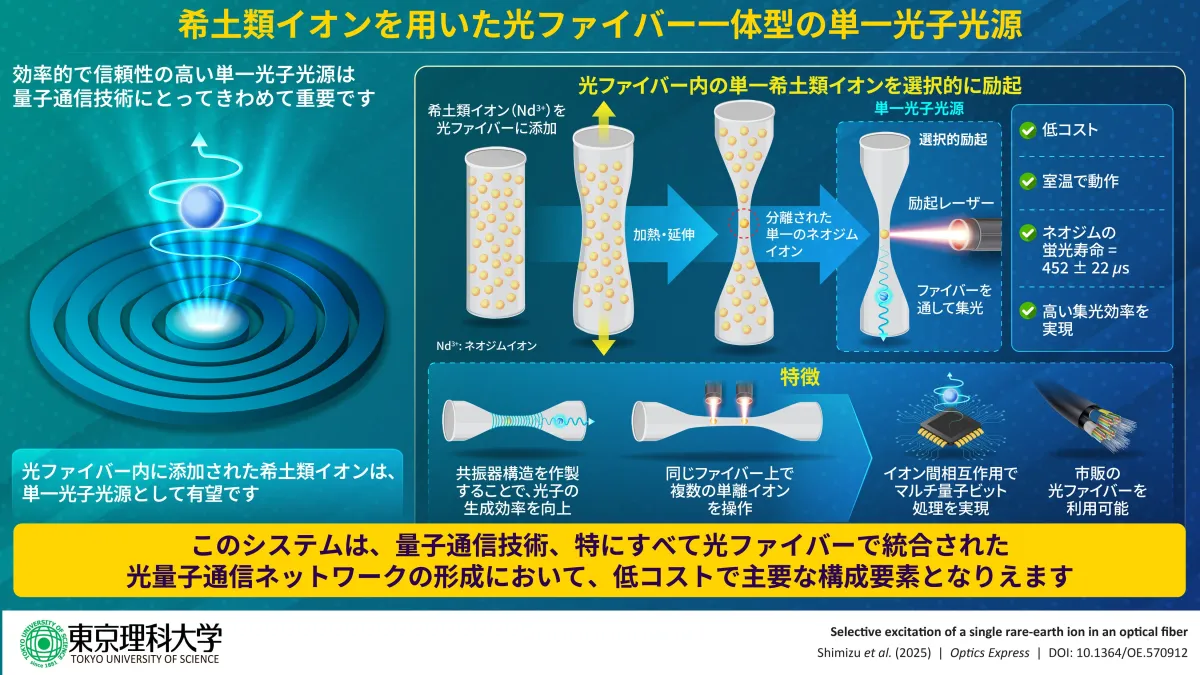
Single photon sources serve as critical devices for realizing quantum communication, which relies on the fundamentals of quantum mechanics to ensure absolute security in information transmission. The production and efficient propagation of these single photons through optical fibers are of utmost importance. In this groundbreaking research led by Kaito Shimizu, a doctoral candidate, and his colleagues, a novel approach has been developed to excite a single rare-earth atom—neodymium (Nd3+)—leveraging focused laser light.
By aiming laser light at a rare-earth ion embedded within the optical fiber, the team was able to generate single photons directly inside the fiber. This approach represents a significant advancement over traditional methods that typically required the use of quantum dots or external sources placed near the fiber, which inherently involved higher losses during transmission.
Importance of Quantum Communication
As the development of quantum computers looms, it is becoming increasingly clear that conventional communication systems may soon struggle to guarantee secure information transfer. Quantum cryptography, which relies on quantum communication techniques, is poised to become essential. To facilitate secure communication, developers must create single photon sources that can efficiently transmit photons over long distances with minimal loss, particularly through optical fibers. The integration of such sources within the fibers implies a potential revolution in communication technology, allowing seamless operational capabilities.
Prior Work and Innovations
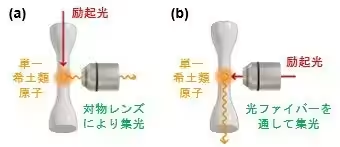
The research group had previously proposed a method utilizing rare-earth atoms to generate single photons at room temperature within optical fibers. However, previous techniques faced inefficiencies related to lens performance and required external extraction of these photons before being directed back into the fiber. In contrast, the new method allows for direct generation and transmission of single photons without the risk of loss occurring during the extraction process.
Experimental Insights
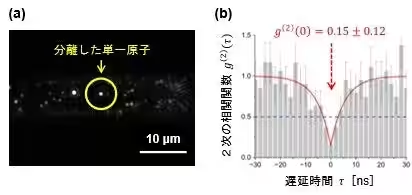
Using an Nd3+ ion as the single photon source, the team applied heat and stretch techniques to fabricate a device with isolated Nd3+ ions within the fiber. Excitation of the single Nd3+ ions through the fiber's side ultimately led to measurable single photon generation, verified through photon correlation measures, thereby showcasing the higher efficiency of this method.
Mark Sadgrove, an associate professor involved in this research, emphasized the significance of their findings, stating, "Historically, single photon sources and optical networks have developed separately, but our approach could lead to fully integrated quantum communication systems within optical fibers."
Future Implications
With the potential to optimize the security and efficiency of communication systems, the implications of this research extend far beyond theoretical applications. It may lay the groundwork for implementing secure communication channels across industries needing data encryption, thus heralding a new era in quantum communication. The paper detailing this research has been published online in the esteemed journal, Optics Express.
Conclusion
This innovative leap forward in single photon generation not only advances quantum communication technology but also contributes significantly to ensuring data security in an increasingly interconnected world. As researchers strive to further refine these processes, the integration of advanced quantum communication methods seems more attainable and promising than ever before.
References
Paper Title: Selective excitation of a single rare-earth ion in an optical fiber
Authors: Kaito Shimizu, Kazutaka Katsumata, Ayumu Rikuta, Tsuyoshi Kanemoto, Kei Sakai, Tomo Osada, and Kaoru Sanaka
DOI: 10.1364/OE.570912
Topics Consumer Technology)
【About Using Articles】
You can freely use the title and article content by linking to the page where the article is posted.
※ Images cannot be used.
【About Links】
Links are free to use.