



Accelerating Research and Development of Magnetothermal Thermoelectric Conversion Devices
Introduction
The research team led by Masayuki Murata and Tetsuharu Lee from the National Institute of Advanced Industrial Science and Technology (AIST) has established a new methodology for evaluating the thermoelectric power generation characteristics of devices under magnetic fields. This breakthrough comes in collaboration with Advance Engineering Co., Ltd., a subsidiary of Chino Corporation. The method has been validated using Bi-Sb (Bismuth-Antimony) thermoelectric elements, paving the way for a general-purpose evaluation system to be released by Advance Engineering.
Highlights
- - A novel approach has been developed to convert temperature differences into electrical energy under magnetic fields, significantly enhancing the capabilities of traditional Seebeck effect technologies.
- - The evaluation system designed based on this method will soon be released to the market, facilitating easier assessment of thermoelectric devices.
- - There are strong expectations for the societal implementation of magneto-Seebeck effect-based thermoelectric generators and Nernst effect-based thermal flow sensors.
Background
Thermoelectric materials are essential in converting heat differentials into electrical energy, particularly through the Seebeck effect, which occurs along a temperature gradient within a semiconductor or metal. These materials can be configured into thermoelectric modules to harness waste heat from industrial processes for power generation—an embodiment of efforts directed toward societal adoption.
Notably, scientific interest has surged around magneto-Seebeck and Nernst effects as cutting-edge thermal conversion efficiencies. The magneto-Seebeck effect observes a change in the Seebeck coefficient upon the application of an external magnetic field, significantly enhancing the universal performance of thermoelectric materials. Likewise, the Nernst effect produces electromotive forces perpendicular to both the thermal gradient and the magnetic field, facilitating innovative designs that avoid limitations of traditional thermoelectric configurations.
While this realm holds immense potential for applications requiring high performance in thermoelectric conversion, it remains largely on the research and materials development front. Hence, establishing a general technology capable of evaluating the power generation characteristics of thermoelectric devices under magnetic fields is critical.
Development of the Evaluation System
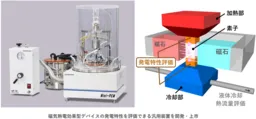
Up to now, evaluating the thermoelectric power generation under magnetic fields was encumbered by bulky setup requirements involving heating components, cooling systems, and thermal flow sensors that necessitated large equipment like superconducting magnets. Collaborating with Advance Engineering, AIST developed an innovative system that employs high-performance permanent magnets to simplify this process.
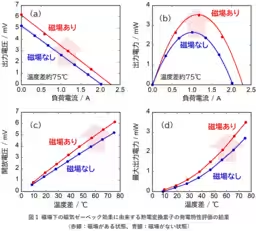
The compact design enables straightforward integration with existing commercial devices and offers stable evaluations of thermoelectric characteristics at temperatures exceeding 200°C and a range of magnetic field conditions. In testing the Bi-Sb device, a clear correlation was established where output voltage and power increased with rising magnetic field strength, illustrating this system's capability to facilitate thermoelectric performance assessments efficiently.
Future Plans
Moving forward, the research team plans to leverage this new device and methodology to advance materials and device development utilizing the magneto-Seebeck and Nernst effects. Ongoing improvements to the evaluation device will aim to accommodate a broader variety of thermoelectric element shapes and sizes.
Furthermore, results showcasing this technological advancement will be presented at the 73rd Annual Meeting of the Japan Society of Applied Physics, scheduled for March 15-18, 2026. The new evaluation system from Advance Engineering is anticipated to hit the market on March 12, 2026.
Conclusion
With growing societal demands for sustainable and efficient energy solutions, the successful development of these magnetothermal thermoelectric devices could signal a transformative shift in harnessing waste heat and improving energy efficiency across various industries. As research continues to unfold, the potential for these innovative evaluations to drive the implementation of high-performance thermoelectric technologies remains substantial.

Topics Consumer Technology)
【About Using Articles】
You can freely use the title and article content by linking to the page where the article is posted.
※ Images cannot be used.
【About Links】
Links are free to use.