



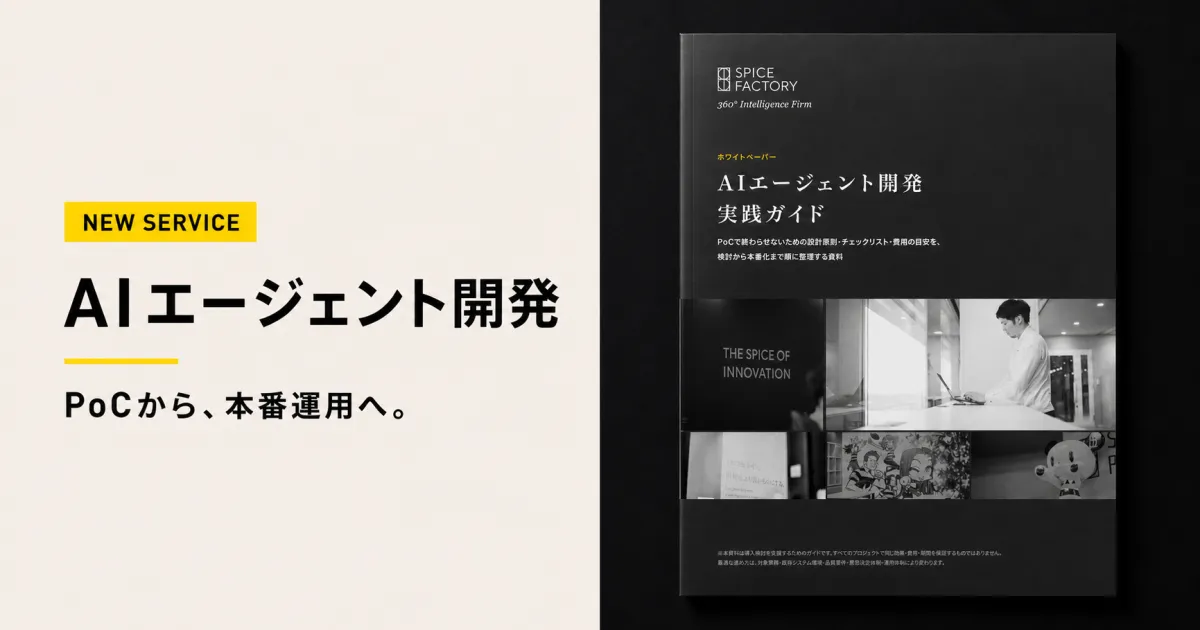
Spice Factory Launches Comprehensive AI Agent Development Service for Businesses
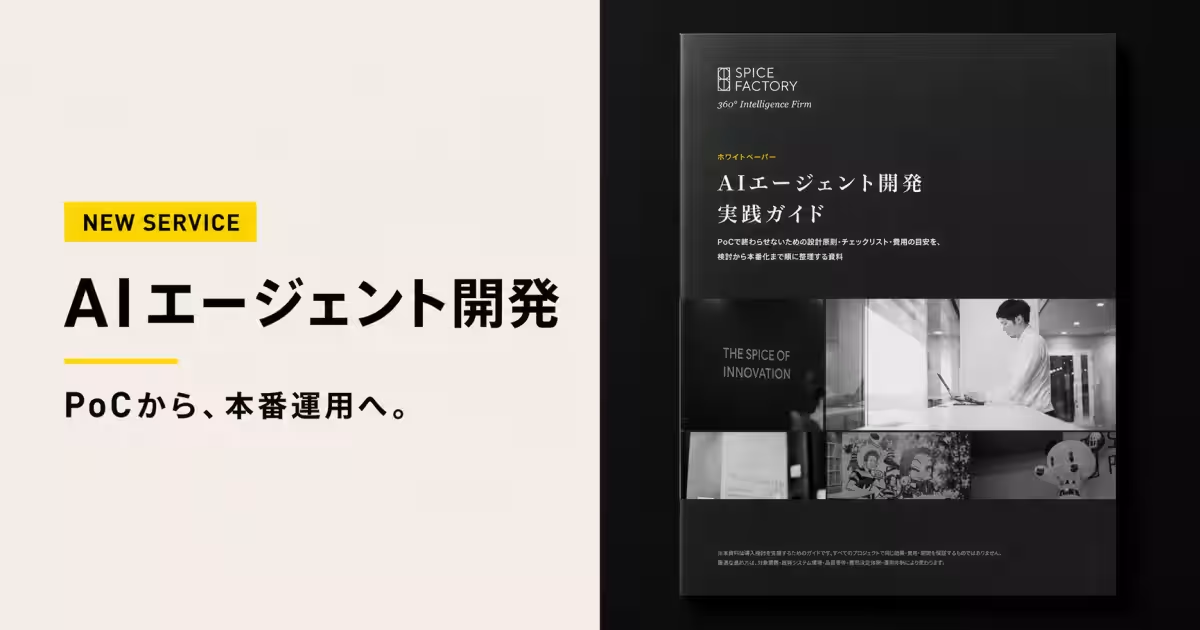
Spice Factory Introduces AI Agent Development Service
In a groundbreaking move towards enhancing business processes, Spice Factory Inc., headquartered in Minato, Tokyo, has unveiled its new service focused on AI agent development. This initiative is designed to assist companies in incorporating AI agents into their operations, guiding them through every stage from assessment and diagnosis to implementation and ongoing management.
Service Overview
Spice Factory's AI agent development service is built around the motto “Don't let AI agents remain as mere PoCs.” The emphasis is on not relying solely on the performance of AI; instead, it aims for a hybrid approach combining Large Language Models (LLMs) for handling ambiguities with deterministic code for calculations and authority assessments. Crucial operations will require human approval, thus establishing a synergy between automation and human oversight.
Companies utilizing this service will be supported through various methodologies, including evaluation tests, version control, audit logging, emergency stop mechanisms, and transparency in costs. This strategy aims to help businesses transition from the initial testing phase of AI agents to their safe and sustainable integration into ongoing operations.
Context Behind the Service
As the utilization of generative AI in business becomes more prevalent, many organizations face challenges when shifting from PoC to full implementation. Often, issues surrounding quality control, security, delineation of accountability, data management, and continual operation arise. AI agents cannot simply be entrusted to decipher natural language; businesses must also consider accountability for incorrect outputs or actions, detail recovery procedures, and facilitate ongoing improvements.
Spice Factory has leveraged its own sales DX platform, which includes AI functionalities for tasks such as sales data analysis, drafting emails, and reading business cards. Insights gained from these operations have been integrated to create a structured service offering for businesses considering AI agent adoption.
Key Features of the Service
1. Clarifying Roles in Hybrid Design
The service prominently features a hybrid structure that clarifies the roles of AI, code, and humans in business tasks. Operations are broken down into stages where deterministic code is utilized for straightforward computations, LLMs manage ambiguous tasks like interpretation and text creation, and essential operations require human validation or coded verification to ensure security and efficiency.
2. Evaluation-Driven Operations
To assure quality at every stage, a


Topics Other)









【About Using Articles】
You can freely use the title and article content by linking to the page where the article is posted.
※ Images cannot be used.
【About Links】
Links are free to use.