



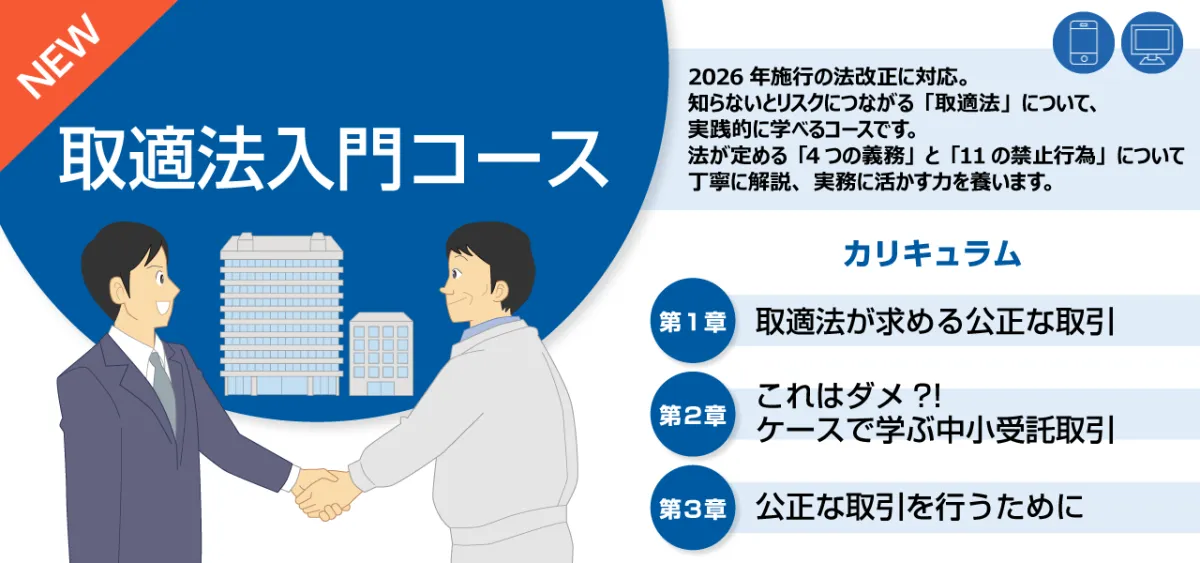
New e-Learning Course on Compliance Law: 'Introduction to Tori-Tekiho' Launching in January 2026
Introduction to Tori-Tekiho: New e-Learning Course by JMAM
In January 2026, the Japan Management Association Management Center (JMAM) will introduce a fresh e-learning course titled 'Introduction to Tori-Tekiho'. This course aims to provide companies and individuals with essential knowledge of the new law set to go into effect on January 1, 2026. The 'Tori-Tekiho' (or Small Business Transaction Compliance Law) is expected to address key areas that affect fair business practices, especially for small and medium-sized enterprises (SMEs).
Understanding the Tori-Tekiho Law
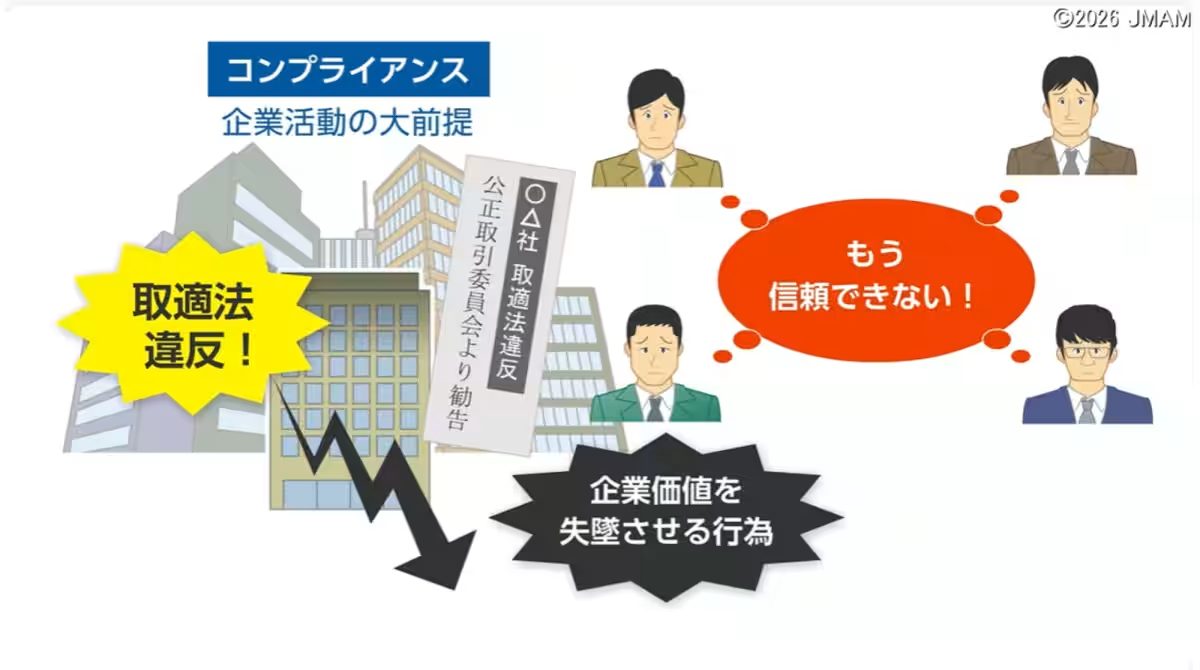
The Tori-Tekiho law's intent is to prevent payment delays and unfair treatment, ensuring that SMEs, often in weaker positions during transactions, are protected. Its implementation signifies a significant shift in Japan's approach to ensuring equitable trading practices. Violations could lead to administrative guidance, penalties, or loss of reputation, critically impacting business continuity. Thus, compliance is not just a legal requirement, but a strategic necessity for firms.
The course structure incorporates these changes alongside timely information about the law's expectations. Participants will learn about the legal revisions, including new classifications of businesses and transactions, alongside prohibited practices. This ensures learners can take appropriate action in practical situations, thereby equipping them with relevant knowledge for their work environment.
Course Development Background
The necessity for this course stems from the expanding scope of the Tori-Tekiho law. It is designed to comply with legal reforms that affect diverse business transactions and protect the interests of SMEs. By delineating the 'four obligations' and 'eleven prohibited practices', the course intends to clarify specific responsibilities companies must adhere to under the new legislation.
Practical examples from real-life scenarios will be utilized to highlight common transaction risks such as unsolicited discounts or pressure to return goods, making learning relatable and actionable. The involvement of a legal expert, Katsuki Honai, ensures that the content remains reliable and informative, catering to all business personnel, especially those involved in buying and procurement.
Course Outline and Features
Course Name:
- - Tori-Tekiho Introduction Course
Objective and Features:
- - Quick acquisition of essential knowledge required under the new law.
- - Simplified organization of the four obligations and eleven prohibited acts.
- - Specific case studies to clarify real-world risks associated with the law.
- - Support for building a framework that safeguards corporate integrity.
Study Duration:
- - Estimated learning time: 60 minutes / Minimum execution time: 36 minutes.
Target Audience:
- - Business professionals, employees involved in transactions, and purchasing agents.
Curriculum Overview:
1. Fair Trading Required by Tori-Tekiho
- Relevant transactions under Tori-Tekiho
- Definition of 'Small Business Transactions'
- Four Obligations
- Eleven Prohibited Acts
- Enforcement and penalties for violations
2. Case Studies to Learn Small Business Transactions:
- Discounts / Payment deadlines / Returns / Coercive purchasing
3. Conducting Fair Transactions Workshop
- A test comprising ten questions.
Participants can anticipate engaging content with practical exercises tailored to real-life business scenarios, equipping them with vital skills needed for effective compliance management.
What is JMAM's e-Learning Library?
The e-Learning Library® offered by JMAM facilitates multi-device learning, ensuring access to essential education anytime. It goes beyond compliance training and harassment prevention, encompassing over 500 courses covering skills development and legal compliance.
With more than 4,500 businesses and organizations utilizing this platform, it has reached over 4 million participants, enhancing the educational journey for individuals at all levels within an organization.
In short, the 'Introduction to Tori-Tekiho' course represents a proactive approach to ensuring that Japanese businesses can navigate the changing landscape of compliance effectively, ultimately fostering a culture of fairness and integrity in commerce.
For more information, visit JMAM's Course Page.



Topics Business Technology)
【About Using Articles】
You can freely use the title and article content by linking to the page where the article is posted.
※ Images cannot be used.
【About Links】
Links are free to use.