



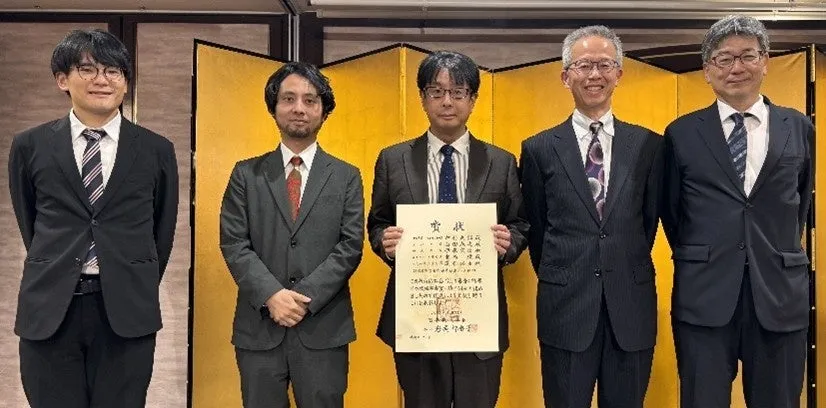
Solaris and Chuo University Jointly Receive the 2025 Japan Society of Mechanical Engineers Award
Solaris and Chuo University's Milestone Achievement
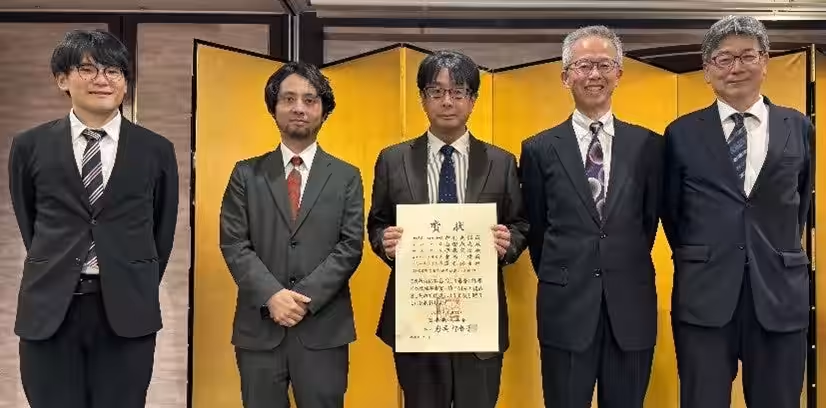
Solaris, a startup derived from Chuo University focused on artificial muscle development and soft robotics, has jointly received the prestigious "2025 Japan Society of Mechanical Engineers Award" alongside the Nakamura Laboratory of Chuo University. This recognition was awarded for the development and commercialization of their innovative earthworm-like robotic system, "Sooha®.", demonstrating excellence in industrial collaboration and practical implementation of advanced engineering technology.
The Japan Society of Mechanical Engineers Award was established in 1958, aimed at promoting the development of mechanical engineering and industry in Japan. The "Technical Award", in particular, is granted for innovative new technologies that exhibit exceptional originality, excellence, and contributions to society and the economy.
Contributions to Award-Winning Technology
With the diversification and complexity of industrial infrastructure, inspecting and cleaning piping with small diameters and intricate bends has become increasingly challenging. This was resolved through proprietary technology that mimics the peristaltic movements of earthworms, enabled by the innovative development of "axial fiber-reinforced artificial muscles". This approach allows for simultaneous inspection and cleaning of complex piping systems with an internal diameter of around 100mm.
Role Distribution in the Project
- - Chuo University (Research and Development): Conducted foundational and applied research on the locomotion mechanism that mimics the peristaltic method of earthworms, establishing the driving principles using axial fiber-reinforced artificial muscles.
- - Solaris (Commercialization): Based on the technology from Chuo University, Solaris engineered the "Sooha" product to endure harsh real-world environments, vigorously promoting social implementation through its deployment in semiconductor factories and other industrial settings.
Key Points of Recognition
1. Establishment of an Innovative Technology: The design of the soft robotics system inspired by the movements of earthworms, combined with the application of pneumatic artificial muscles that balance flexibility and strong traction.
2. Concrete Achievements and Economic Benefits in Industrial Settings: This technology provides tangible results, improving productivity and reducing costs. For instance, monitoring and cleaning of debris generated within pipes during semiconductor manufacturing enhances operational efficiency and significantly decreases downtime.
3. Solid Academic and Technical Foundation: Backed by over 47 related academic papers and more than 60 patent applications, this system is built upon a trustworthy academic background that supports its reliability and effectiveness.
4. Contribution to Societal Issues: The solution addresses pressing concerns such as the maintenance efficacy of aging social infrastructure and the shortage of labor, providing practical answers to these challenges.
Future Outlook
Solaris plans to accelerate the strengthening of its product lineup following the commercial model "Sooha 100A", continually adding functions to meet the needs of the industry. As a leading company in the field of soft robotics, Solaris aims to deepen its provision of solutions to societal issues like aging infrastructure and labor shortages, seeking further expansion of its business in the market.
For inquiries:
Solaris Inc.
Address: 14-13 Higashiyama-cho, Itabashi-ku, Tokyo 174-0073, Japan
Email: [email protected]
Phone: +81-3-5615-9560
Website: https://solaris-inc.com/
Topics Consumer Products & Retail)




【About Using Articles】
You can freely use the title and article content by linking to the page where the article is posted.
※ Images cannot be used.
【About Links】
Links are free to use.