




SCIEN Partners with Ehime to Enhance Paper Industry Quality Control with AI
SCIEN Partners with Ehime for AI-Driven Quality Control
SCIEN, a prominent AI development firm, has recently been recognized in the Continuation Framework of Ehime Prefecture's digital implementation support initiative, "Triangle Ehime 3.0," for its groundbreaking project aimed at automating quality control processes specifically tailored for the paper industry. This initiative represents a significant shift in how quality management is approached within manufacturing environments, particularly in paper and non-woven fabric production, where identifying minute defects and assessing quality is critical.
Addressing Quality Control Challenges in Ehime’s Paper Industry
The paper-related industries in Ehime deal with a diverse range of materials such as paper, films, and release liners. One of the persistent challenges in these fields is the detection of micro-defects and determining their impact on overall quality. While advancements have been made in defect detection technology, such as imaging systems, crucial decisions regarding whether a defect is acceptable and how to manage it in subsequent processes still heavily depend on the expertise of seasoned inspectors.
The fundamental issue arises from the binary decision-making process (acceptable vs. non-acceptable). If AI projects a judgment that deviates from seasoned inspectors' intuition, it may lead to complications where manual re-evaluation becomes necessary. Compounding this is the industry’s struggle with labor shortages, the need for skill transfer to younger generations, the need for cross-process defect information sharing, and the drive to reduce waste.
Thus, the demand exists not merely for AI as a decision-making tool but for continuous learning and sharing of judgment criteria, allowing these systems to adapt and improve over time.
Overview of the AI Quality Control Project
Building upon insights gathered through previous years, SCIEN's project for the upcoming fiscal year will focus on creating a "Explainable AI" and a data platform that transfers field knowledge. This innovative approach will not only instruct AI to classify defect images but also to provide rationale, quality management justifications, and revise corrections made by human inspectors in the form of metadata. The outcome of this is a production-oriented AI model that reflects the unique quality judgments of different manufacturing companies.
Key initiatives include:
- - Extending beyond mere image classification to articulate reasoning and quality management considerations.
- - Documenting the reasons behind any adjustments made by inspectors in a natural language format to establish a Human-in-the-Loop improvement cycle.
- - Translating image data into language-based data, preparing to connect with future analytical inquiries such as root cause analyses and waste reduction assessments.
- - Utilizing specific learning sets from each implementation site to refine code, operational methodologies, and data acquisition techniques.
Developing a Specialized AI Model
Remarkably, the AI model being developed is not a generic image classification tool but one explicitly tailored to the quality management needs of the paper and paper processing industries. It aims to encapsulate tacit knowledge exhibited by experienced workers—decisions like, "This defect is permissible," or "This needs re-evaluation in later stages," must be systematically stored as images, inspection results, reasoning, and revision histories to inform AI's decision-making logic.
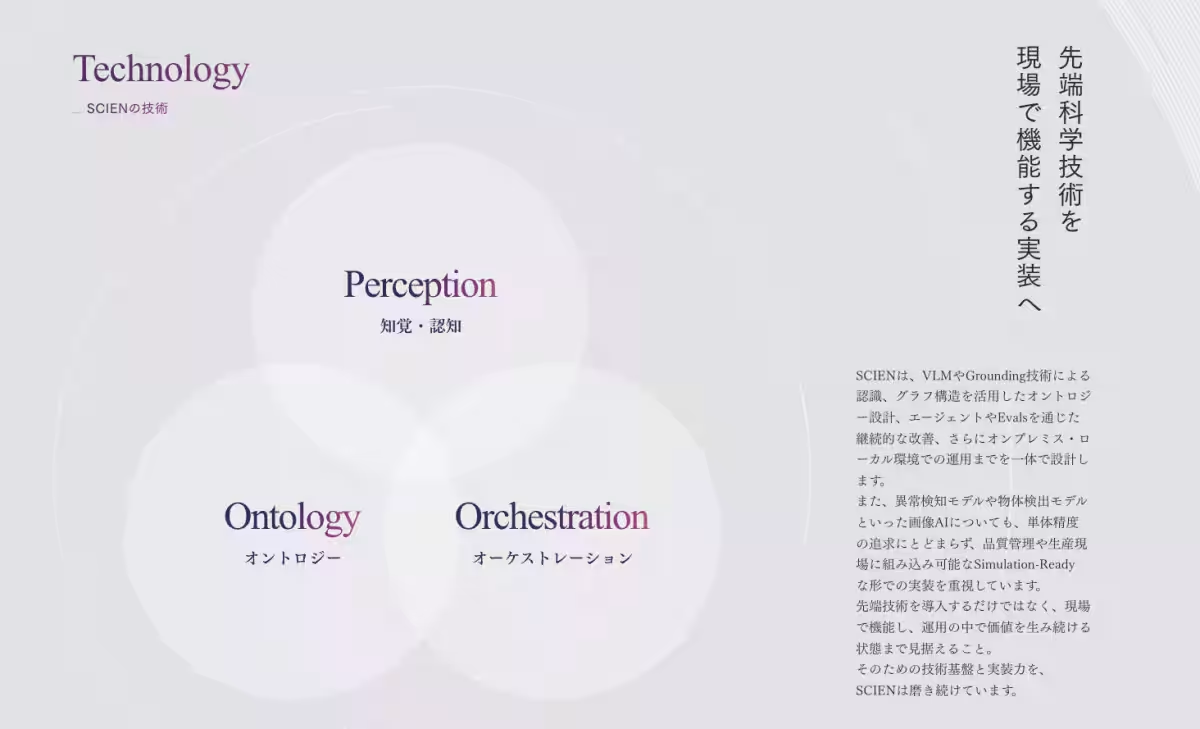
Furthermore, the project encompasses three crucial facets:
- - Perception: Detecting and classifying defect images while extracting relevant characteristics for quality management.
- - Ontology: Structuring defect types, process steps, reasons for judgments, and subsequent handling to share these criteria as organizational knowledge.
- - Orchestration: Aligning AI outputs, inspector revisions, and operational systems to continuously refine both the AI model and operational protocols.
By adopting this framework, AI is positioned not as a replacement for human judgment but as a supportive tool that enhances knowledge transfer from seasoned inspectors to the next generation while elevating the consistency of quality assessments.
Commitment to Workforce Development
In alignment with the Triangle Ehime initiative, SCIEN’s project also places a strong emphasis on workforce development by taking on local students and promoting the learning and implementation of AI technologies. The project's objective is to nurture future professionals equipped to manage AI solutions in regional manufacturing contexts. Students will be directly involved in the practical aspects of AI implementation, from understanding real-time production challenges to data acquisition, annotation, model training, evaluation, UI advancement, and operational maintenance.
This program emphasizes experiential learning, helping students tackle incomplete data and real-world constraints, thereby creating a workforce prepared to address regional industrial challenges effectively.
About SCIEN
Founded with the vision of enhancing daily life through the power of science, SCIEN is committed to not just providing technology, but generating value that is truly essential to society. The company specializes in the development of in-house inspection systems and automation solutions that move beyond Proof of Concept (PoC) to systematic implementations. By focusing on a problem-driven approach rooted in deep understanding, SCIEN contributes to the digital transformation and value creation in various sectors.
Company Information:
- - Name: SCIEN, Inc.
- - Location: 3F, Soubunkan Building, 6-25-14 Hongo, Bunkyo-ku, Tokyo
- - CEO: Sora Tabata
- - Established: February 2, 2024
- - Services: AI Development, Systems Operations, Consulting
- - Website: scieninc.jp
Contact Information for Inquiries
For further details, please reach out to SCIEN at:
- - Email: [email protected]
- - Address: 6-25-14 Hongo, Bunkyo-ku, Tokyo
- - Contact Page: scieninc.jp/contact


Topics Consumer Technology)
【About Using Articles】
You can freely use the title and article content by linking to the page where the article is posted.
※ Images cannot be used.
【About Links】
Links are free to use.