



Exploring the Emotional Typology of MBTI Relationships: Insights from 14,000+ Behavior Logs
Exploring the Emotional Typology of MBTI Relationships: Insights from 14,000+ Behavior Logs
The MBTI compatibility diagnostic service, "Futari no Torisetsu", recently published a comprehensive report detailing 14,507 behavior logs collected from users between January and August 2026. This study presents unique insights into the types of individuals who seek compatibility assessments, highlighting how the emotional temperaments significantly influence interpersonal dynamics.
Key Findings
Discovery 1: Emotional Types Dominate
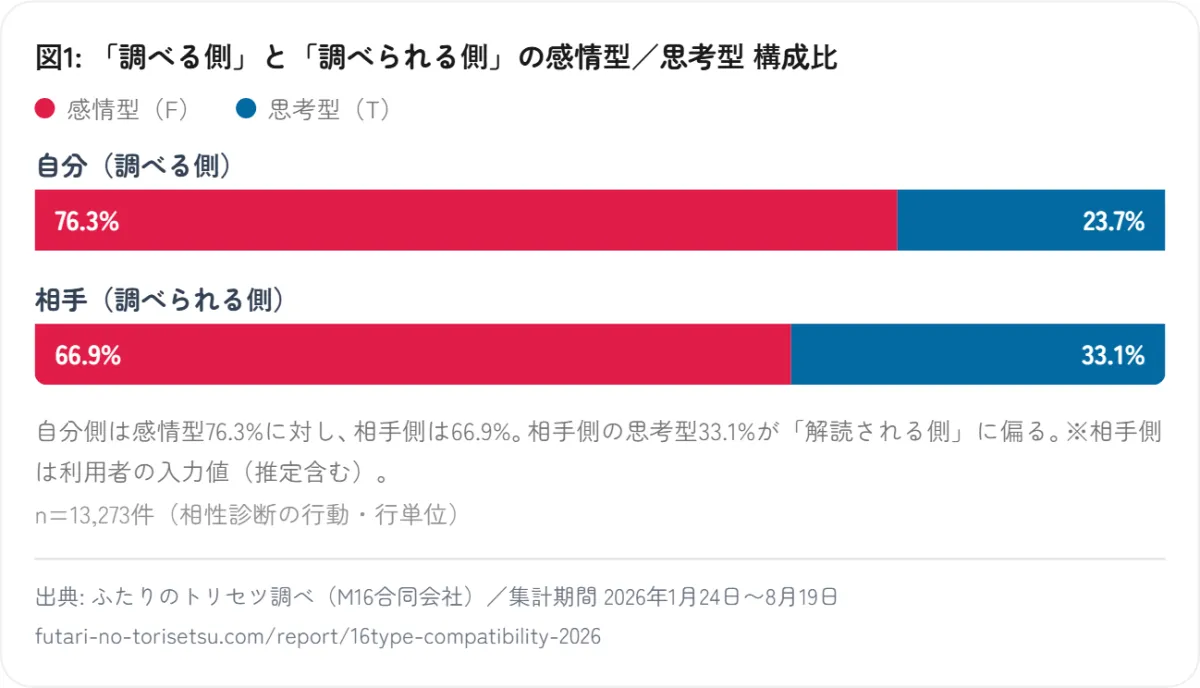
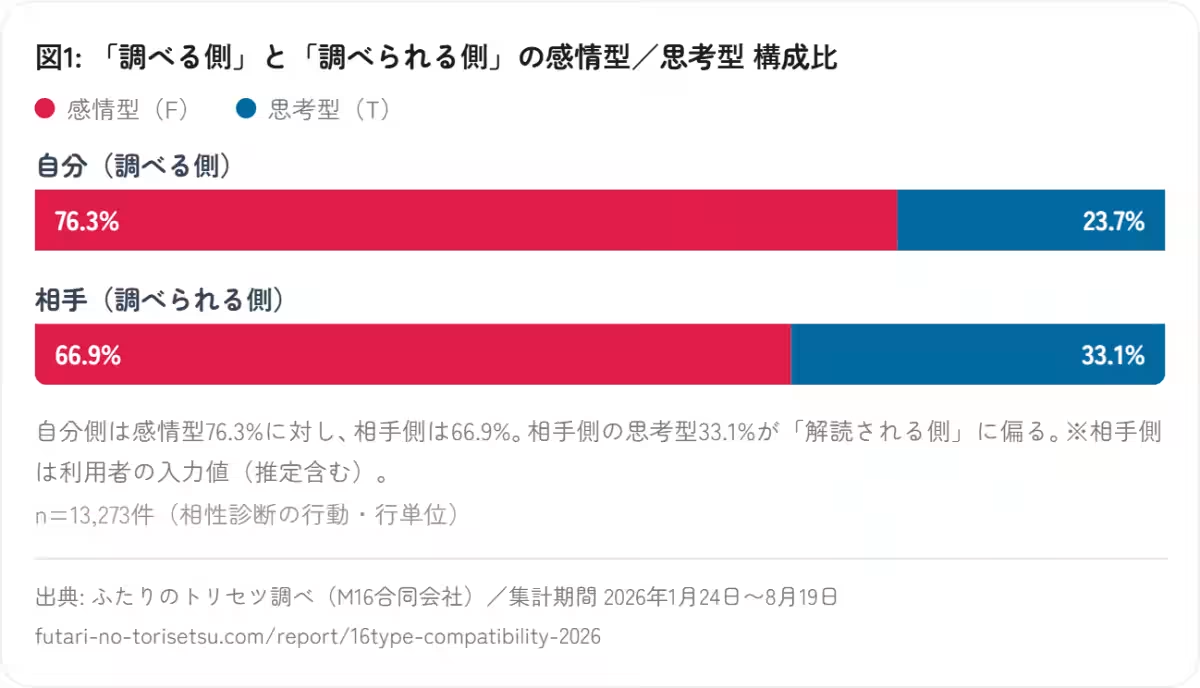
According to the gathered data, a staggering 76.3% of users identified themselves as feeling types (F-types) when inputting their personality type for the compatibility test. In contrast, only 66.9% of the types entered for their partners were emotional types, with the remaining 33.1% identified as thinking types (T-types). This indicates a noticeable asymmetry, showcasing that emotional types predominantly seek to understand their thinking counterparts.
Among 5,627 unique users who consistently utilized the app with fixed types, 77.0% were feeling types, further solidifying this trend. This asymmetrical behavior is crucial as it depicts how emotional types are generally on a quest to decode the thought processes of their partners, indicating a one-side approach to understanding interpersonal relationships.
Discovery 2: Varying Degrees of Linguistic Expression
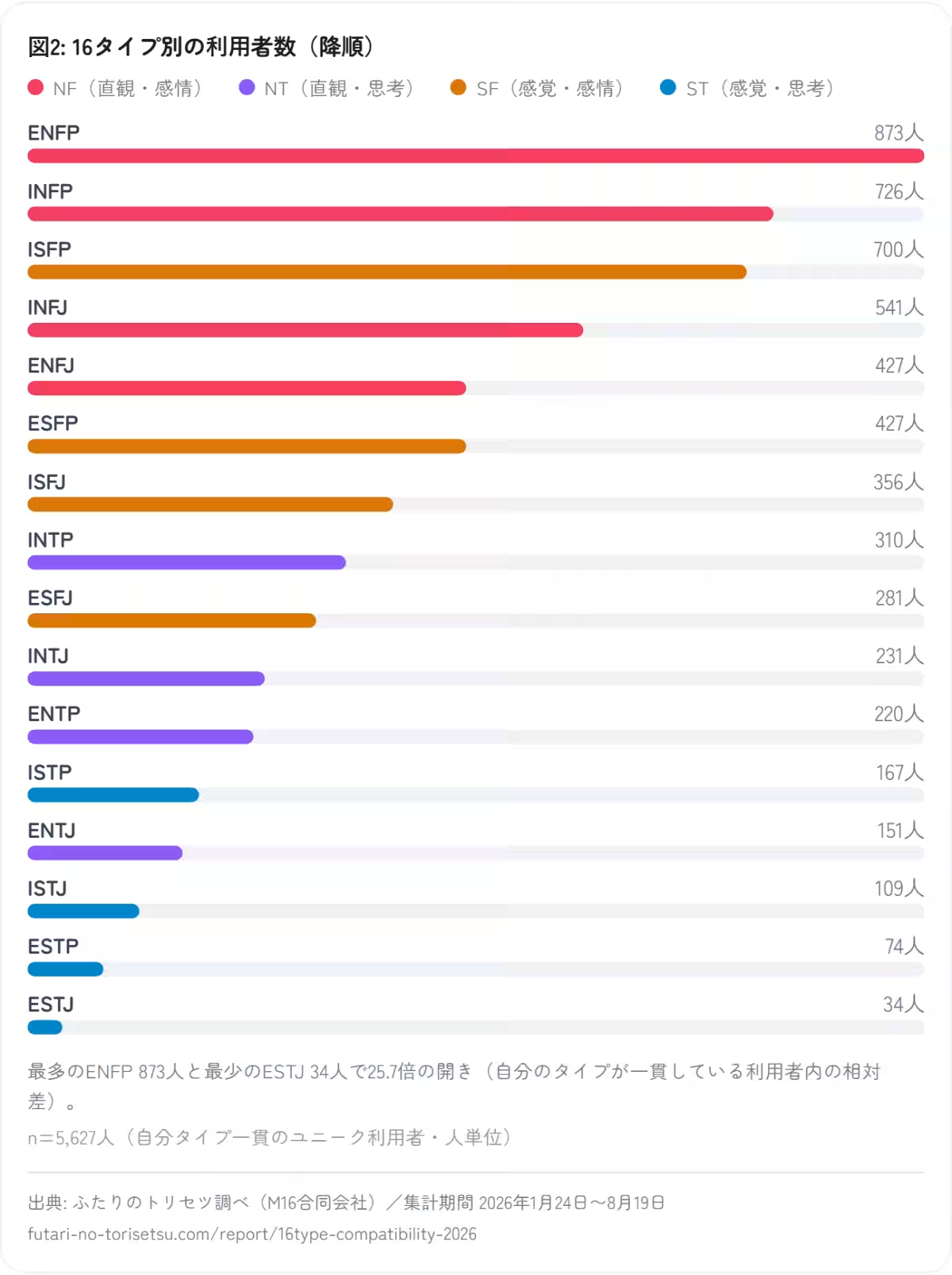
The type composition of users revealed that the most common personality type was ENFP, comprising 15.5% of users (873 individuals), while the least represented type was ESTJ at only 0.6% (34 individuals). This represents a staggering 25.7 times difference, indicating a significant variance in users’ willingness to articulate their relationship dynamics. The inclination to verbalize compatibility may hinge heavily on personality type, suggesting some types are inherently more drawn to expressing their relational insights.
Discovery 3: Lack of Typical Couple Types
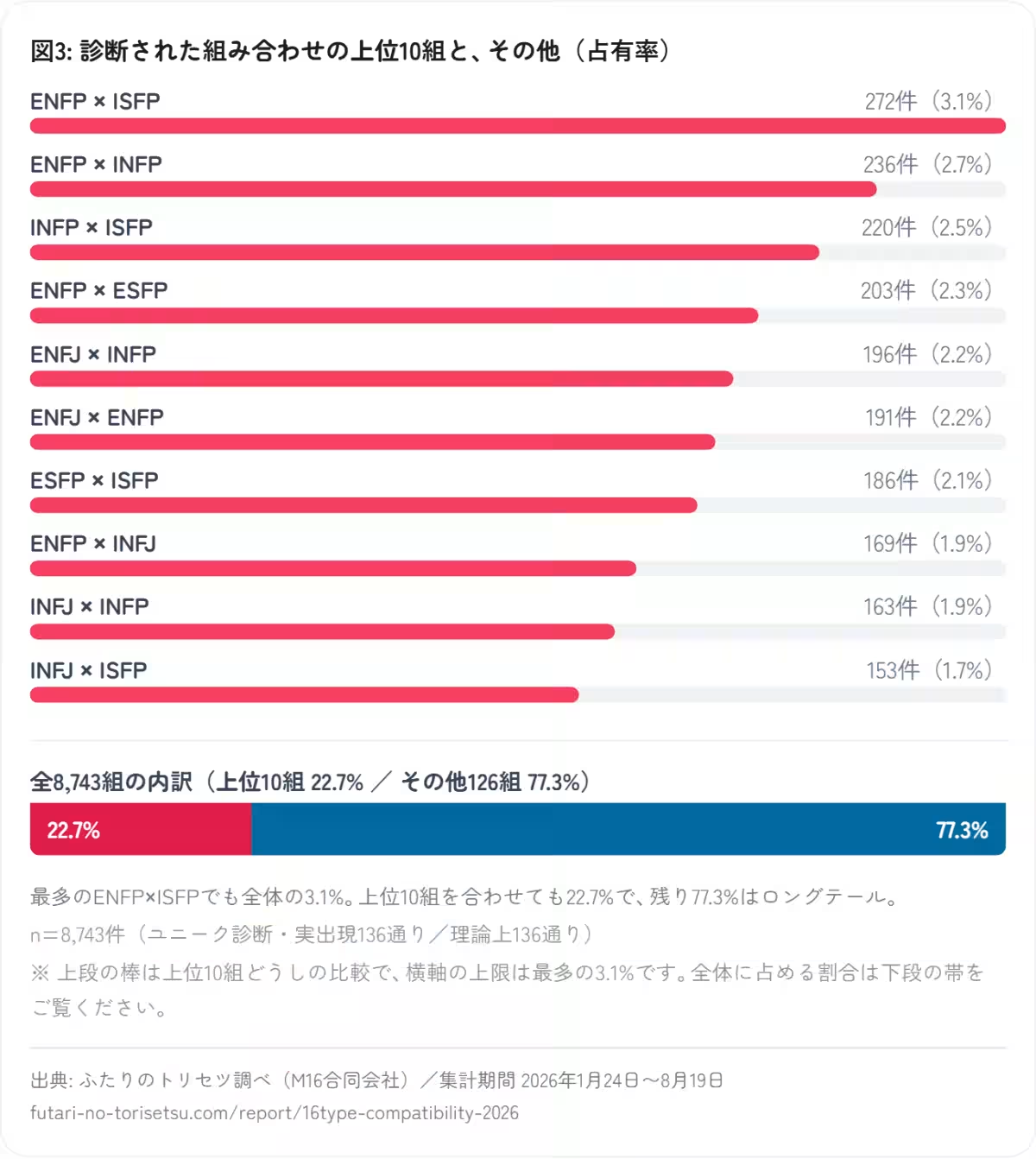
In examining the combinations of types across 8,743 unique assessments, it was found that every theoretical combination of type pairings emerged, with no one combination dominating the landscape. The most frequently observed pairing of ENFP and ISFP only constituted 3.1% of the total sample, illustrating a wide distribution among different type combinations. This diversity points to a lack of standardized couple types, emphasizing that every relationship is uniquely constituted beyond prevailing stereotypes.
Additional Insight:
Only 8.2% of the assessments involved users examining compatibility with someone of the same personality type. Moreover, a notable 85.4% of users evaluated compatibility with a singular individual of interest, reflecting a focused engagement on specific relationships rather than generalized inquiries.
Expert Commentary
Daichi Kudo, CTO of M16 LLC, shared, "We view these results as a testament to the limitations of discussing compatibility as broad generalizations or rankings. Given that no specific type pairing dominates, it is essential to perceive every relationship as a distinct entity. Our service is designed with this perspective in mind."
Survey Overview
- - Conducted by: M16 LLC, operators of "Futari no Torisetsu"
- - Methodology: Analysis of behavior logs from the compatibility diagnostic service, with no reliance on survey-based data. The type of the partner is derived from user inputs, which could include assumptions.
- - Collection Period: January 24 – August 19, 2026
- - Sample Size: 14,507 diagnostic interactions
- - Note: The population represented consists solely of users of this service and does not reflect the general population.
About "Futari no Torisetsu"
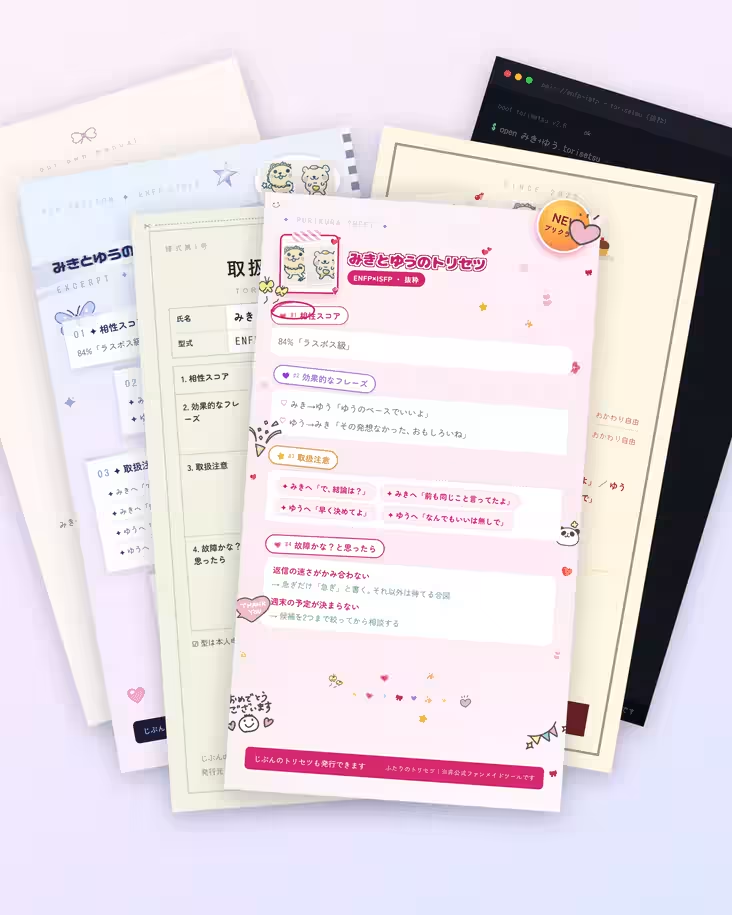
This unique service allows users to input their type along with their partner's type (even estimated) to generate a comprehensive relational compatibility report and AI generated "user guide". Most diagnostic features remain accessible at no cost. The service, actively engaging approximately 37,000 users and generating over 106,000 page views recently, emphasizes its growing appeal within the community. Users can save compatibility results in various design formats for personalized sharing.
Topics People & Culture)
【About Using Articles】
You can freely use the title and article content by linking to the page where the article is posted.
※ Images cannot be used.
【About Links】
Links are free to use.