




Samsung's Health-Based Models Enhance Personalized Health Insights Through AI Technologies
Advancing Health Insights: Samsung's Innovative AI Models
In a groundbreaking showcase at the Galaxy Unpacked event in July 2026, Samsung Electronics unveiled its vision for 'Connected Care', a new era in digital health. During the 'Health Forum', the focus was on transforming healthcare from a reactive model to a proactive approach. By utilizing data continuously, users will gain a better understanding of their health condition, translating insights into tailored preventive care. One of the cornerstone technologies propelling this forward is the 'Health-Based Model' developed by Samsung Research.
Harnessing AI in Wearable Technology
Artificial Intelligence (AI) is increasingly facilitating the analysis of biosignals from wearable devices like smartwatches. By identifying meaningful patterns from health data such as sleep, heart rate, and physical activity levels, AI aids users in understanding and managing their wellbeing.
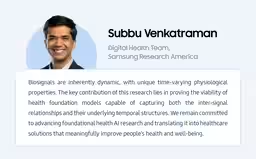
Samsung Research America's Digital Health Team is at the forefront of developing new AI technologies that derive health insights from continuous monitoring of biosignals captured by wearables. Their objective is not just data collection but translating those metrics into practical health advice tailored to individual needs.
The Launch of Two Groundbreaking Models
Recently, Samsung researchers introduced two foundational models based on wearable data:
- - xMAE (Physiology-Aware Masked Cross-Modal Reconstruction for Biosignal Representation Learning): This model studies the connections between different biosignals over time.
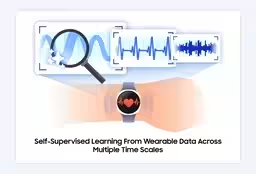
- - HiMAE (Hierarchical Masked Autoencoder): This model understands diverse health patterns from time-series data of wearables, analyzing both short-term and long-term trends.
Both models reflect significant advancements in the AI healthcare sector, showcasing improvements in our ability to understand physiological relationships and changes over time.
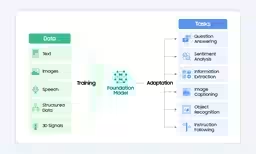
The Health-Based Model: Understanding Body Signals
The Health-Based Model is designed to autonomously learn meaningful characteristics related to health from unlabeled biosignal data. By leveraging vast amounts of health data for pre-training, it can significantly enhance the analysis of biosignals, improve existing biomarkers, predict health risks, and contribute to the development of new biomarkers.
Examining the xMAE Model's Capabilities
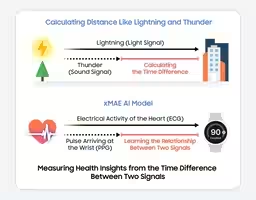
The xMAE model allows for continuous monitoring of heart conditions. Using both Electrocardiograms (ECG) and Photoplethysmograms (PPG) as input signals, this model reconstructs parts of the ECG data using PPG. While ECG directly measures the heart's electrical activity, PPG detects changes in blood flow, enabling uninterrupted monitoring through wearable devices without user intervention. This capability highlights the model's potential to accurately analyze cardiovascular health features without requiring active measurement by the user.
The research team trained the xMAE model using approximately 9,400 hours of ECG and PPG data, leading to superior performance in 15 out of 19 evaluation tasks, exceeding that of existing single biosignal models and multi-modal learning approaches. Notably, the features learned by this model can be applied across different sensor devices and body parts, enhancing its versatility.
Enhancing Understanding with HiMAE
The HiMAE model addresses the necessity of analyzing health data across different timeframes. By employing multiple encoders to independently analyze both short-term and long-term data, this model effectively captures the necessary information for tasks like heart rate analysis and sleep forecasting.
During training, segments of the data are hidden and need to be restored, allowing the model to learn vital patterns in biosignals, even when labeled data is limited. Impressively, a pre-trained single HiMAE model can handle classification, numerical predictions, and data generation tasks with enhanced performance. Additionally, it is optimized for computational efficiency, producing results in less than a millisecond on smart-watch level CPUs. One of its most significant advantages is its ability to analyze raw health data in real-time, independent of cloud servers.
The Next Leap Towards Connected Care
The xMAE and HiMAE models exemplify a significant evolution in understanding physiological relationships and changes over time through AI. Both models are designed to facilitate diverse health-related tasks from a singular pre-trained model while providing accurate, continuous, and personalized health insights.
Research team voices emphasize the potential of these health-based models, laying the technological foundation for delivering efficient and accurate ongoing health insights. Samsung plans to continue advancing these models, aspiring to enhance health functionalities that operate effectively on constrained sensors and computing resources.
Conclusion
The implications of Samsung's research transcend mere technological achievements; they pave the way towards comprehensive health solutions that will fundamentally improve individuals' health and well-being. By intertwining AI with continuous health monitoring, Samsung is setting a new standard in personalized healthcare solutions through its innovative applications of biosignal analysis. This impressive capability signals a likely shift in how we approach health management in the near future.


Topics Health)




【About Using Articles】
You can freely use the title and article content by linking to the page where the article is posted.
※ Images cannot be used.
【About Links】
Links are free to use.