



GlobalData Releases White Paper on AI-Powered Voice Services Evolution at MWC 2026
AI and the Evolution of Voice Services
At the recently concluded MWC 2026 in Barcelona, Andy Hicks, the Principal Analyst at GlobalData, presented an eye-opening white paper titled Reinventing Voice: A Converged Future. This document explores how telecommunication firms can harness AI to redefine the value of voice services.
The Need for a Fully Converged Voice Network
As the telecommunications sector transitions into a new era marked by 5G advancements, operators face the dual challenge of modernizing their networks while managing legacy systems from earlier generations like 2G and 3G. As these older technologies approach the end of their life cycles, maintaining them is essential for basic services such as machine-to-machine communication (M2M) and international roaming. In this regard, establishing a fully converged voice network has become paramount. Such a network can accommodate services running across 2G, 3G, 4G, and 5G, addressing issues related to operational lifecycle challenges and facilitating seamless future development.
Hicks emphasizes that the contemporary shift towards containerization enables this fully converged architecture to smoothly transition from virtual machines to container systems. This innovation helps operators reduce total cost of ownership (TCO) while simultaneously fostering continuous innovations and frequent updates to their voice services.
AI's Role in Voice Services Transformation
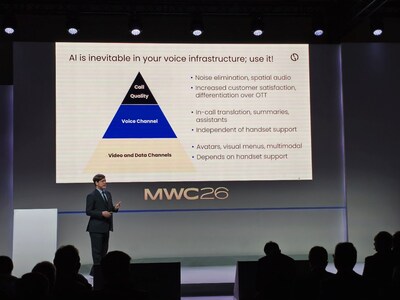
The rapid evolution of AI presents new opportunities for enhancing voice services. According to Hicks, operators can achieve profound integration of AI into voice services through a three-phase approach.
1. Enhancing Call Experiences: Initially, AI can be leveraged to improve the basic telephone experience, offering operators a competitive edge against Over-The-Top (OTT) applications. Features like intelligent noise suppression and immersive surround sound technology elevate communication into a more sophisticated realm.
2. Innovative Features Implementation: The second phase involves integrating AI into audio channels to introduce innovative functionalities such as real-time translation and intelligent call summaries. These enhancements impose no additional requirements on terminals, allowing operators to swiftly deploy new services and gain a first-mover advantage in AI-powered voice innovations.
3. Multimodal Services Development: The final phase takes innovation a step further by integrating AI into both video and data channels, transforming call technologies from a unidirectional mode to a multimodal service. This transition enables the development of interactive experiences, such as customer support services and healthcare assistants, embodying the concept of calling as a service.
Concluding Thoughts
Hicks noted that operators must seize the opportunities presented by AI. By utilizing a fully converged voice network as their foundation, they can drive service innovations and reinvigorate the intrinsic value of voice services, propelled by the dual advancements of 5G and AI. To delve deeper into this compelling vision for the future of voice services, the full white paper is available for reading here.
Topics Telecommunications)
【About Using Articles】
You can freely use the title and article content by linking to the page where the article is posted.
※ Images cannot be used.
【About Links】
Links are free to use.