



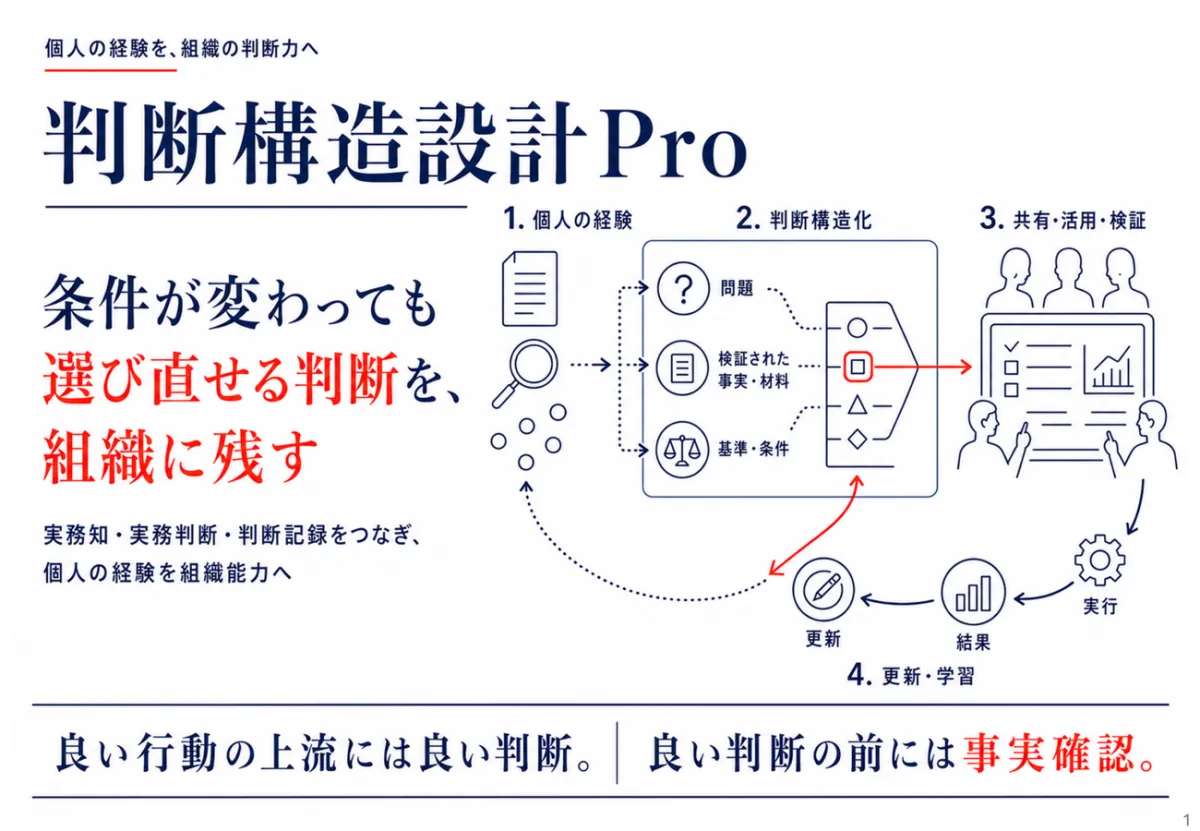
Transforming Individual Experiences into Organizational Decision-Making with Judgement Structure Design Pro
Transforming Individual Experiences into Organizational Decision-Making: Judgement Structure Design Pro
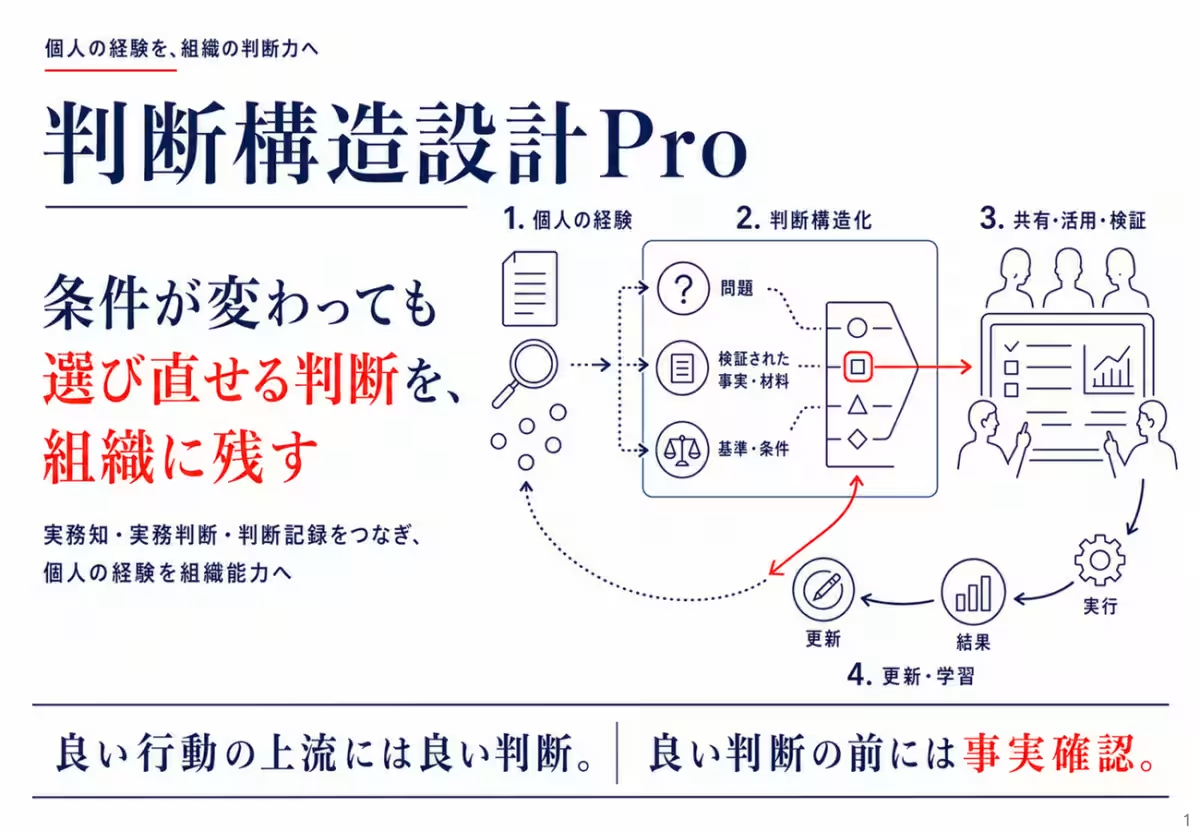
Request Inc., led by CEO Tomoyasu Kohata, announces the launch of Judgement Structure Design Pro, a groundbreaking system designed to help organizations leverage individual experiences to create a replicable decision-making framework. This innovative approach is not about merely documenting past successes or individual answers; rather, it links the crucial elements such as problems to solve, verified facts, conditions to maintain, comparison criteria, options and reasons, outcomes, and the current scope of application. This design framework allows other individuals within the organization to recreate judgments in changing conditions, enabling necessary re-evaluations and updates based on outcomes.
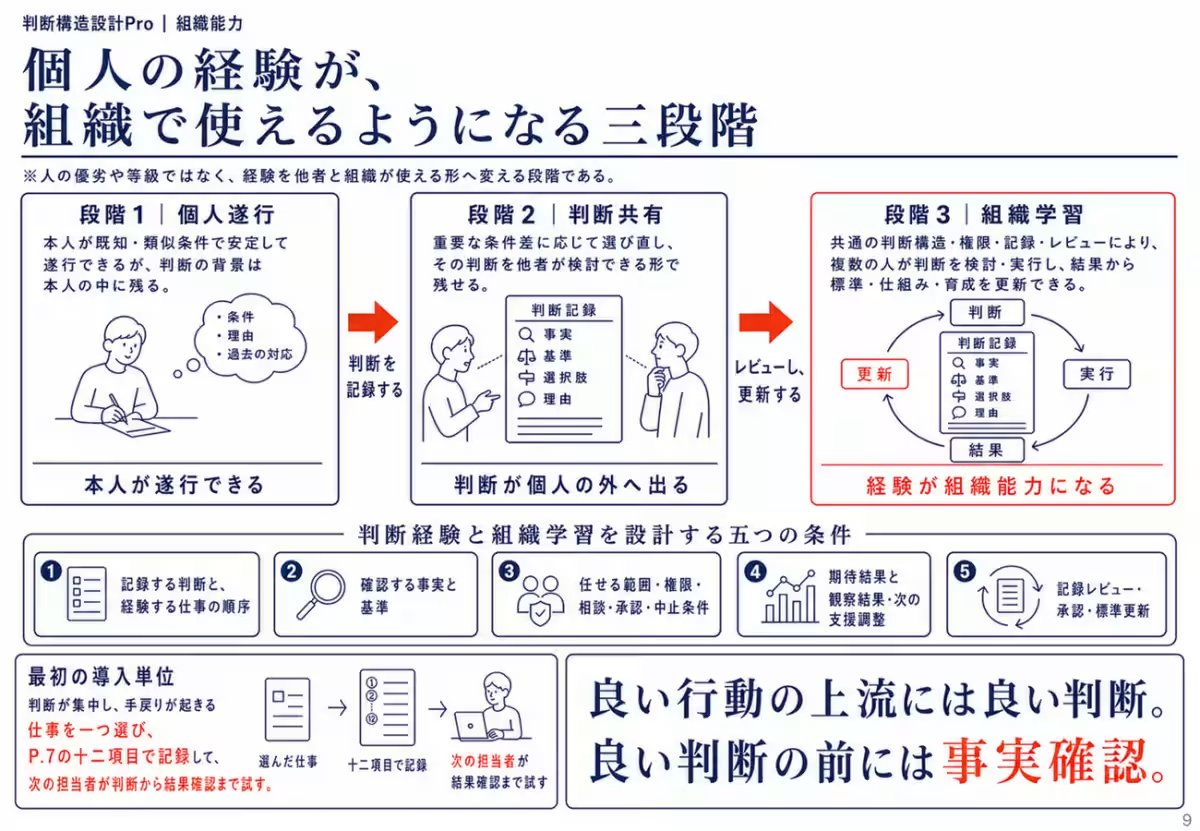
This release showcases four of the nine pages from the program, including the cover, background, practical knowledge, and organizational capability sections. For those interested in the complete nine-page version, a request can be made via email by providing their name and company information.
Transforming Personal Experience into Organizational Judgment
Organizations often possess unique judgments that only experienced individuals can make. However, when the rationale behind these judgments remains subjective and confined to the individual, it becomes challenging for organizations to replicate the same judgments if those individuals leave or if job conditions change.
The key is not just to preserve past answers but to document the following:
- The perceived issues
- The confirmed facts
- The conditions to maintain
- The options compared
- The reasoning behind selecting those methods
- The actual outcomes after implementation
- The applicability of previous judgments in future scenarios.
By preserving the relationships among these judgments, individual experiences can be transformed into organizational capabilities that can be shared, utilized, and verified by others. The foundational philosophy of Judgement Structure Design Pro is encapsulated in the notion that `good actions stem from good judgments, and good judgments are rooted in fact-checking`.
The Importance of Moving Beyond Personal Judgments
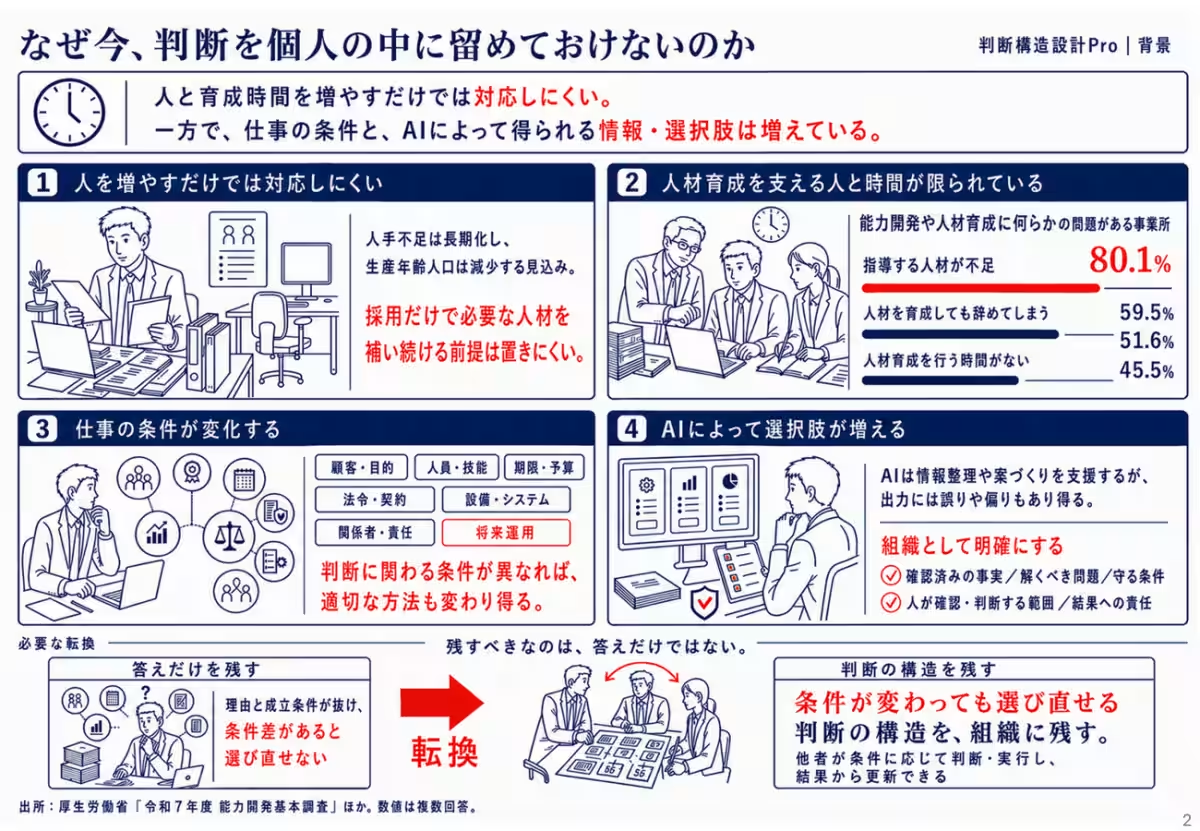
Currently, many organizations are grappling with a shortage of personnel and time necessary for effective human resource development. According to the Ministry of Health, Labour and Welfare’s `Basic Survey on Skill Development` from the seventh year of the Reiwa era, 80.1% of organizations reported having some issues concerning skill development and personnel management. The specific concerns included a lack of individuals able to mentor, resignations after training, and insufficient time allocated for development.
Simply increasing staff and training time is becoming an insufficient response to these growing challenges. Concurrently, various factors surrounding work—customers, objectives, skills, deadlines, budgets, laws, contracts, equipment, systems, stakeholders, responsibilities, and future operations—continue to evolve. Moreover, AI technologies are generating a flood of information and potential options, yet warnings arise that the AI outputs might contain inaccuracies or biases. Thus, organizations are expected to clarify the following points:
- What constitutes verified facts?
- What remains unverified and is treated as hypotheses?
- What is the problem that requires resolution?
- What criteria and comparison standards should be maintained?
- Which boundaries are set for human judgment?
- Who bears the responsibility for execution outcomes?
The necessity arises not from merely increasing past answers but from establishing a “structure of judgment” that organizations can maintain, allowing for adaptive re-evaluation despite changing circumstances.
The Role of Outcomes in Knowledge Creation
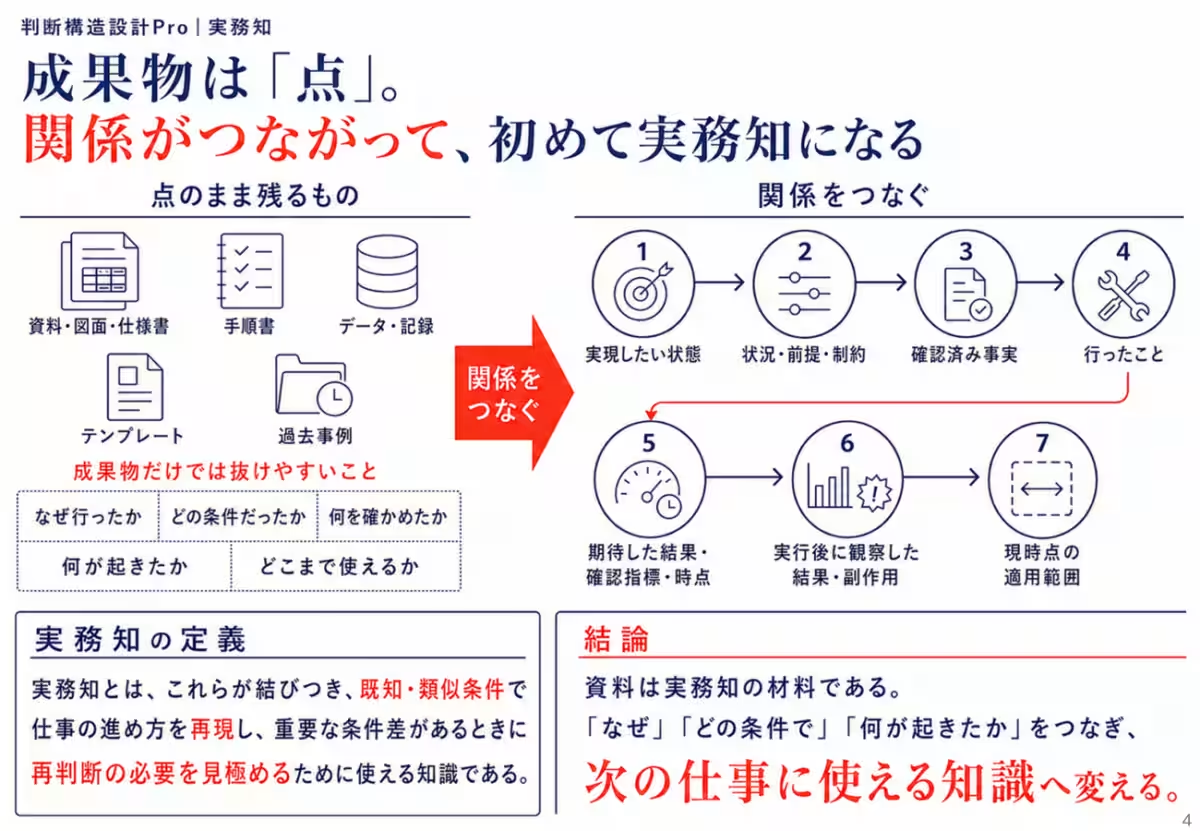
Organizations produce numerous artifacts such as documents, diagrams, specifications, procedure manuals, data, records, templates, and past cases. However, relying on these artifacts alone can often lead to gaps in understanding the following:
- Why a specific method was chosen
- The conditions under which the judgment was made
- The confirmations conducted before execution
- The results following execution
- Extent to which past methods can still be applied.
Judgement Structure Design Pro aims to connect these artifacts, linking seven key relationships:
1. Desired outcome
2. Situational context, assumptions, and constraints
3. Verified facts
4. Actions taken
5. Expected results, verification indicators, and timings
6. Observed outcomes and side effects post-execution
7. Current scope of applicability.
By connecting these elements, documents and records transform into practical knowledge, enabling the replication of work processes under known or similar conditions and assessing the need for re-evaluation when critical condition differences arise.
Balancing Standardization with Re-evaluation
Judgement Structure Design Pro does not advocate for selecting a different method for every job. Instead, it emphasizes the stabilization of standardized elements through procedures, mechanisms, systems, and automation. However, when deviating from previously established applications or when significant differences exist in maintained conditions, comparison priorities, authority, responsibilities, and expected outcomes, re-evaluation becomes necessary based on confirmed facts. This method differentiates between standardization supporting reproducibility and practical discretion addressing significant condition disparities, thereby enhancing both stability and adaptability for organizations.
Three Phases of Transforming Individual Experience into Organizational Capability
1. Personal Execution - Individuals can perform reliably under known and similar conditions, yet the background reasoning remains confined to them.
2. Shared Judgement - Decisions are recorded based on important condition differences, enabling others to verify and scrutinize the inherent conditions, facts, benchmarks, options, and reasons.
3. Organizational Learning - Multiple individuals use common judgement structures and records for examination and execution, updating standards, mechanisms, roles, and developmental content based on resulting findings.
This cyclical process transitions organizations from a state where experience is stored within individuals to one where collective judgment is learned and updated across the organization.
Proposed Use Cases for Judgement Structure Design Pro
Judgement Structure Design Pro can be beneficial in addressing several issues, such as:
- - Concentration of judgment among specific experts or managers
- - Changes in personnel leading to loss of understanding regarding prior judgment reasons or established conditions
- - Presence of procedure documents leading to inconsistencies due to varying on-site conditions
- - Accumulated past examples failing to guide decisions regarding similar conditions or applications
- - Transfer of deliverables that lack explanations for chosen methods
- - Unclarified responsibilities for verifying AI outputs and related standards
- - Results and side effects from execution being neglected in next judgments or standards.
Starting with Centralized Judgments and Revisitations
Initially, there is no need to document all organizational judgments at once. Instead, it’s advisable to begin with work where judgment tends to concentrate among specific individuals, and handbacks occur due to personnel or condition changes. Focus on one job, document one set of judgments using twelve criteria, and allow the next person to read the documentation, verifying issues through to execution outcomes. This practical usage will guide updates in record items, verification methods, approval scopes, and support strategies.
Access to the Complete Nine-Page Version of Judgement Structure Design Pro
In this release, we reveal four out of nine pages, including the cover, background, practical knowledge, and organizational capabilities. The comprehensive nine-page version, in addition to these four pages, encompasses:
- - Overall picture of Judgement Structure Design Pro
- - The intersection of recreation and re-evaluation in practical judgments
- - Three elements essential for establishing judgment validity
- - The eight procedures that conclude practical judgments through result-based updates
- - The twelve record items ensuring verifiability of others' experiences.
To access the full document, kindly email your company name and name to our designated address:
Email: [email protected]
Subject Line: Request for Judgement Structure Design Pro (Full Nine-Page Version)
Required Information: Company Name / Your Name.
About Judgement Structure Design Pro
The Judgement Structure Design Pro is designed to connect essential factors such as actual problems to be solved, judgment materials, conditions to maintain, options and justifications, authority and responsibilities, anticipated results and observational outcomes, applicability, and re-evaluation conditions. This ensures that others can appropriately recreate, re-evaluate, and verify these judgments based on contextual conditions. The aim is not to just solidify past answers but to bring the judgment processes out of individual confinement, allowing continuous updates based on outcomes.
About Organizational Behavior Science®
Organizational Behavior Science® seeks to elucidate the 'why' behind the thinking and actions of individuals in a workplace context by investigating business environments, history, and experiences to better enable their replication. Request Inc. bases its work on data from 980 companies and 338,000 working individuals, focusing on the research and educational development of adults in organizations.
Company Overview
- - Company Name: Request Inc.
- - Representative: CEO Tomoyasu Kohata
- - Location: 4F Keio Frente Shinjuku 3-4-8, Shinjuku, Tokyo 160-0022
- - Business Summary: Aiming for `better performance`, focusing on organizational behavior science derived from 980 companies and 338,000 workers.
- - Official Website: Request Group
- - Company Profile: Corporate Profile
- - Representative Profile: Profile



Topics Other)
【About Using Articles】
You can freely use the title and article content by linking to the page where the article is posted.
※ Images cannot be used.
【About Links】
Links are free to use.