



Hitachi and Toyota East Japan Team Up to Enhance Energy Management System for Automotive Factories
Introduction
Hitachi, Ltd. has recently partnered with Toyota Motor East Japan, Inc. to implement an enhanced Energy Management System (EMS) known as 'EMilia' at Toyota's Iwate plant in Kanegasaki, Iwate Prefecture. Set to begin operations in April 2026, this initiative aims to integrate advanced Physical AI technologies to optimize energy supply and demand management in automotive manufacturing.
Significance of EMilia
The collaborative endeavor focuses on achieving accurate power demand forecasting and real-time demand-supply control. This enhancement allows Toyota East Japan to utilize onsite and offsite renewable energy sources such as hydro, wind, and solar power. By optimizing the electricity supply-demand balance, the project contributes to stable operations and supports efforts towards a carbon-neutral society, particularly amid increasing renewable energy usage.
Addressing Energy Imbalance
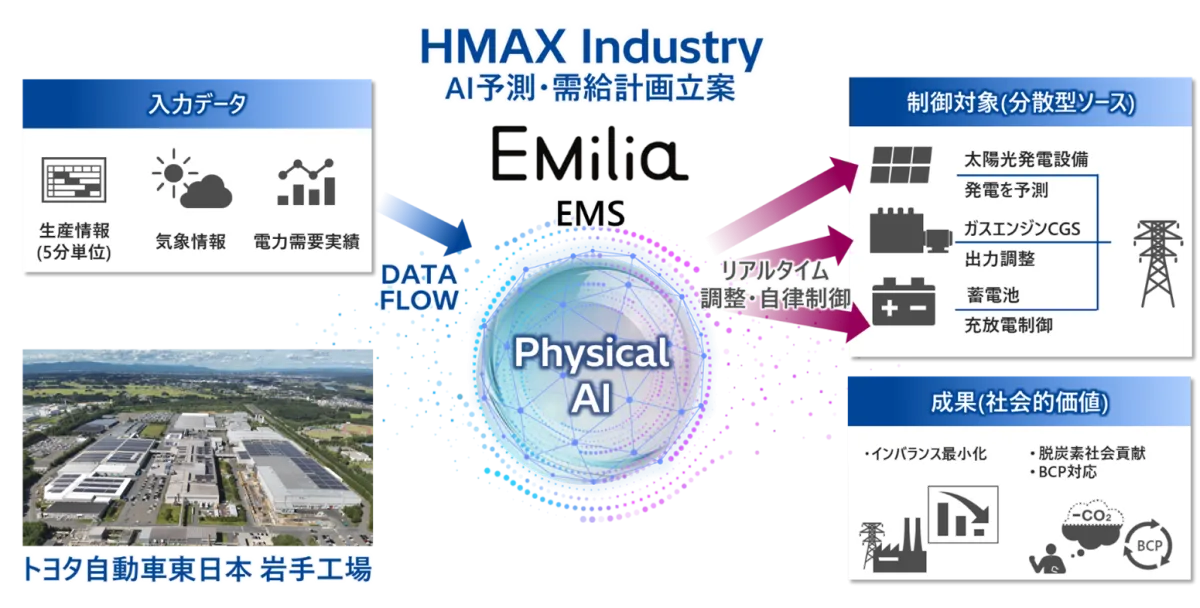
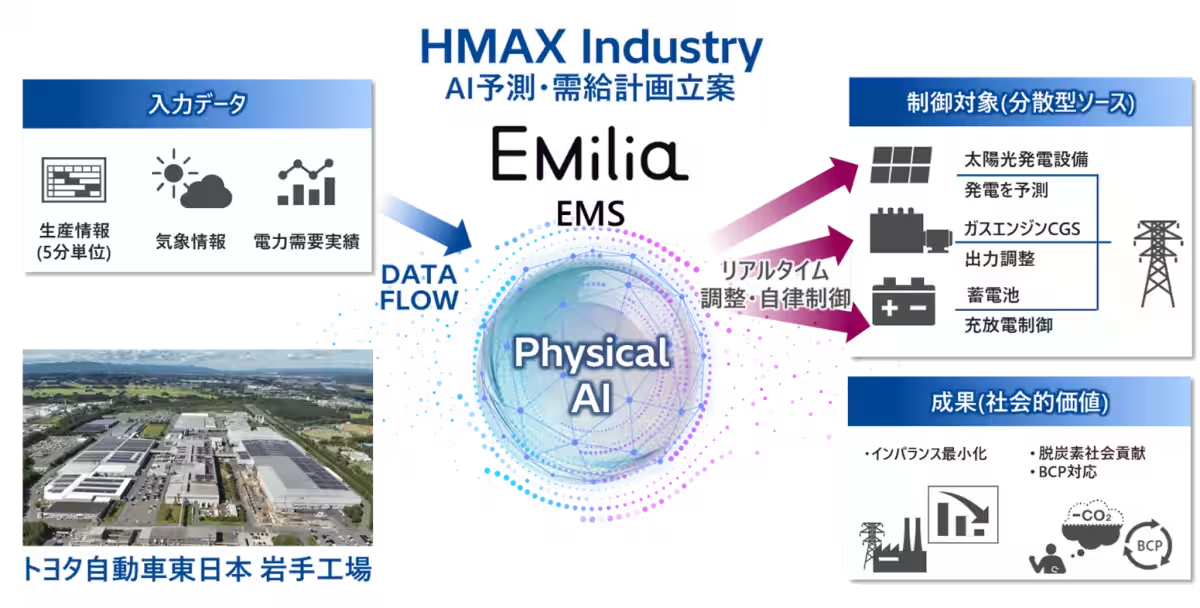
As the use of renewable energy expands, especially in factories, the ability to manage variations due to weather conditions is crucial. Traditional methods for balancing energy supply have relied heavily on the experience of skilled operators, which often results in inconsistencies in forecasting accuracy. To tackle these challenges, the integrated Energy and Equipment Management Service 'EMilia' employs Physical AI to understand various influencing factors including production data, weather information, and energy consumption records, enabling high-precision demand forecasting and automated planning for energy procurement from renewable sources.
The system continuously monitors real-time demand fluctuations to align operational statuses with planned electricity consumption. This proactive approach minimizes imbalances by autonomously controlling decentralized energy resources, ensuring efficient energy usage.
Enhancements for Disaster Resilience
In addition to managing energy balance, 'EMilia' incorporates battery charge management and autonomous controls that play a critical role during power outages, ensuring availability of emergency power and maintaining supply to nearby areas. This dual approach ensures that operations can adapt to supply-demand dynamics while preparing for unforeseen events.
Future Applications of EMilia
Hitachi envisions utilizing this initiative as a model for advanced energy optimization across various sectors, including data centers, manufacturing, distribution, office buildings, commercial facilities, and local microgrids. The charm of the 'HMAX Industry' solution lies in its premise of leveraging a wealth of installation data to combine advanced AI capabilities with domain knowledge, thus transforming industries globally.
Collaborative Development
Toyota East Japan has also initiated the 'Kanegasaki Resilience Grid,' aimed at enhancing local resilience and preventing power outages due to natural disasters. The project allows the factory to leverage locally generated renewable energy while transitioning to autonomous operation during outages, ensuring power supply for factory operations and community emergency responses. However, this ambitious plan faced challenges in maintaining supply-demand balance with fluctuating renewable energy usage.
To overcome these challenges, the 'EMilia' system was integrated as the core technology, ensuring high-level predictive controls crucial for maintaining supply-demand equilibrium while safeguarding battery reserves for emergencies.
Core Technology of EMilia
The unique characteristics of the 'EMilia' system arise from the combination of its advanced foundational technology and tailored expansions developed in collaboration with Toyota East Japan. The integration has led to an impressive imbalance rate of just around 1%, exemplifying the system's operational accuracy. The comprehensive features include:
1. High-Precision Demand Forecasting: Utilizing Physical AI to learn complex relationships such as temperature variations, the system can predict solar power generation while delivering precise electricity demand forecasts.
2. Strict Real-Time Autonomous Control: The system autonomously adjusts the output of co-generation systems and batteries without human intervention, ensuring safety by adhering to predefined operational limits while balancing current and planned energy levels.
3. Custom Functionality: Tailoring the system to incorporate Toyota’s specific production plans enhances accuracy in demand forecasting, while also optimizing control strategies based on unique operational rules and equipment specifications, further enhancing safety during real-time decision-making.
4. Emergency Power Resilience: The expansion ensures battery reserves are maintained, allowing for sustained power supply during emergencies and supporting neighborhood power distribution.
Conclusion
The 'EMilia' integrated energy management service exemplifies innovation in energy optimization for various sectors while addressing the pressing needs for decarbonization and energy resilience. With Hitachi’s commitment to developing advanced solutions, the partnership with Toyota demonstrates a forward-thinking approach towards a sustainable and technologically enabled industrial future.
For more details on 'EMilia', visit Hitachi's official page.
About Hitachi
Hitachi, Ltd. is dedicated to contributing to a harmonized society through its social innovation business, leveraging IT, operational technology, and products for a sustainable future. With a focus on digital systems, services, energy, and mobility, Hitachi aims to generate value from data to solve societal challenges. For detailed information, please visit Hitachi's global site.
Topics Energy)
【About Using Articles】
You can freely use the title and article content by linking to the page where the article is posted.
※ Images cannot be used.
【About Links】
Links are free to use.