



Innovative Non-Destructive System for Estimating Corrosion of Water Pipes to Begin Testing in Urban Areas
Innovative Approach to Water Pipe Maintenance
In Japan, the aging of water pipes buried underground has become a pressing societal issue, particularly within urban areas. More than 20% of these pipes have surpassed their expected lifespan, necessitating urgent replacement and repair efforts. A research team from the National Institute of Advanced Industrial Science and Technology (AIST) has developed a non-destructive system aimed at improving the estimation of corrosion levels in water pipes.
Understanding the Technology
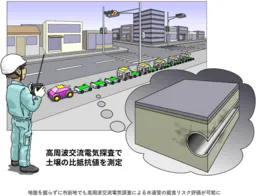
The new system employs high-frequency alternating electric current testing to rapidly and automatically measure the soil resistivity surrounding water pipes. The resistivity of soil is a critical factor that influences the rate at which pipes corrode. Traditionally, assessing this corrosion would involve extensive digging, a process that is time-consuming and labor-intensive. The innovative solution developed by AIST allows for the evaluation of corrosion risk while causing no damage to asphalt or concrete surfaces.
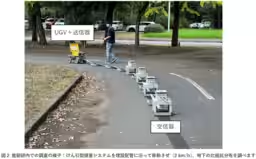
This enhanced electric surveying method has been further refined by integrating an Unmanned Ground Vehicle (UGV). This UGV is designed to swiftly assess wide areas of soil resistivity, leading to a more efficient evaluation of the corrosion risk posed to buried water pipes.
The Significance of the Trials
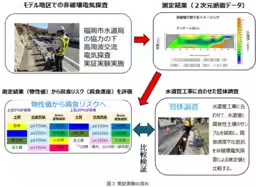
Starting on September 1, 2025, the team will conduct a pilot experiment in Fukuoka City. Their procedure will involve measuring soil resistivity at various depths where water pipes are laid and comparing their findings against actual corrosion levels determined during the concurrent replacement operations of the pipes. This comparison will help validate the accuracy of their preliminary estimations, allowing for a more precise assessment of future corrosion rates.
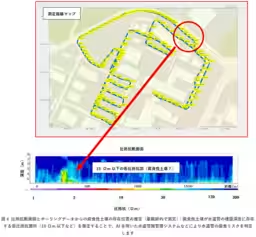
By mapping the results, the researchers aim to establish a prioritization system for updating existing pipelines, ultimately contributing to better water infrastructure management.
Background and Need
The corrosion of water pipes is not just a technical issue but a growing concern for public health. Many water pipes in Japan were laid during the rapid economic growth era, and as they reach the end of their service life, immediate action is essential. The corrosion process is influenced by factors such as the age of the pipe, the material used, and the surrounding soil conditions. Signs of accelerated corrosion are particularly evident in soils with low resistivity.
Although traditional methods rely on excavating individual pipes to assess their condition, such approaches are impractical on a large scale. Therefore, finding a reliable non-invasive method for evaluating the corrosion risk is critical.
Details of the Testing
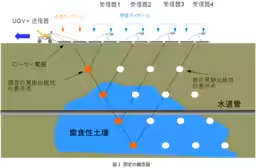
The non-destructive electric testing apparatus consists of a pair of transmitting and receiving dipoles. The transmitter emits high-frequency currents, and the receiver measures the electric potentials, allowing for an assessment of resistivity at varying underground depths. By enhancing this technology to enable multiple dipoles to function collectively, the system can cover broader areas more quickly than manual methods.
During the upcoming trials, the team will implement a series of investigations in selected areas, starting with the electrical survey of the soil to collect resistivity data. Following the non-destructive tests, a more in-depth analysis will occur using soil sampling and the inspection of the pipes as they are replaced.
The aim is to correlate the resistivity measurements with the actual conditions of the soil and pipes, thereby verifying the estimations. This innovative approach hopes to significantly reduce costs and time spent on repairs, enhancing the overall effectiveness of municipal water management.
Future Prospects
The collaboration with the Kubota Group, a partner in the research initiative, will allow the experiment's findings to be expanded to other municipalities. This replicability will help build a comprehensive dataset for water management systems incorporating AI technology. Over time, AIST plans to standardize the data formats based on this research, facilitating integration with existing systems for risk assessment.
By making this innovative technology publicly accessible and establishing guidelines for its use, AIST aims to enhance water infrastructure management practices across Japan, setting a new standard for the industry.
For additional insights, refer to the official press release.
Topics Consumer Technology)
【About Using Articles】
You can freely use the title and article content by linking to the page where the article is posted.
※ Images cannot be used.
【About Links】
Links are free to use.