



Okayama University Develops Innovative Cationization Technique for Protein Stability and Diagnosis
Overview
Okayama University, located in Okayama City, has made significant strides in the field of protein research with its innovative development of the S-cationization technique. This groundbreaking approach enables the solubilization and purification of inherently unstable and aggregation-prone natural denatured proteins, which have posed challenges in both basic research and clinical applications.
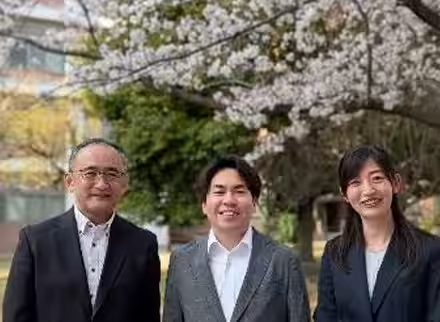
Research conducted by a team including Ph.D. student Ryui Sakaguchi, Assistant Professor Ai Miyamoto, and Professor Junichiro Futami, has shown that proteins, previously difficult to handle, can now be finely purified using this technique, paving the way for improved antibody generation and biomarker measurement accuracy.
Major Findings
The S-cationization method allows for the enhanced extraction of self-antigens from the blood. When these antigens are used for immunization in rabbits, high-quality antibodies are produced. These antibodies have demonstrated over 80% reproducibility and reliability in multiple self-antibody testing panels with a measurement error of below 20%. This indicates a significant step forward in clinical research applications.
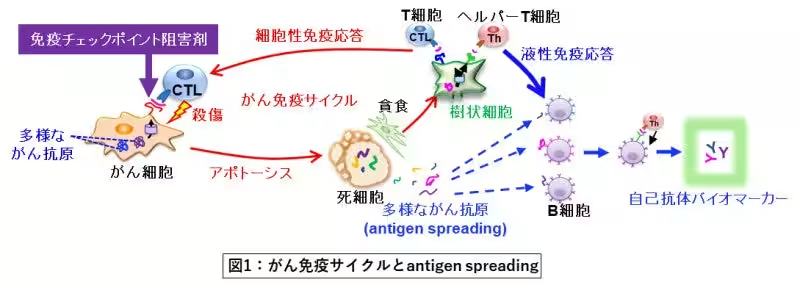
Self-antibodies are critical biomarkers in cancer and autoimmune disease research, as they provide insights into individual patient immune responses. Traditional methods have struggled due to the instability and aggregation of the designated self-antigens, many of which fall under the category of natural denatured proteins. The breakthrough achieved by Okayama University’s research group offers a robust research tool to tackle the complexities surrounding these proteins.
Future Applications
In addition to providing critical insights into cancer and autoimmune disorders, the S-cationization technique is expected to accelerate the development of next-generation diagnostic tools. By addressing the issues of protein denaturation and aggregation, this method can greatly enhance biomarker measurement precision. It positions itself as a foundational technology with the potential to contribute extensively to both fundamental research and diagnostic drug development.
The groundbreaking research findings have been published in the prestigious journal Bioconjugate Chemistry on March 4, 2026. Researchers emphasize the urgency of resolving the protein aggregation issue as it remains a substantial challenge in both research and industrial use.
Professor Futami highlights, “The stability and functionality of proteins are paramount for innovative healthcare solutions. Our technique is set to facilitate the accuracy of personalized medicine, thereby making significant contributions to improving patient outcomes.”
Conclusion
Overall, the S-cationization technology embodies a promising advancement in protein science, potentially transforming the landscape of biomarker quantification and temperature stability in the biomedical field. Ongoing support for this research includes funding from the Japan Society for the Promotion of Science (JSPS) and various academic grants focused on health systems science. The implications of this work could resonate far beyond basic research, potentially leading to breakthroughs in therapeutic strategies and personalized medical approaches.
For detailed information about the study and the S-cationization technique, please visit Okayama University's official press release.
Topics Health)



【About Using Articles】
You can freely use the title and article content by linking to the page where the article is posted.
※ Images cannot be used.
【About Links】
Links are free to use.