



Revolutionary Observation Method Unveils Real-time Processes Inside Batteries
Revolutionary Observation Method Unveils Real-time Processes Inside Batteries
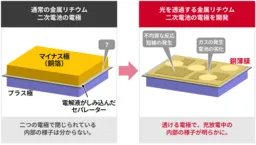
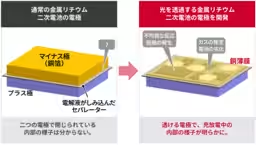
The intricate world within a battery has long been a mystery, shrouded behind opaque materials that prevent direct observation of its internal workings. However, researchers at the National Institute of Advanced Industrial Science and Technology (AIST) have developed a groundbreaking technique that enables real-time visualization of the electrochemical reactions occurring within operating batteries. This innovation not only enhances our understanding of battery performance but also contributes to the advancement of next-generation lithium metal batteries.
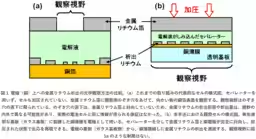
In typical batteries, the internal structure comprises two electrodes and a separator, which are made from materials that do not allow visible light to pass through. As a result, direct observation of the internal processes while a battery is discharging or charging has been virtually impossible. This limitation hampers the development of high-performance batteries, particularly lithium metal batteries, which promise increased energy density and efficiency.
The AIST research team, led by Senior Researcher Akihiro Kitta, along with Senior Researchers Hikaru Sano and Yuta Maeyoshi, has successfully created electrodes thin enough to allow visible light to pass through, thus permitting observation of charge-discharge reactions directly inside the battery cells. By utilizing ultra-thin copper films about 10 nanometers thick—equivalent to 1/10,000th the thickness of standard copy paper—the researchers can now view processes occurring on the electrode surfaces without disassembling the battery.
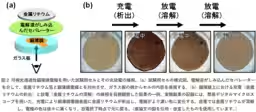
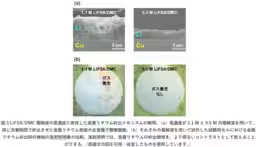
In experiments conducted with this innovative approach, gas evolution from the electrolyte decomposition during charging can be clearly monitored. The team discovered that during the charging process, gas bubbles form at the interface of the separator and the electrode, significantly influencing the overall performance of the battery. Additionally, the researchers observed uneven deposition of lithium metal on the electrode surface, which can lead to short-circuiting issues—an important safety consideration for battery design.
The implications of this research are profound, especially for the emerging field of high-energy-density batteries. Understanding the mechanisms of lithium metal deposition and dissolution is essential for improving the cycle stability and reliability of batteries. By visualizing these processes in real time, researchers can devise strategies to mitigate degradation and enhance battery performance.
This research has been published in the journal Electrochemistry Communications, marking a pivotal step towards the realization of safer and more efficient lithium metal batteries. The findings are critical, especially as industries increasingly demand batteries that can store more energy in smaller formats, setting the stage for advances in electric vehicles and portable electronics.
The necessity for improved rechargeable batteries has drawn significant attention globally. Current lithium-ion batteries, while prevalent, face limitations regarding energy capacity and longevity. Metal lithium batteries offer a promising alternative, capable of storing substantially more energy. However, challenges such as lithium plating and dendrite formation can lead to safety risks, including thermal runaway and battery failure.
Previous studies at AIST had focused on using optical microscopy to observe lithium metal behavior on electrode surfaces. However, those methods required specially designed battery cells, complicating the observations. In contrast, this new development allows for real-time monitoring within standard, pressurized battery environments, thus bringing laboratory results closer to practical applications.
Through the application of advanced copper thin films and the exploration of various electrolyte chemistries, the research team is now initiating a comprehensive examination of next-generation electrolytes. Their findings reveal how electrolyte composition can impact lithium deposition patterns—crucial information for optimizing battery designs moving forward.
As the battery industry evolves, this visualization technique also holds potential for broader applications. It may aid in unraveling complex phenomena in various electrochemical systems beyond lithium metal batteries, including traditional lithium-ion systems and future innovations like hydrogen fuel cells and solar cells.
In conclusion, the progress made by the AIST team demonstrates how innovative thinking can open new vistas in battery research. By directly observing the dynamic processes within batteries, scientists can better understand and ultimately enhance their performance—a key stride towards more sustainable and efficient energy storage solutions.
For further details on this remarkable study, readers can refer to the published paper in Electrochemistry Communications or the official AIST press release.
Topics Consumer Technology)
【About Using Articles】
You can freely use the title and article content by linking to the page where the article is posted.
※ Images cannot be used.
【About Links】
Links are free to use.