



Kyocera and Taiwan Plastic Group Sign Agreement for Energy Management System Development
Kyocera and Taiwan Plastic Group Forge Alliance for Energy Management Development
In a significant move towards sustainability, Kyocera Corporation and Taiwan's Formosa Group have entered into a partnership agreement aimed at establishing a new framework for developing Energy Management Systems (EMS). This agreement, signed by Osaki Electric Industry Co., Ltd., Formosa Smart Energy Tech Co., Ltd. (FSETC), Formosa Plastic Japan New Energy Co., Ltd. (FBEC), and Kyocera, signifies a collective effort to streamline and enhance energy management for companies in Japan. The ultimate goal is to finalize the contract by the end of December 2026.
Background of the Collaboration
As businesses increasingly move towards decarbonization, there is a noticeable uptick in the adoption of renewable energy sources, particularly solar power. However, users of renewable energy face challenges such as higher electricity costs compared to fossil fuel-derived power and an instability in power supply that can be influenced by weather and other installation conditions. To tackle these issues, the joint effort involving Osaki Electric, FSETC, and FBEC aims to create a comprehensive service that employs artificial intelligence (AI) to control both the EMS and battery systems in unison. This service has been named SmaRe:C.
SmaRe:C leverages AI to optimize electricity costs and boost the utilization rate of renewable energy. The batteries used in the SmaRe:C service are developed by FSETC and sold in Japan by FBEC. Additionally, Osaki Electric’s proprietary edge AI device, the Aiel Master, is integrated into the battery systems.
Previously, in April 2025, Osaki Electric, FSETC, and FBEC had already signed a partnership agreement to build a collaborative framework for the development, manufacture, and support of the SmaRe:C service. The newly signed agreement with Kyocera will allow the provision of solar power from Kyocera's facilities for the SmaRe:C service.
Overview of the Agreement
The agreement aims to create new value in the energy market through collaborative efforts towards the development of the SmaRe:C initiative. The focus is on confirming the mutual intent to cooperate among all parties involved, paving the way for further discussions leading to a definitive contract by the end of December 2026.
Stakeholders Involved
- - FSETC: Responsible for manufacturing the batteries used in the SmaRe:C service, specializing in lithium iron phosphate cells and modules for electric vehicles and energy storage systems.
- - FBEC: Handles the sales of the batteries tailored for the SmaRe:C service, focusing on providing residential and industrial energy storage systems in Japan.
- - Kyocera: Supplies the solar power needed for the SmaRe:C initiative, known for its wide range of manufacturing including components for industries, semiconductors, and communication devices.
Introduction to SmaRe:C
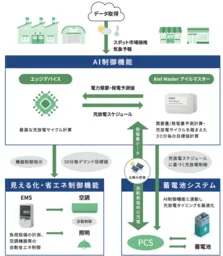
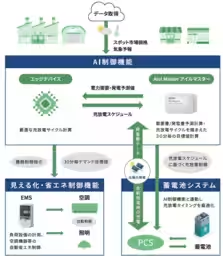
SmaRe:C is an innovative service that utilizes AI and battery storage to refine electricity costs while maximizing the utilization rates of renewable energy sources. By incorporating an edge AI device alongside the EMS, battery storage, and power conditioners, SmaRe:C aims to control the generation rates of solar power, adjust to the spot market electricity prices, and manage battery charge and discharge cycles with precision. This comprehensive control mechanism facilitates the optimal procurement of renewable energy resources while ensuring cost-effectiveness.
System Configuration & Features of SmaRe:C
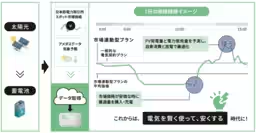
The system for SmaRe:C utilizes a combination of generated solar power, spot market prices, and weather forecasts to intelligently manage the battery charge and discharge cycles through edge AI technology. This approach not only allows for smarter energy storage but also enhances the timing of electricity usage to minimize costs. Its notable features include:
1. Cost-Effective Electricity Procurement: AI-driven edge control enables purchasing electricity at lower prices through market-related plans, reducing expenses during peak pricing periods.
2. Optimal Charge and Discharge Control: The system ensures that electricity bought at lower costs is stored in the batteries, while predicting usage patterns to discharge energy at the most advantageous times.
3. High-Quality Batteries from Taiwan: The batteries used in this system come from a manufacturer recognized for its quality, ensuring that the entire production process from raw materials through to battery systems is carried out in-house by Taiwan Plastic Group, a conglomerate established in 1954.
With these advancements, SmaRe:C not only represents a significant leap towards efficient energy management but also plays a crucial role in the broader shift towards sustainable energy practices.
Company Overview
For those interested in implementing SmaRe:C, inquiries can be directed through the SmaRe:C dedicated site.
Visit SmaRe:C Contact Page
Topics Consumer Technology)
【About Using Articles】
You can freely use the title and article content by linking to the page where the article is posted.
※ Images cannot be used.
【About Links】
Links are free to use.