




The Shift in Managerial Roles in the Age of AI: Redefining Decision-Making Opportunities
The Shift in Managerial Roles in the Age of AI: Redefining Decision-Making Opportunities
In today’s rapidly evolving corporate landscape, particularly influenced by artificial intelligence (AI), the roles of management are undergoing significant transformations. A study conducted by Request Inc., which focuses on organizational behavior science, has revealed alarming trends: decision-making experiences among employees are diminishing. This article delves into the causes, implications, and necessary adjustments that managers must make to foster an environment conducive to growth and effective decision-making.
The Decline of Decision-Making Experiences
According to recent findings, a staggering 82% of companies surveyed have reported a decrease in decision-making experiences within their workforce. The analysis is based on data from over 33.8 million personnel experiences across 980 different companies, monitored between 2022 and 2025. With such a substantial proportion of organizations confirming that their employees have fewer opportunities to exercise judgment, one can only question the implications of this shift on future business operations and employee development.
The Impact of AI on Job Roles
The surge of generative AI tools is drastically altering traditional job functions. Tasks previously requiring human judgment and discretion—such as document drafting, data analysis, and customer interaction—are being increasingly automated. The trend toward standardization, process-driven work, and the integration of advanced IT solutions has created a work environment where following established protocols is prioritized over independent thought and decision-making.
The Managerial Perception
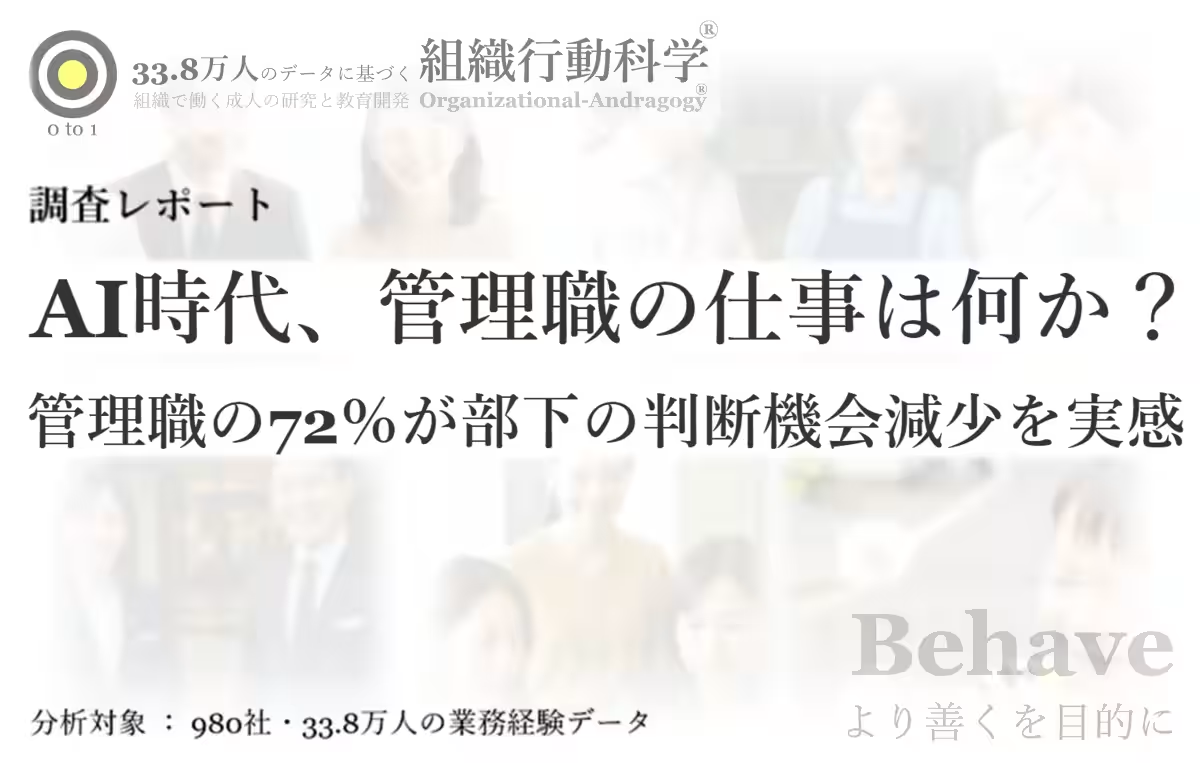
The research also uncovered that 72% of managers themselves feel that their subordinates are receiving fewer opportunities to make decisions. This sentiment highlights a crucial concern: as efficiency increases, there is a concurrent reduction in experiences that hone critical judgment skills. While the operational side benefits from streamlined processes, there is a growing scarcity of personal experiences that employees can learn from, leading to a workforce potentially ill-equipped for the complexities of modern business challenges.
Why is Judgment Experience Diminishing?
The bulk of this transformation can be traced back to several interrelated factors. As businesses strive for efficiency—propelled by the adoption of AI and related technologies—the nature of jobs has shifted dramatically. Activities that once required situational assessment and nuanced decision-making can now often be reduced to rote tasks or processes that can easily be automated.
The Challenge for Managers
With the increasing reliance on technology for day-to-day tasks, employees may find themselves missing out on vital judgment experiences crucial for their professional development. While AI efficiently handles data and provides insights, it cannot replace the unique human ability to assess risks, set priorities, and make nuanced decisions based on situational context. This presents a challenge for managers, who must balance the benefits of technological assistance with the need for experiential learning.
The Future: Designing Decision-Making Opportunities
Going forward, the role of managers must evolve from being mere leaders who dictate actions to becoming facilitators of decision-making experiences. The ability to design roles and projects that encourage discerning judgment is essential in cultivating future leaders equipped to navigate complex, ambiguous situations. In the AI era, it is imperative that management teams intentionally integrate opportunities for employees to engage in decision-making processes, thereby enriching their practical experiences.
Emphasizing Quality over Quantity in Decision-Making
In an era marked by swift technological advancement, the qualities that will drive corporate success involve not only technical expertise but, crucially, the capacity for sound judgment. Managers should embrace this paradigm shift, shifting their focus towards empowering their teams to prioritize and assess risk judiciously, leading to higher-quality decision-making within organizations.
Conclusion
The rise of AI and automation in the workplace signifies a pivotal moment in the evolution of managerial responsibilities. As data from Request Inc. indicates, the onus is on leaders to cultivate environments rich in decision-making opportunities. Evolving from traditional roles to become architects of experiential learning is critical not just for individual employee growth but for maintaining competitive advantage in the 21st-century marketplace.
As we progress deeper into the AI era, it is not merely information and knowledge that will define effective leadership, but the capability to nurture decision-makers who can thrive amidst automation's unwavering tide. The call to action for all managers is clear: prioritize judgment experience, adapt to the changing landscape, and invest in the future of work in a world where effective decision-making will remain paramount.

Topics Business Technology)
【About Using Articles】
You can freely use the title and article content by linking to the page where the article is posted.
※ Images cannot be used.
【About Links】
Links are free to use.