


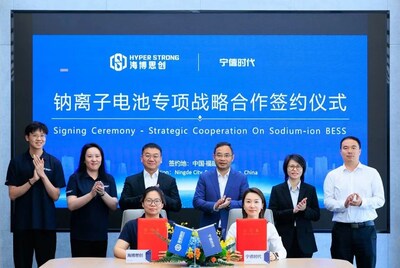

CATL and HyperStrong Enter Historic Partnership for Sodium-Ion Battery Production
CATL and HyperStrong: A Game-Changing Partnership for Sodium-Ion Batteries
On April 27, 2026, CATL and HyperStrong made headlines by signing a monumental strategic cooperation agreement concerning sodium-ion batteries, marking a significant milestone in global energy storage technology. The agreement, which took place in Ningde, Fujian, encompasses a commitment to supply 60 GWh of sodium-ion batteries over the next three years. This collaboration highlights the accelerating development of sodium-ion technology as a promising alternative to traditional lithium-ion systems.
The Importance of Sodium-Ion Technology
Sodium-ion batteries are increasingly recognized for their potential to streamline energy storage, particularly in renewable resources. Unlike lithium, sodium is abundant and less expensive, making it an attractive material for large-scale battery production. Furthermore, sodium-ion batteries exhibit admirable thermal stability and longevity at elevated temperatures, reducing risks often associated with other battery types.
For CATL, this agreement represents not only a significant leap in their production capabilities but also an extension of their leadership in energy storage solutions. By fully harnessing sodium technology, CATL aims to bolster its supply chain efficiency and environmental sustainability—central to modern energy demands.
Enhancing Energy Density through Innovation
One of the standout features of CATL's sodium-ion batteries is their enhanced energy density, achieved through meticulous control of battery morphology and surface modification. By overcoming challenges in mass production, like foam formation in hard carbon production lines and humidity management, CATL enhances not just the quality but also the scalability of sodium-ion batteries. This approach ensures a consistent product while maintaining competitiveness in the rapidly growing energy storage market.
Additionally, the integration of advanced production technologies—such as angstrom-scale pore size control and dynamic adaptive formation—has positioned CATL at the forefront of battery manufacturing innovation. These innovations are crucial in establishing a robust framework for continuous energy supply, critical for large-scale renewable energy applications.
Strategic Implications of the Partnership
As the largest sodium-ion supply agreement globally, the CATL and HyperStrong cooperation sets a precedent for future developments in energy storage solutions. This partnership not only emphasizes their strategic focus but also represents a significant commitment to energy transition worldwide. Both companies aim to work collaboratively in research, product applications, and project implementation to enhance the quality and capability of sodium-ion technologies.
Moreover, the synergy between CATL and HyperStrong enables precision adaptation to meet various industry demands, effectively reducing application costs and expediting the timeline from product development to deployment in energy systems globally.
A Sustainable Future with Sodium-Ion Batteries
With its sodium-ion technology coinciding perfectly with contemporary energy storage needs, CATL's initiative serves as a blueprint for future energy solutions. The collaboration is expected to pave the way for integrating these batteries into various applications, ultimately contributing to lower energy losses and improved economic performance across installations. This positions the battery technology within a framework that supports international energy transitions, addressing both sustainability and efficiency.
In conclusion, CATL and HyperStrong's partnership marks a decisive step forward in advancing sodium-ion battery technology. It signifies the onset of a promising era for scalable, efficient, and environmentally friendly energy storage systems that can transform how we utilize renewable energy.
Photo: View Image
Topics Energy)
【About Using Articles】
You can freely use the title and article content by linking to the page where the article is posted.
※ Images cannot be used.
【About Links】
Links are free to use.