



Innovative Clothing Harnessing Body Heat Offers Hope to Off-Grid Communities
Harnessing Body Heat for Electricity: A Revolutionary Clothing Innovation
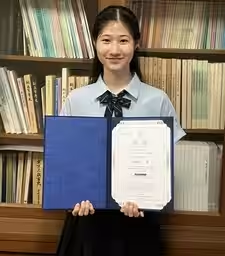
In an era where sustainable solutions are crucial, a groundbreaking concept has emerged from the creative minds of students at Tsukuba University Affiliated High School. Their research, which received the prestigious Asahi Kogyo WakuWaku Future Award at the WakuWaku Research Expo 2026, revolves around clothing designed to generate electricity using body heat. This innovative initiative holds promise for off-grid regions lacking stable electricity access, potentially impacting the lives of around 600 million people worldwide.
The WakuWaku Research Expo, organized by Tomonokai, serves as a national platform for junior high school and high school students across Japan to showcase their exploratory research projects. The goal of the Expo is not only to foster curiosity and creativity among students but also to encourage solutions for pressing societal challenges.
Exploring the Concept
The award-winning research, led by Niko Fukushima, centers on addressing the challenges faced by off-grid areas. The central theme is to devise clothing that can solve energy supply shortages through body heat conversion. Utilizing Peltier elements, which can generate electricity from temperature differences, the project investigates various configurations and conditions under which the clothing can maximize energy output.
Fukushima's team embarked on two primary studies: the first focused on measuring the electricity generated by incorporating Peltier elements into garments. By testing different configurations, such as wear time and the placement of elements on the body, they gathered data on electricity output. They recorded variations in generation based on body heat, environmental conditions, and the effectiveness of specific garment areas, such as the back and armpits, which maintained significant temperature differentials regardless of external weather changes.
The second aspect of the research delved into optimizing energy production beyond just temperature differentials. This included innovative approaches such as sweat generation and *friction-based energy. By merging three different methods—temperature differences, sweat from the body, and mechanical friction—the researchers provided a detailed analysis of the potential energy outputs that could be achieved. The simulations included considerations of seasonal variations and human activity levels, emphasizing the feasibility of integrating this technology into everyday life.
Impact on Off-Grid Communities
The freshness of Fukushima's approach stands out, especially as it paves the way for practical solutions to long-standing energy access issues. The research showcases a significant step towards practical applications that could serve communities living without reliable sources of electricity. The implications of a clothing item that can generate its power through human activity and temperature regulation are profound, providing not just a means of comfort but a sustainable source of energy.
As the Asahi Kogyo Group, we firmly believe in a future where creativity and innovation merge to tackle environmental challenges. Our long-term vision, ASAHI-VISION 2050, emphasizes the importance of nurturing such imaginative solutions. We are dedicated to supporting student-led research that addresses environmental issues and societal challenges, ensuring a brighter, more sustainable future.
In conclusion, Niko Fukushima's research is an inspiring testament to the potential of youth-led innovations. Recognizing the intersection of science, creativity, and social responsibility, the exploration of body heat-powered clothing serves not only as a scientific endeavor but as a beacon of hope for millions living without electricity.
Congratulations to Niko Fukushima and her team for their remarkable work! Explore more about their research at this link.
About Asahi Kogyo
Founded in 1925, Asahi Kogyo is committed to creating optimal spaces through advanced technologies based on the science of air, water, and heat. Engaged in equipment installation and manufacturing businesses, we work tirelessly toward designing comfortable environments across various industries, such as semiconductor manufacturing and precision environmental control systems.


Topics Consumer Products & Retail)




【About Using Articles】
You can freely use the title and article content by linking to the page where the article is posted.
※ Images cannot be used.
【About Links】
Links are free to use.