



Introduction of a New Heat-Evolved Gas Analysis Service with Humidity and Oxygen Control
Introduction
The Toray Research Center (TRC) has recently unveiled an innovative analytical service capable of simultaneously controlling humidity and oxygen levels for heat-evolved gas analysis, known as TPD-MS (Temperature Programmed Desorption Mass Spectrometry). This advanced offering addresses critical challenges in the field of materials science, where understanding gas emissions during heating is vital for assessing product safety and performance.
Importance of Humidity and Oxygen Control
The behavior of gases released during heating is significantly influenced not only by temperature but also by environmental conditions like humidity and oxygen concentration. Historically, accurately controlling these variables concurrently has presented technological challenges, particularly due to the destabilizing effect of humidity on mass spectrometry detection stability and the complexities of reaction control in the presence of oxygen.
TRC's proprietary atmosphere control technology bridges these gaps by integrating precise control mechanisms into the TPD-MS system. This integration enables reliable analysis under conditions that mimic actual use environments, including atmospheric pressure.
Applications and Benefits
The rollout of this service offers vital insights into the types of trace gases emitted at high temperatures, along with critical temperature ranges. This capability allows for early detection of material degradation and assists in estimating potential risks to human health and surrounding environments. This analysis is especially beneficial in the field of energy storage materials, where degradation behaviors and gas emissions can vary significantly with temperature and environmental conditions—including humidity and oxygen. Understanding these dynamics is essential for mitigating safety risks associated with material breakdown during charging and discharging processes.
Adapting this technology across various material fields such as electronic components, composites, resins, and adhesives will not only enhance safety design during selection and development phases but also lead to more efficient evaluation timelines.
Background and Context
As materials continue to evolve toward high functionality and added value, the impact of heat during manufacturing processes and usage becomes increasingly pivotal to product safety and reliability. The gases released during heating can pose risks not just to the integrity of the materials themselves but also to adjacent components and end-users alike. Thus, accurately evaluating emitted gases is essential for effective risk avoidance and safety assurance.
Technical Innovations and Analytical Examples
TRC has developed unique atmosphere control technologies optimized for humidity control, oxygen supply, and sample introduction conditions. By embedding this technology within the TPD-MS system, TRC can now facilitate simultaneous control of both humidity and oxygen levels during gas analysis.
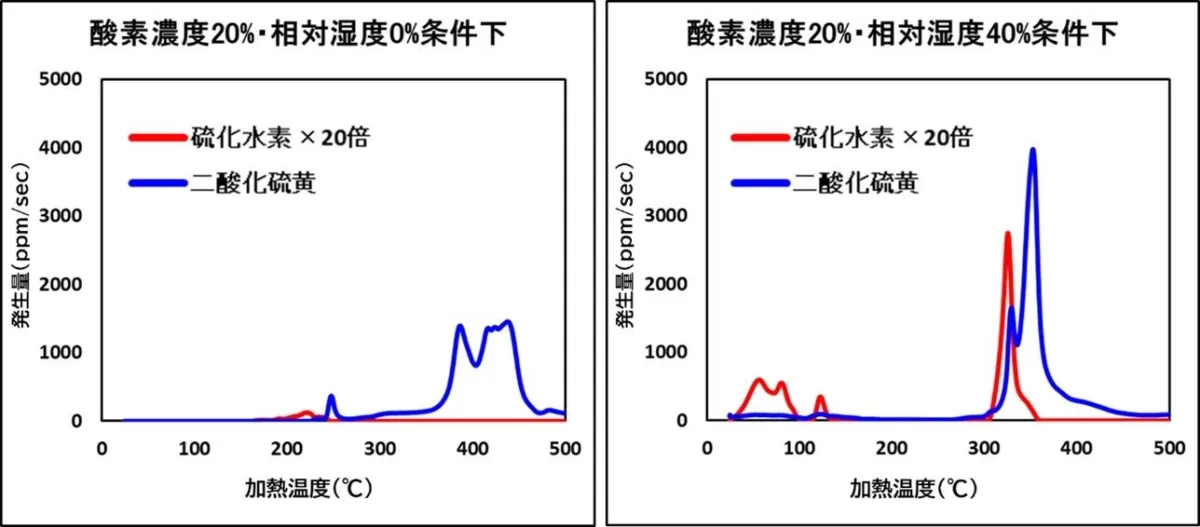
One notable example illustrating the efficacy of this technology involves analyzing sulfide-based electrolytes for all-solid-state batteries. When examining the emission behavior under 20% oxygen concentration, comparisons were made between relative humidity levels of 0% (dry conditions) and approximately 40%. The results indicated detectable releases of hydrogen sulfide at low temperatures (room temperature to about 200℃), emphasizing potential environmental and health risks. Furthermore, distinct atmospheric dependencies were observed in the behavior of high-temperature decomposition gases, further confirming the technology's role in elucidating material degradation processes.
Figure illustrating gas emission behaviors under different humidity conditions.
Future Prospects
The analytical service provided by TRC has extensive applications beyond energy storage materials, encompassing a wide range of fields such as electronic materials, polymers, composites, and adhesives. Leveraging years of expertise in heat-evolved gas analysis, TRC aims to propose optimal testing conditions tailored to specific needs, thereby facilitating the development and resolution of technical challenges associated with advanced materials.
Conclusion
The introduction of this service represents a significant advancement in material safety assessment and risk management related to gas emissions during heating. As industries increasingly prioritize safety and performance, TRC's innovative analysis capabilities will play a crucial role in the responsible development of next-generation materials.
Topics Consumer Products & Retail)
【About Using Articles】
You can freely use the title and article content by linking to the page where the article is posted.
※ Images cannot be used.
【About Links】
Links are free to use.