




Revolutionary CMOS Circuit for Quantum Computing at Cryogenic Temperatures
Development of a CMOS Circuit for Microwave Signals in Quantum Computers
Researchers from the National Institute of Advanced Industrial Science and Technology, led by senior researcher Hiroshi Fuketa, have unveiled an innovative silicon CMOS integrated circuit designed to selectively extract the necessary microwave signals for controlling quantum bits in cryogenic environments. This groundbreaking technology addresses crucial challenges in quantum computing by significantly enhancing wiring efficiency and reducing heat generation within cryogenic systems, thereby contributing to the scalability of quantum computers.
The Need for Quantum Scalability
With the demanding forecasts suggesting that practical quantum computers may require over a million quantum bits (qubits), the effective control of these qubits is paramount. Each qubit must be cooled to near absolute zero and controlled using individual microwave signals. As the number of qubits increases, so too does the complexity of managing the accompanying microwave transmission cables. This escalation leads to problems concerning space management and the introduction of heat into the cryogenic environment, hindering the functionality of the quantum computer.
Innovations in Cryogenics
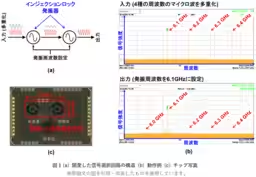
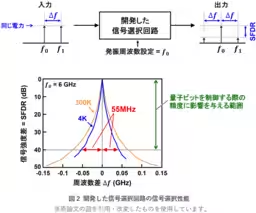
In this latest research, the team utilized a technology referred to as CryoCMOS, which leverages standard CMOS semiconductor manufacturing processes to create highly efficient and low-cost solutions for operating integrated circuits at cryogenic temperatures. Instead of relying on multiple cables to transmit microwave signals from room temperature to the cryogenic environment, this new method enables the generation of multiple qubit control microwave signals at room temperature that are then multiplexed into a single cable. This allows for the selective extraction of the desired frequencies within the cryogenic system.
Testing showed that the new signal selection CMOS integrated circuit could reduce the necessary number of cables for microwave transmission to just one-eighteenth of previous methods, cutting down dramatically on the potential for heat influx and maintaining optimal temperatures within the cryogenic chamber. In addition, this system consumes only 0.25 mW per qubit, which is thirty times less power than conventional methods that generate microwave signals inside the refrigerator.
Production Capabilities and Future Prospects
The CryoCMOS technology is exceptionally promising, as it can be mass-produced using standard CMOS processes, making it viable for widespread application and commercialization. The advances brought by this research are expected to lay down a vital foundation for the successful scaling of quantum computers, which historically has been limited by wiring constraints.
Furthermore, the findings from this work will be presented at the IEEE Symposium on VLSI Technology and Circuits, contributing to the growing body of knowledge around quantum computing technologies.
Conclusion
The proposed innovations in CMOS technology not only address significant practical challenges but also mark a considerable leap forward in the field of quantum computing. As this technology progresses from development to real-world application, we can expect substantial advancements in the operational capabilities of quantum computers, potentially redefining computational limits.
To explore further details regarding this revolutionary technology, visit the official press release here.

Topics Consumer Technology)
【About Using Articles】
You can freely use the title and article content by linking to the page where the article is posted.
※ Images cannot be used.
【About Links】
Links are free to use.