



Perovskite Solar Cells Proven to Endure Japan's Summer Heat Successfully
Key Breakthrough for Perovskite Solar Technology
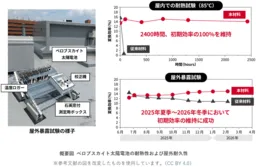
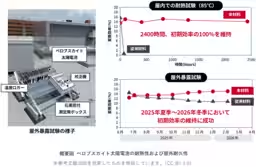
The Renewable Energy Research Center of the National Institute of Advanced Industrial Science and Technology (AIST), led by Senior Researcher Hiroyuki Kanda and Team Leader Takuro Murakami, has made significant strides in enhancing the thermal stability and outdoor durability of perovskite solar cells. Utilizing commercially available organic materials like 2-phenylpyridine and 3-phenylpyridine, the research team successfully demonstrated that the integration of these substances into the hole transport layer resulted in the maintenance of initial conversion efficiency even under prolonged exposure to outdoor conditions, from the summer of 2025 to the winter of 2026.
Research Insights
During the heat resistance test, samples maintained a perfect 100% efficiency even after 2400 hours at an elevated temperature of 85°C. This breakthrough is crucial as it addresses one of the major challenges facing perovskite solar cells: deterioration under high-temperature conditions that can reach over 70°C in summer. The typical degradation mechanism involves the breakdown of the hole transport layer, leading to a significant drop in performance after only a few dozen hours of exposure.
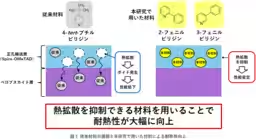
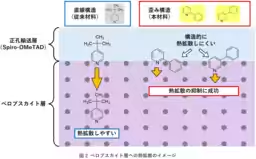
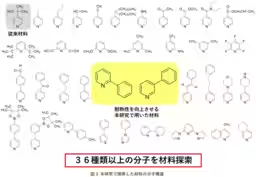
The use of 2-phenylpyridine as a non-linear molecular structure helps to suppress heat diffusion in the perovskite layer, which typically allows for easier thermal migration due to the linear configuration of previous materials like 4-tert-butylpyridine. By preventing this diffusion, the new material keeps the efficiency stable, demonstrating considerable potential for real-world applications.
Broader Significance
The appeal of perovskite solar cells lies in their flexibility, lightweight properties, and suitability for installation on curved surfaces. These features allow for a wider variety of installation opportunities compared to conventional solar panels, thus significantly increasing potential energy generation sites. However, improving thermal stability is essential for seamless integration into outdoor environments.
As part of the research process, a comprehensive examination of 36 different molecular structures revealed that the orientation of substituent groups, specifically on the pyridine ring, is crucial for durability. The findings suggest that placing a phenyl group at angles of 60° or 120° relative to the nitrogen atom enhances thermal resistance and stability.
Future Directions
Moving forward, the research team is set to explore various non-linear molecular structures to further augment the durability of solar cells. Upcoming tests will not only include thermal resistance but also humidity and light stability assessments, alongside long-term outdoor exposure trials. The goal is to develop high-performance perovskite solar cells with a lifespan exceeding 20 years, integrating optimized compositions and innovative techniques to minimize degradation.
Details surrounding this advancement will be showcased at the 73rd Annual Meeting of the Japan Society of Applied Physics on March 17, 2026. The research is supported by NEDO (New Energy and Industrial Technology Development Organization) as part of its initiative to develop next-generation solar cell technologies.
In conclusion, these developments mark a significant step toward the practical implementation of perovskite solar cells, potentially transforming the solar energy landscape, especially in outdoor applications subjected to extreme temperatures.
Topics Energy)
【About Using Articles】
You can freely use the title and article content by linking to the page where the article is posted.
※ Images cannot be used.
【About Links】
Links are free to use.