



Achieving Control Over Light Properties with the Length of Molecules: Systematic Synthesis of Chirality in Helicine Molecules
Overview
Researchers have made significant strides in the field of molecular synthesis by presenting a new method for systematically creating chiral helicene molecules. These findings have implications for the control of light properties, particularly in relation to circularly polarized light (CPL), which is increasingly important in various modern technologies, from advanced displays to quantum computing.
Key Discoveries
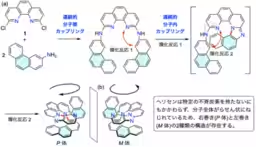
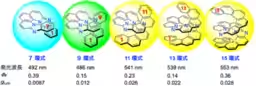
The research team, led by a dedicated group from Anan National College of Technology and Waseda University, achieved a breakthrough by establishing a new synthesis method that allows for the control of molecule length in helicenes. This innovation involves creating nitrogen-containing helicenes through two straightforward steps, leveraging readily available raw materials. Among these, the fifteen-ring helicene stands out as one of the longest chiral molecules synthesized to date, offering exceptional optical properties.
A critical finding of the study reveals the existence of a "critical length" where significant changes in the properties of circularly polarized luminescence occur as the helicene molecule length exceeds a certain threshold. Understanding this transition helps refine the engineering of materials for future applications in sophisticated light-information technologies.
Importance of Helicenes
Chiral molecules like helicenes, which feature aromatic rings twisted in a spiral formation, are crucial in applications requiring circularly polarized light. Yet, traditional synthesis methods have been cumbersome, leading to low yields and complex procedures, posing significant barriers for further research in the field. The newly developed method helps overcome these challenges by enabling better control over helicene length and subsequently, their CPL properties.
The implications of this research extend into potential applications that include high-performance liquid crystal display (LCD) sources, innovative 3D display technologies, and advanced optical communication systems. The new helicene molecules demonstrate not only improved solubility and thermal stability but also superior luminescence properties compared to previously reported compounds.
Future Exploration
Moving forward, the findings underscore a paradigm shift in how researchers can predict and enhance optical properties through careful control of molecular dimensions. This method could lead to the development of new organic materials with exceptional properties tailored for advanced optical applications. There's significant potential for using this knowledge to create other spiral-shaped compounds, potentially changing the material landscape in various research fields.
Overall, this research lays the groundwork for more effective design and synthesis of functional organic materials, setting the stage for future advancements in the realms of display technology and optical communications. The combination of unique design insights and systematic synthesis methods represents a promising future for the manipulation of light and information processing at the molecular level.
Topics Consumer Technology)
【About Using Articles】
You can freely use the title and article content by linking to the page where the article is posted.
※ Images cannot be used.
【About Links】
Links are free to use.