




How Father's Paternity Training Can Transform Family Dynamics in Japan
Transforming Family Dynamics: The Impact of Father's Paternity Training in Japan
As societies evolve, the roles of fathers in childcare continue to gain importance. A groundbreaking study conducted in Japan by the EVIDENCE STUDIO, in collaboration with the University of Tokyo, has revealed the transformative effects of a simple two-hour paternity training program on family dynamics.
The Study Overview
The research targeted over 1,200 male employees across four organizations, using a randomized control trial (RCT) method. By examining the effects of a brief training session, the study aimed to understand its impact on fathers' involvement in childcare and the subsequent effect on mothers’ workloads.
Led by Professor Shintaro Yamaguchi from the University of Tokyo's Graduate School of Economics, the project involved in-depth collaboration with organizations that emphasized creating a supportive environment for fathers to participate actively in childcare.
Significant Findings
The results of the study were compelling:
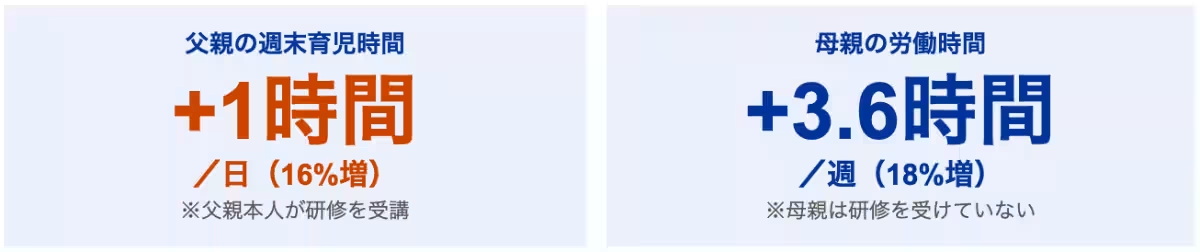
- - After participating in the training, fathers increased their weekend childcare by approximately one hour per day (16% increase).
- - The study also noted changes in domestic labor sharing, with mothers who did not attend the training increasing their working hours by 3.6 hours per week (18% increase).
- - Notably, families with children under five showed even more substantial growth, with childcare contributions increasing by an astounding 2.3 hours per day.
- - An impressive 16% rise in participants who took the initiative to inquire about parental leave options after the workshop.
- - However, merely informing employees that their peers support parental leave was insufficient to alter their behaviors or intentions.
Role of EVIDENCE STUDIO
EVIDENCE STUDIO's role was pivotal not only in establishing the research’s framework but also in its execution. Tasks included:
1. Defining Issues and Themes: Extensive discussions involving member companies and local government officials led to identifying the promotion of men's involvement in childcare as a priority issue.
2. Funding: EVIDENCE STUDIO secured funding, ensuring the research’s independence and quality.
3. Organizational Collaboration: The establishment of a cooperative framework involving two private companies and two local administrations was essential for recruiting participants.
4. Training Management: In collaboration with NPO Fathering Japan, the group implemented a training program aimed at enhancing the skills necessary for fathers to balance careers and childcare.
5. Overall Project Management: EVIDENCE STUDIO ensured ethical compliance and managed the progress of the research systematically.
Research Background
Japan boasts one of the most generous parental leave regulations in the world, allowing up to 12 months of leave for fathers. Despite this, only about 30% of fathers utilized their parental leave as of 2023. A predominant concern among those who do not take leave centers around workplace culture, suggesting that structural changes alone may be insufficient for behavior change.
Recognizing the lack of large-scale studies assessing workplace interventions to encourage paternal involvement, EVIDENCE STUDIO set out to explore whether directly influencing workplace norms and attitudes could impact fathers' behavior effectively.
Methodology
Conducted between August 2023 and March 2024, the an RCT setup tested the effects of the training across 80 workplaces. Participants were divided into two groups, one receiving the training and the other serving as a control group. The sessions engaged male facilitators to discuss integrating parenting with career responsibilities, along with strategies for managers to support subordinates in taking parental leave. Additionally, the training included information interventions to address misconceptions about colleagues' views on paternity leave.
Detailed Outcomes
Training Effects
Post-training analyses revealed increased childcare participation from fathers positively correlated to overall family time spent together, mirroring progress in mothers’ working hours, leading to a re-evaluation of domestic roles.
The Limits of Awareness
While the data showed significant support among co-workers for male participation in taking parental leave (86% approval), only 54% believed their peers supported this stance, indicating a gap between perception and reality. Unfortunately, sharing this information was not enough to drive change in intentions or actions regarding parental leave.
Policy and Social Implications
- - The combination of legal frameworks, economic support, and incentivization of workplace participation is crucial. Even minimal training can lead to substantial behavioral changes.
- - The ripple effects of increased father involvement in childcare can significantly enhance mothers' continued employment, ultimately benefiting family life.
- - Communicating a supportive workplace culture is insufficient without structured organizational backing that fosters an inclusive environment.
In Japan, where addressing declining birth rates is critical, promoting paternal participation in childcare can radically improve families' quality of life. This research showcases how simple workplace training can be an effective strategy for achieving these societal changes.
Research Publication
Title: Workplace Norms and Paternal Involvement in Childcare
Journal: University of Tokyo CREPE Discussion Paper (CREPEDP-202)
Authors: Mari Tanaka, Hiroko Okudaira, Mariko Sakka, Shintaro Yamaguchi
URL: Research Paper Link
Funding: Japan Society for the Promotion of Science (JP23H00045), EVIDENCE STUDIO
- ---

Topics People & Culture)


【About Using Articles】
You can freely use the title and article content by linking to the page where the article is posted.
※ Images cannot be used.
【About Links】
Links are free to use.