



TM Forum Unveils Reliable Autonomous Network Solution Package for Core Networks
Introduction
The telecommunications industry is experiencing a significant transformation with the introduction of autonomous networks (AN). Recently, TM Forum, in collaboration with Huawei, unveiled a highly reliable solution package designed specifically for core networks. This innovative initiative was highlighted during a masterclass on autonomous networks in Asia, showcasing the latest advancements in network reliability and management.
Key Features of the Solution Package
The newly released solution package emphasizes high stability by integrating the IG1500 standards from TM Forum, which facilitates the creation of reusable templates for autonomous networks. This approach not only enhances fault management capabilities but also marks a new era in commercial replication of core network solutions. At the heart of this package are seven critical dimensions, ensuring comprehensive stability within core network architecture, including:
1. High Stability Deployment
2. Control Plane Recovery Post-Failure
3. User Plane Recovery After Incidents
4. Infrastructure Restoration
5. Surge Protection Ability
6. Risk Prediction
7. Quality of Service (QoS) Recovery
Through the Management Data Analytics Function (MDAF) defined in 3GPP TS 28.104, this solution package establishes a systematic framework aimed at enhancing overall network resilience. The implementation of digital twin technology allows for closed-loop management, covering everything from risk forecasting to automated optimization, significantly boosting the network's capability to withstand extreme scenarios such as signaling storms.
Innovative Risk Assessment and Mitigation Strategies
One of the standout innovations within this package is the risk assessment model for storm scenarios. By leveraging digital twin modeling, the solution provides a virtual network environment capable of anticipating risks and enabling active defenses. Before a signaling storm occurs, the system collects comprehensive traffic statistics, node connection data, and timing device configurations. Using simulation devices, it generates impact models to accurately assess network capacity and provide optimization recommendations. This proactive approach allows operators to swiftly eliminate potential faults before they escalate, minimizing service disruption.
Standardization Drives Industry Adoption
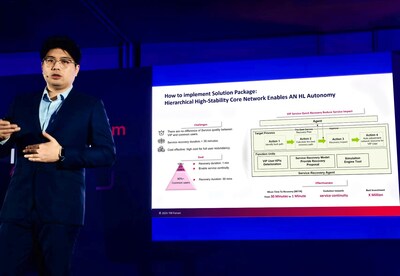
This AS solution package strictly adheres to TM Forum's IG1500 standards and integrates seamlessly with existing systems via standardized API interfaces. During his presentation, Michael Wang emphasized that this solution provides a standardized framework for technical implementation, showcasing its viability in stabilizing core network scenarios through the Catalyst project. He elaborated on key processes, including the accurate identification of VIP users, rapid determination of recoverable paths, and instant solution generation for restoration. The objective is to reduce the recovery time for VIP users from 30 minutes to just 1 minute while maintaining a 30-minute recovery window for general users, thereby enhancing the network experience for high-value users and alleviating economic losses caused by their departure.
Conclusion
With the launch of this AS solution package, the security of core network stability has officially been integrated into standard TM Forum scenarios. Huawei’s replicable and scalable model for building highly stable networks equips operators with a powerful tool to enhance resilience while facilitating essential support for revenue generation through network optimization. The implications of this advancement are profound, setting a new benchmark for the industry and paving the way for more robust autonomous networks in the future.
Topics Telecommunications)
【About Using Articles】
You can freely use the title and article content by linking to the page where the article is posted.
※ Images cannot be used.
【About Links】
Links are free to use.