



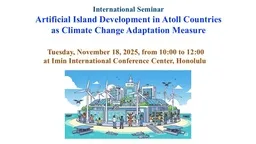
Exploring Artificial Island Development as Climate Change Adaptation in Atoll Nations
Exploring Artificial Island Development as Climate Change Adaptation in Atoll Nations
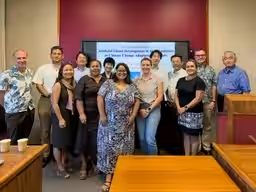
On November 18, 2025, an insightful international seminar titled "Development of Artificial Islands as Climate Change Adaptation in Atoll Nations" was held at the Imin International Conference Center in Honolulu, Hawaii. Organized by the Japan Global Infrastructure Foundation (Japan GIF), in collaboration with the College of the Marshall Islands and Hosei University, the seminar tackled a pressing global issue: the survival of atoll nations facing the realities of climate change and rising sea levels.
Climate change is not just a looming threat but a current crisis for countries like the Republic of the Marshall Islands (RMI) and the Maldives. The loss of land due to rising sea levels not only poses a risk to inhabitable areas but also infringes upon indigenous rights to ancestral lands. Therefore, the discussions at this seminar went beyond technical solutions, emphasizing the importance of human rights to remain and maintain cultural identity and sovereignty through artificial island development.
Opening Remarks
The event commenced with opening remarks from Jennifer Seru, a professor at CMI, and Mikiyasu Nakayama, the chairman of Japan GIF. They stressed that while relocation should be considered only as a last resort, developing artificial islands could potentially safeguard sovereignty, facilitate safe living conditions, and ensure economic stability for the people living in these atoll nations.
Presentation Highlights
Citizen Awareness of Artificial Island Development
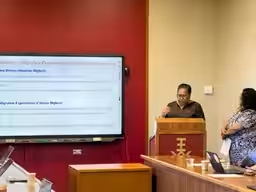
Daisuke Sasaki, an associate professor from Tohoku University, presented findings from a comparative study of public awareness in Majuro (Marshall Islands) and Male (Maldives). The results revealed overwhelming support for artificial island initiatives, with 82% of citizens in Majuro backing domestic artificial island projects. Key factors contributing to this support included satisfaction with living conditions, infrastructural quality, and safety from disasters.
Analyzing Generational Gaps
Jennifer Seru and Mylast Bilimon reported on the differences in perspectives between students at CMI and the general public in Majuro. The younger generation displayed optimism about sustaining community life on artificial islands, while older citizens took a more realistic and skeptical viewpoint, often informed by personal experiences and familial obligations impacting their adaptive behavior.
Economic Challenges and Funding Realities
Mikio Ishiwata from Meiji University focused on the significant costs associated with adaptation strategies in atoll nations, using the Marshall Islands as a case study. He highlighted the financial vulnerability faced by these nations, noting that the costs for land elevation and coastal defenses vastly exceed national budgets, posing serious challenges for justifying these investments economically.
Ensuring Social Inclusion in Migration
Akiko Sakamoto discussed migration to artificial islands in the Maldives, suggesting methods for promoting social inclusion among diverse groups. She noted that migration aimed at enhancing human capital, such as education and employment opportunities, correlated with higher life satisfaction. Sakamoto highlighted the need for a "soft integration" approach, emphasizing community connections over geographic segregation.
Panel Discussion and Q&A
The panel discussion moderated by Nori Tarui from the University of Hawaii at Manoa examined critical issues surrounding land ownership and urgency. Unlike the Maldives, where land is government-owned, land ownership complexities in the Marshall Islands have raised significant concerns regarding rights and claims related to artificial island ownership. As predictions estimate only 30-50 years before areas become uninhabitable, prompt action on artificial island construction, estimated to take 7-10 years, is critical.
Conclusion of the Seminar
The seminar underscored that, despite the technical and economic hurdles, artificial island development presents a promising option for the atoll nations to ensure their communities continue to thrive in their homelands. Moving forward, there is a critical need for the international community to bolster funding frameworks, alongside fostering resident consensus-building, developing legal systems concerning land rights, and supporting community regeneration through comprehensive approaches. The diverse insights shared during the event manufactured a clear urgency for immediate international cooperative actions in response to climate threats affecting vulnerable atoll populations.
Topics Environment)
【About Using Articles】
You can freely use the title and article content by linking to the page where the article is posted.
※ Images cannot be used.
【About Links】
Links are free to use.