




Revolutionizing Software Development: 99.7% Faster File Dependency Verification
Revolutionizing Software Development: 99.7% Faster File Dependency Verification
In the realm of modern software development, the ability to continuously integrate changes with precision is paramount. As projects grow in size and complexity, effective management of file dependencies becomes crucial. Researchers from Waseda University and Tokyo University of Technology have unveiled a groundbreaking technique known as mkcheck2, which accelerates file dependency verification by an astonishing 99.7%. This innovative method is set to transform large-scale software development, tackling one of its most persistent bottlenecks.
The Challenge of File Dependencies
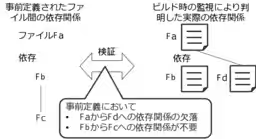
Software builds are an integral part of any development process, relying heavily on accurately defined dependencies between files. When changes occur, such as updating a source file, the associated dependent files must automatically trigger a build. However, in large-scale software projects, missing or incorrectly defined dependencies can lead to significant errors—over half of development issues are often attributed to such misconfigurations. These mistakes result in scenarios where necessary builds are skipped, or, conversely, unnecessary builds are performed, wasting valuable development time.
To address these challenges, traditional verification methods often required exhaustive checks of all relevant files each time a build occurred. These methods, while accurate, introduced substantial delays, complicating continuous development and reliability in software systems.
Introducing mkcheck2
The research team led by Professor Hironori Washizaki (Waseda University) and Associate Professor Kazunori Sakamoto (Tokyo University of Technology) has developed mkcheck2, which blends lightweight system call monitoring via eBPF (extended Berkeley Packet Filter) with differential analysis. This new approach allows developers to maintain high verification accuracy while drastically reducing processing time.
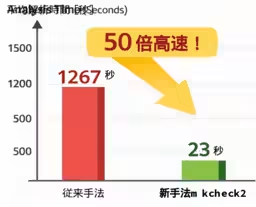
The results are striking: the average verification time per code modification dropped from approximately 1,267 seconds to just 23 seconds. This breakthrough enables developers to automate the build process safely, ensuring reliability and efficiency in evolving software products.
How mkcheck2 Works
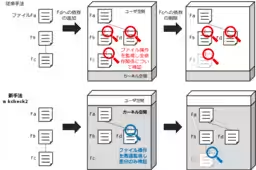
The mkcheck2 technique leverages eBPF to monitor system calls directly at the kernel level—where the operating system manages essential operations—rather than at the user space. This direct method circumvents the significant overhead associated with traditional monitoring techniques, thereby minimizing additional processing time to nearly zero.
Additionally, mkcheck2 utilizes differential analysis, focusing solely on the parts of the code that have changed rather than re-evaluating all dependencies each time. By adopting this targeted approach, mkcheck2 achieves processing speeds that are up to 99.7% faster than prior verification methods, while still capturing a 100% detection rate for missing dependencies when tested across 300 open-source projects.
Societal Impact and Future Directions
The implications of mkcheck2 extend beyond just improving software build times; they also enhance overall software quality. By facilitating earlier detection and resolution of dependency errors, developers can ensure that their software remains robust and secure, fostering user trust. This technique is especially vital in environments demanding continuous integration, such as cloud services and AI systems, where ongoing modifications and timely quality checks are essential.
Looking ahead, while mkcheck2 currently relies on the Linux operating system, expanding its applicability to other platforms remains a priority. Also, the method may still have limitations concerning the detection of redundant dependencies. Future advancements will focus on integrating mkcheck2 with other build systems, introducing automated correction features, and enhancing its synergy with continuous integration environments.
Conclusion
This research represents a significant leap forward in resolving long-standing challenges in large-scale software development. The combination of high accuracy and speed promises to streamline the build dependency verification process, ultimately paving the way for more efficient and higher-quality software development practices in the era of AI.
Related Technical Details
The breakthrough was presented at the 48th IEEE/ACM International Conference on Software Engineering (ICSE'26) and is documented in the ACM Digital Library under the proceedings. The work has generated considerable interest for its potential to redefine best practices in software engineering.

Topics Consumer Technology)







【About Using Articles】
You can freely use the title and article content by linking to the page where the article is posted.
※ Images cannot be used.
【About Links】
Links are free to use.