




Unraveling the Molecular Code of Brain's Parallel Neural Circuits Related to Learning and Habit Formation
Introduction
Brain functions such as learning and habituation are supported by intricate neural circuits that can operate in parallel without interference. Recent research from Waseda University and Harvard University has successfully decoded the molecular mechanisms that underlie the formation of these circuits. This groundbreaking work highlights how specific proteins contribute to the brain's capability to differentiate functions related to learning and adaptation.
Key Findings
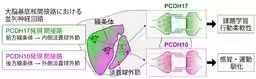
The research, led by Naosuke Hoshina from Waseda University alongside Hisashi Umemori from Boston Children’s Hospital, focused on the protocadherin family of molecules. Particularly, two proteins, PCDH17 and PCDH10, have been identified as critical in constructing distinct parallel neural circuits that support different brain operations. Through animal experiments, the team has elucidated how these proteins facilitate the correct assembly of neural connections that govern the processes of learning and adaptation.
The Study
For many years, the question of how the brain organizes separate neural circuits without overlap was a significant unresolved issue in neuroscience. The study investigated the striatum, part of the basal ganglia responsible for motor control, learning, and habit formation. The researchers confirmed that PCDH17 and PCDH10 operate in a complementary manner, allowing for selective connectivity between neurons involved in distinct functions.
Methodology
Using conditional knockout mice that lacked either PCDH17 or PCDH10 specifically in striatal neurons, the researchers were able to analyze the effects on synaptic connections and behavior. It was found that while axons reached their targets correctly, the synapses—the connection points between neurons—were improperly formed without these molecules. This indicated that PCDH17 and PCDH10 are essential not for directing the pathways but for ensuring that neurons connect with the right partners.
Learning and Habituation
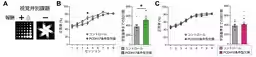
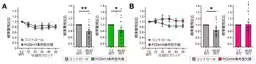
Behavioral tests exhibited significant differences between the two types of knockout mice. Mice lacking PCDH17 struggled with learning tasks that required switching between rules, whereas those without PCDH10 did not show marked learning deficits. In experiments assessing habituation to repetitive stimuli, mice missing PCDH10 displayed persistent heightened reactivity, while the PCDH17-deficient mice exhibited normal habituation responses. This stark contrast affirms that PCDH17 is key for learning circuits and PCDH10 for circuits involved in habituation.
Implications for Neuropsychiatric Disorders
The findings provide new insights into the fundamental wiring principles of the brain and its implications for neuropsychiatric disorders. Dysfunctional circuits within the basal ganglia have been associated with conditions like schizophrenia, autism spectrum disorders, and Parkinson’s disease. Understanding the molecular bases of these connections offers pathways for developing novel therapeutic strategies that could target specific neural circuits affected in these diseases.
Future Directions
Looking forward, researchers aim to explore beyond PCDH17 and PCDH10 to uncover other potential molecular codes that govern neural circuit formation, including whether similar principles apply in other regions of the brain. Such investigations could lead to comprehensive frameworks for understanding how various neural circuits are constructed, with hopes that this knowledge can culminate in innovative methods for selectively modulating or repairing faulty circuits therapeutically.
Conclusion
This study marks a significant advancement in neuroscience, providing clarity on how the brain maintains functional specificity among its neural networks. The discovered molecular codes are not only vital for comprehending the brain's structural complexities but also essential for paving the way towards targeted treatments for disorders linked to neural circuit dysfunctions.

Topics Health)
【About Using Articles】
You can freely use the title and article content by linking to the page where the article is posted.
※ Images cannot be used.
【About Links】
Links are free to use.