



Industry Alpha Expands Development of Alpha-OCS Execution Control Layer for Enhanced Warehouse Operations
Industry Alpha Strengthens Development of Alpha-OCS
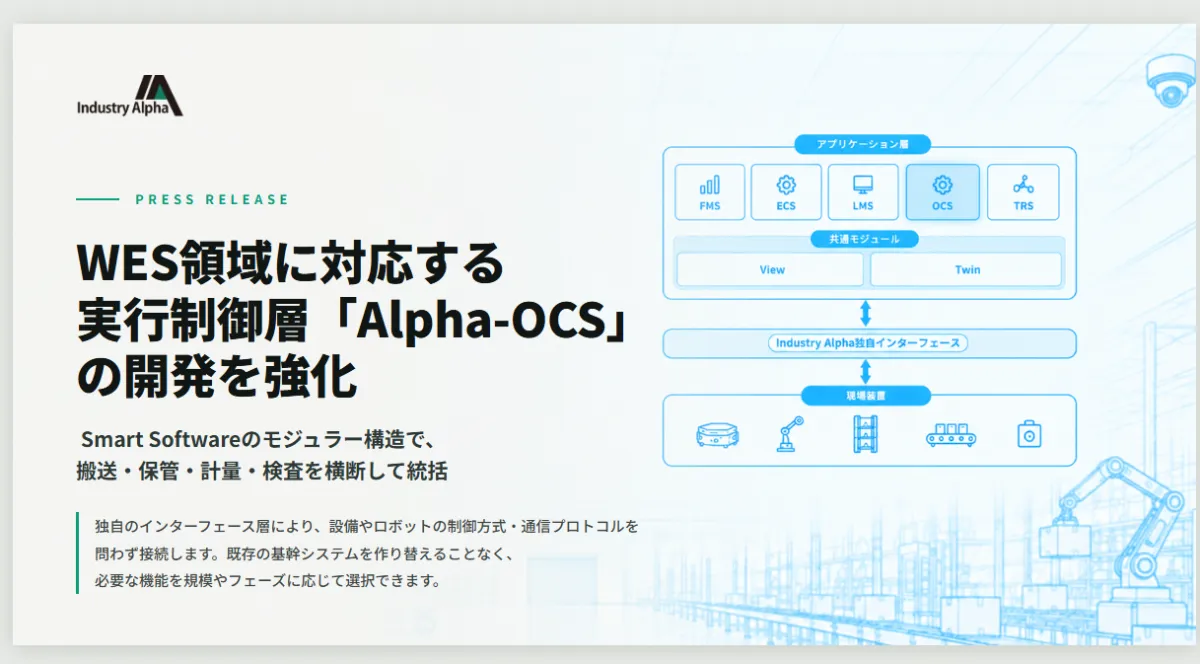
Industry Alpha Co., Ltd. is enhancing the development of its Operational Control System (Alpha-OCS), part of its proprietary Smart Software architecture. This execution control layer facilitates the management of various operational tasks in warehouses and logistics, effectively acting as a Warehouse Execution System (WES). The Alpha-OCS plays a crucial role in translating information from higher-tier foundational systems into actionable tasks for equipment and robots on the ground.
Background — Expanding Demands on Execution Control Layers
The need for a dedicated layer within the warehouse and logistics sector has become increasingly important. This layer determines what tasks to execute at any given moment, in what order, and with which equipment and personnel. As automation progresses, more manufacturers' equipment and robots are being used within the same operations, leading to situations where individual devices operate correctly, but the overall system fails to achieve optimal performance.
However, implementing such a layer comes with its own challenges:
1. Diverse Control Methods: The control methods and protocols differ widely among equipment, with various connection types such as API, IO/PLC, and file integrations depending on the manufacturer and installation year. This results in issues when trying to connect devices with certain products.
2. System Overhaul Prerequisites: Often, existing foundational systems and inventory management solutions must be modified for new systems to integrate, leading to unexpected costs and increased internal coordination burden.
3. Mismatch in Functionality and Product Granularity: Clients might seek to centralize execution commands but end up needing unnecessarily large packages. Vice versa, they might encounter difficulties in expanding functionalities that are critical for future requirements, such as location management and traceability.
Connection Across Manufacturers and Protocols
Since its establishment, Industry Alpha has focused on developing its Smart Software, specifically designed to address stringent requirements within the realm of Autonomous Mobile Robots (AMRs) and fleet control. Real-time responses, collision avoidance between multiple vehicles, and accommodating various equipment types with different constraints are key factors of success.
Modular Structure — Selectable Functionalities
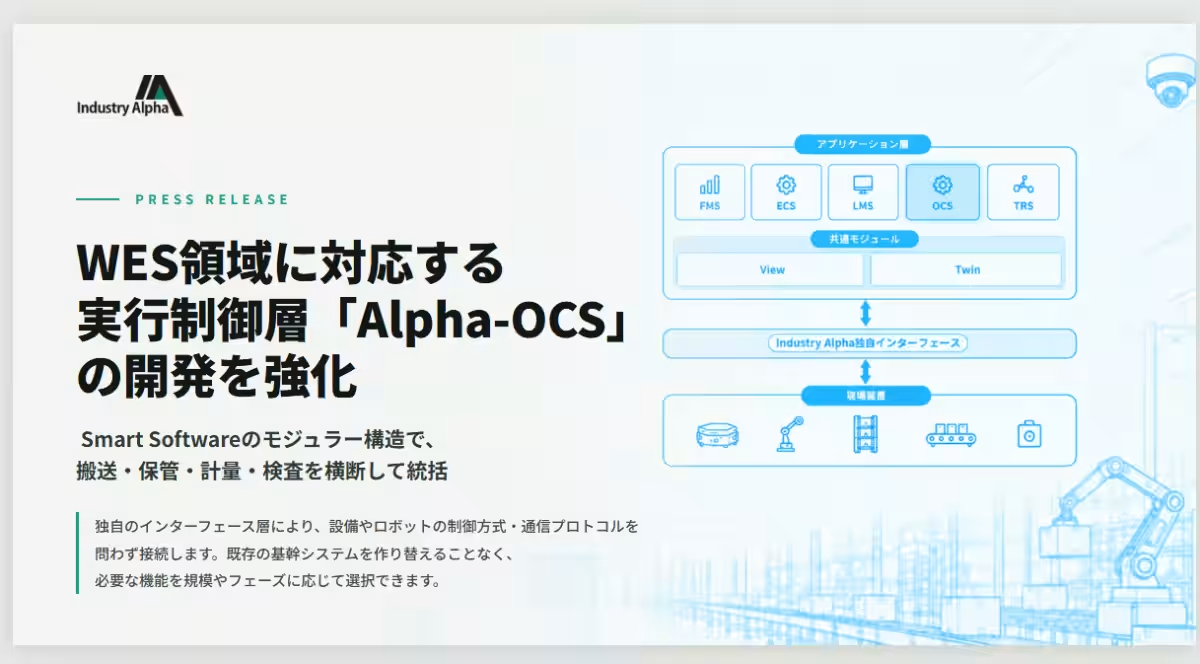
The software's modular structure allows users to select the necessary functions based on their environment, scale, and phase of operations. By separating functionalities into independent systems such as “flotilla control,” “equipment control,” “location management,” “operation oversight,” and “historical management,” users can implement commands independently or in combination. For instance, one can start with centralizing execution commands and expand to include location management or history monitoring as needed, all without altering the existing architecture.
Proprietary Interface Layer — Universal Connectivity
The disparities in control methods and communication protocols across equipment are managed at the interface layer. Industry Alpha can select connection methods—be it an API, IO/PLC, or file integration— tailoring connections to the equipment in use. This means relying on specific manufacturers or standards isn't necessary. With the implementation of IoT modules, even legacy equipment that lacks communication functions can be integrated, maintaining compatibility without the need for system overhauls.
Both the modular structure and the proprietary interface design allow for flexibility and scalability regardless of the operational environment. The structures adapt to include integrated systems such as automated warehouses, elevators, robotic arms, dedicated machines, and various inventory management solutions on the same architecture.
Comprehensive Development
Industry Alpha develops solution components from execution control mechanisms to fleet control, ensuring continuity from execution decisions to hardware control using a cohesive architecture. This design allows adjustments from the conceptual phase, addressing requirements that off-the-shelf products might not fulfill.
Smart Software Components
Key operational systems include:
- - OCS (Operation Control System): Manages operations with upper system integration and task execution.
- - FMS (Fleet Management System): Controls AMRs and other mobile units.
- - ECS (Equipment Control System): Governs fixed equipment like automated warehouses, elevators, and PLC-connected devices.
- - LMS (Location Management System): Tracks inventory locations.
- - TRS (Traceability System): Manages individual identification and historical tracking.
To support these systems, common modules for real-time monitoring such as “View” and simulation “Twin” are available throughout the entire system. Users can select necessary components for their configurations based on granular requirements, ensuring an adaptable implementation.
Rolling Out the Smart Software
The Smart Software is already operational in environments including AMRs, automated warehouses, elevators, and dedicated machines, where it manages execution commands and performance monitoring across diverse equipment. Current projects involve connecting central management systems with automated warehouses, inventory management, and location tracking systems.
Industry Alpha remains committed to ongoing development, ensuring adaptability to various equipment configurations and the operational rules across different environments, continually enhancing ease of use for its clients.
Contact Us
For inquiries regarding WES development and integration with existing systems, reach out to us from the conceptual stage.
Contact: Industry Alpha Contact
Material Download: Download Here
Topics Consumer Technology)




【About Using Articles】
You can freely use the title and article content by linking to the page where the article is posted.
※ Images cannot be used.
【About Links】
Links are free to use.